AcruxCore vs LangSmith: one app measured on both platforms
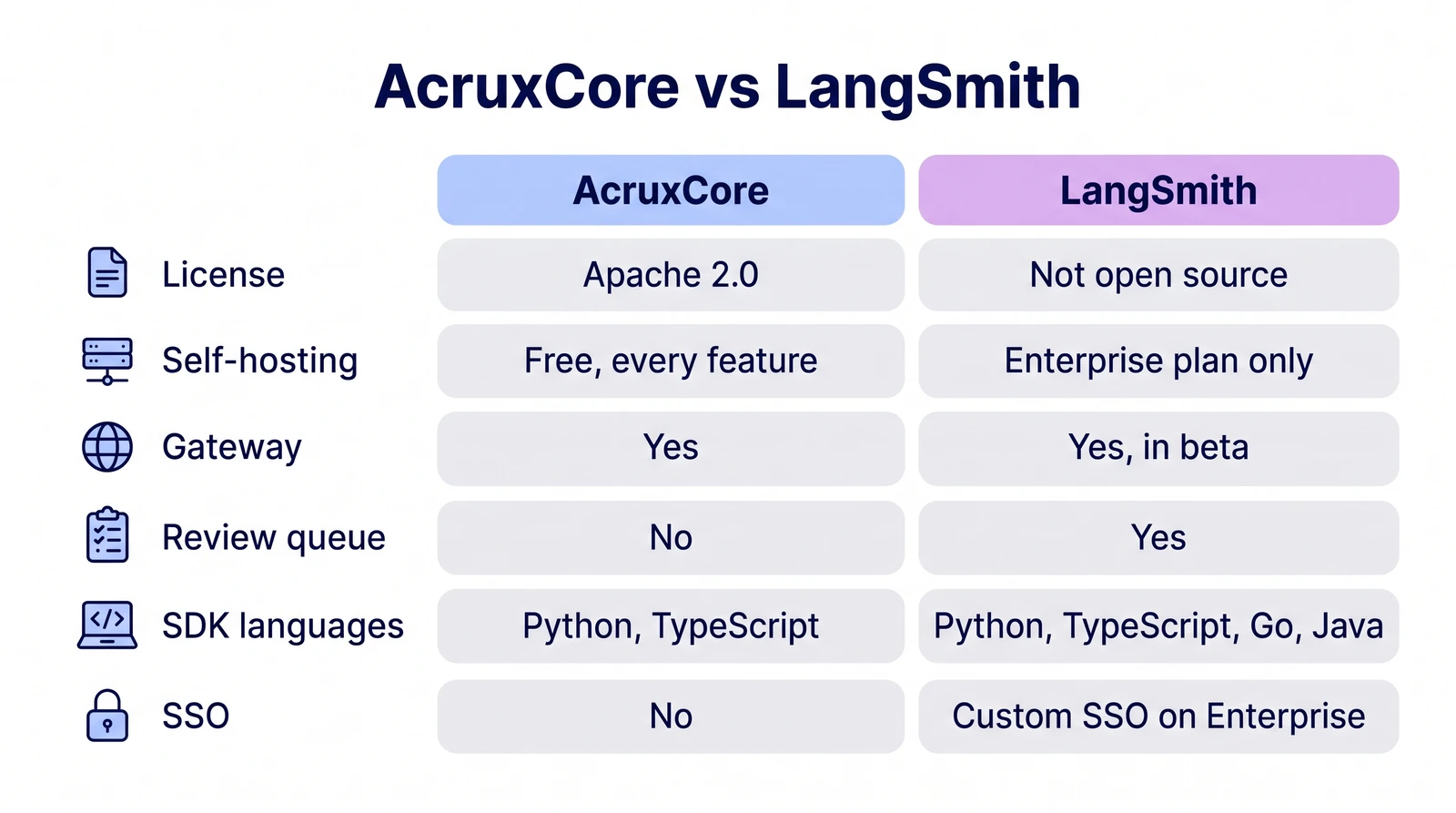
Choose LangSmith if your team reviews model output by hand in a queue, needs a Go or Java SDK, or needs custom SSO. On its Plus plan, 100,000 traces a month for three people cost $567. Choose AcruxCore if you want a gateway, versioned tools and an audit log in a free, open-source platform that you can also self-host, and your team can review replies on the trace page.
We ran the same agent on both platforms, with the same code, data, prompts and model. This post gives the measured numbers for each step, then the features that only one of the two has.
We build AcruxCore. The scripts and run logs for both platforms are linked at the end of the post.
Differences at a glance
| AcruxCore | LangSmith | |
|---|---|---|
| License | Apache 2.0, every feature | SDKs MIT; the platform is not open source |
| Self-hosting | Free, every feature | Enterprise plan only |
| Hosted price, 100,000 traces a month, 3 people | $0; the hosted platform is free to use | $567 on the Plus plan |
| Hosted free plan | The whole platform; no trace or seat limit is listed | 5,000 traces a month, 1 seat |
| Trace data kept on the hosted plan | Message content 90 days; tokens, cost and timing are not deleted | 14 days; 180 days costs extra |
| Hosted regions | Not stated | GCP US, GCP EU, GCP APAC, AWS US |
| SDK languages | Python, TypeScript | Python, TypeScript, Go, Java |
| Gateway in the request path | Yes: fallbacks, cache, budgets, rate limits, virtual keys | Yes, in beta: fallbacks, spend limits, rate limits, data policies |
| Review queue for people | No | Yes |
| Alerts | Email: budgets, evaluation rules, weekly digest | Slack, PagerDuty, Dynatrace, webhook |
| SSO | No | Google and GitHub sign-in; custom SSO on Enterprise |
| Tool catalog that the platform runs | Yes, versioned | Partial: Fleet agents use built-in tool integrations and tools on MCP servers you connect; the Playground's tool registry keeps one current copy of each tool, with no version history |
Sources, read 25 October 2026: LangSmith pricing,
self-hosting,
regions,
SDK reference,
LLM gateway,
gateway fallbacks,
alerts and
annotation queues pages
(tool registry,
Fleet tools and
Fleet MCP servers read 2 November 2026); the
langsmith-sdk repository for the SDK license; and
acruxcore.com/pricing. The $567 figure comes from LangSmith's
pricing calculator on 16 October 2026, and the calculator gave the same rate on 2 November 2026.
The price section explains it.
How we tested
The app is a small agent that reads a client's email. It checks each request against a signed project scope, prices the extra work, and writes a reply. It runs in four steps: extract, classify, price and reply.
- Data: 30 client messages, each with the expected items and total price.
- Scorers: exact items, exact total, and an LLM judge that reads the reply.
- Prompts: two versions. Version 2 rewrites the extract and classify prompts.
- Model: every call, the judge included, went to z.ai
glm-5.3withreasoning_effort="low", straight from the app. - Platforms: LangSmith on its hosted EU region, free plan,
langsmith0.10.10. AcruxCore on acruxcore.com,acruxcore0.18.0. - Date: 16 and 17 October 2026.
- Client machine and location: not recorded. The latency below is mostly model time, so this matters little for the comparison.
The same app also ran on Langfuse. That three-way result is in AcruxCore vs Langfuse vs LangSmith.
Tracing
| AcruxCore | LangSmith | |
|---|---|---|
| Lines of tracing code for this app | 15 | 18 |
| Wrapped OpenAI client | No | Yes, wrap_openai |
| Decorator that makes a function a step | traces.step | @traceable |
| A model call shows its prompt version | As a link: "View traces for this prompt version" | As plain metadata text |
| Calls recorded with no code in your app | Through the gateway | Through the gateway, in beta |
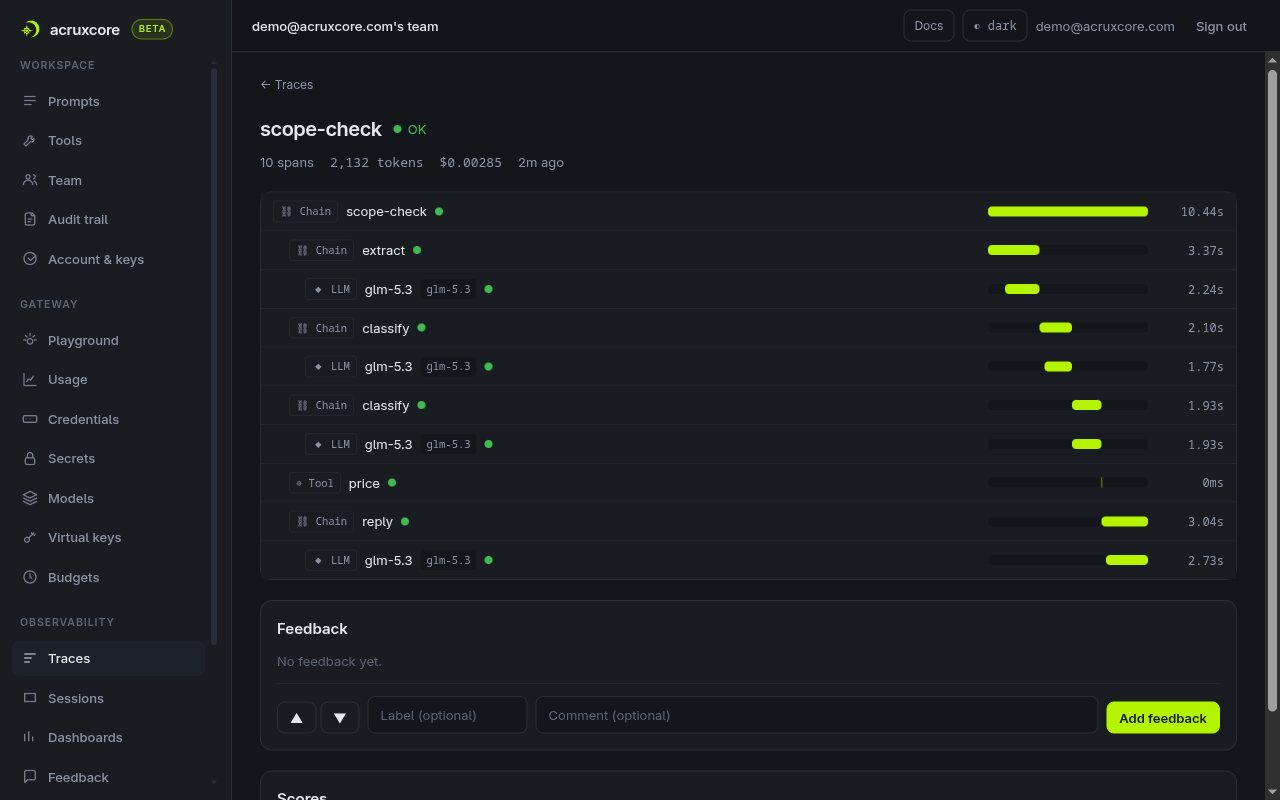
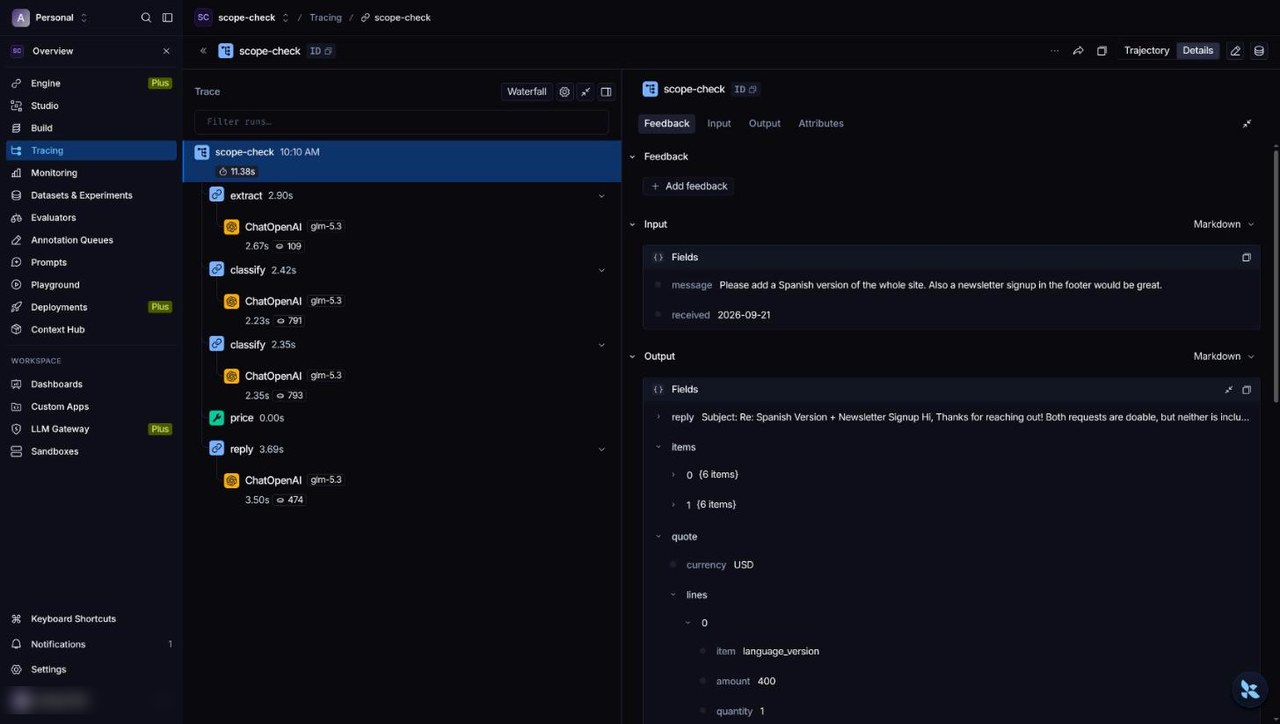
Both platforms stored the same tree for one message. The agent, named scope-check, sat at the
root. Under it came one span per step and one model call inside each step, and the price step was
marked as a tool.
Show screenshots: the same message traced in AcruxCore and LangSmith
The LangSmith code is 18 lines, and 6 of those lines read the prompt. Our app does not install
langchain-core, so LangSmith returns each prompt as a serialized LangChain object. The 6 lines
take the messages out of that object.
The AcruxCore code is 15 lines. The AcruxCore SDK has no wrapped OpenAI client, so 4 of the 15
lines adapt the SDK's chat call to the client.chat.completions.create call that the app makes.
On AcruxCore, a model span has the link "View traces for this prompt version". The link opens every trace that this prompt version produced. On LangSmith, the prompt name and commit hash appear as metadata values on the model run.
Tool calls
In a separate test, we built a weather agent with one tool, get_weather, on each platform. Both
agents called openai/gpt-4o-mini through OpenRouter.
On LangSmith, the tool is a Python function with @traceable, and your code writes the loop
that calls the model, runs the tool and calls the model again. On AcruxCore, the tool and the
prompt are stored on the platform. The gateway runs the tool, and the agent script renders the
prompt and makes one call.
| AcruxCore | LangSmith | |
|---|---|---|
| Lines in the agent script | 19 | 64 |
| Lines in the streaming agent script | 25 | 69 |
| One-time setup | 45 lines, or none in the dashboard | None |
| Cost of one run, as each platform priced it | $0.0000846 for 381 tokens | $0.0000822 for 377 tokens |
With the setup added, the two totals are even: 64 lines on each platform. The AcruxCore setup runs once per team. Each AcruxCore tool span also records the tool version that ran. The full write-up is in Tool-call traces: LangSmith vs AcruxCore.
Prompts, promotion and rollback
| AcruxCore | LangSmith | |
|---|---|---|
| How a chat prompt is stored | A list of role and content messages | A serialized LangChain object |
| Push a prompt from code | Python or TypeScript SDK, or REST | Needs the langchain-core package |
| SDK read without naming a label | Not possible: every read names an alias | Returns the newest commit, even an untested one |
| Promote a version | 4 clicks, with a confirmation | 3 clicks, with a confirmation |
| Roll back | 2 clicks on the same tab | 3 clicks |
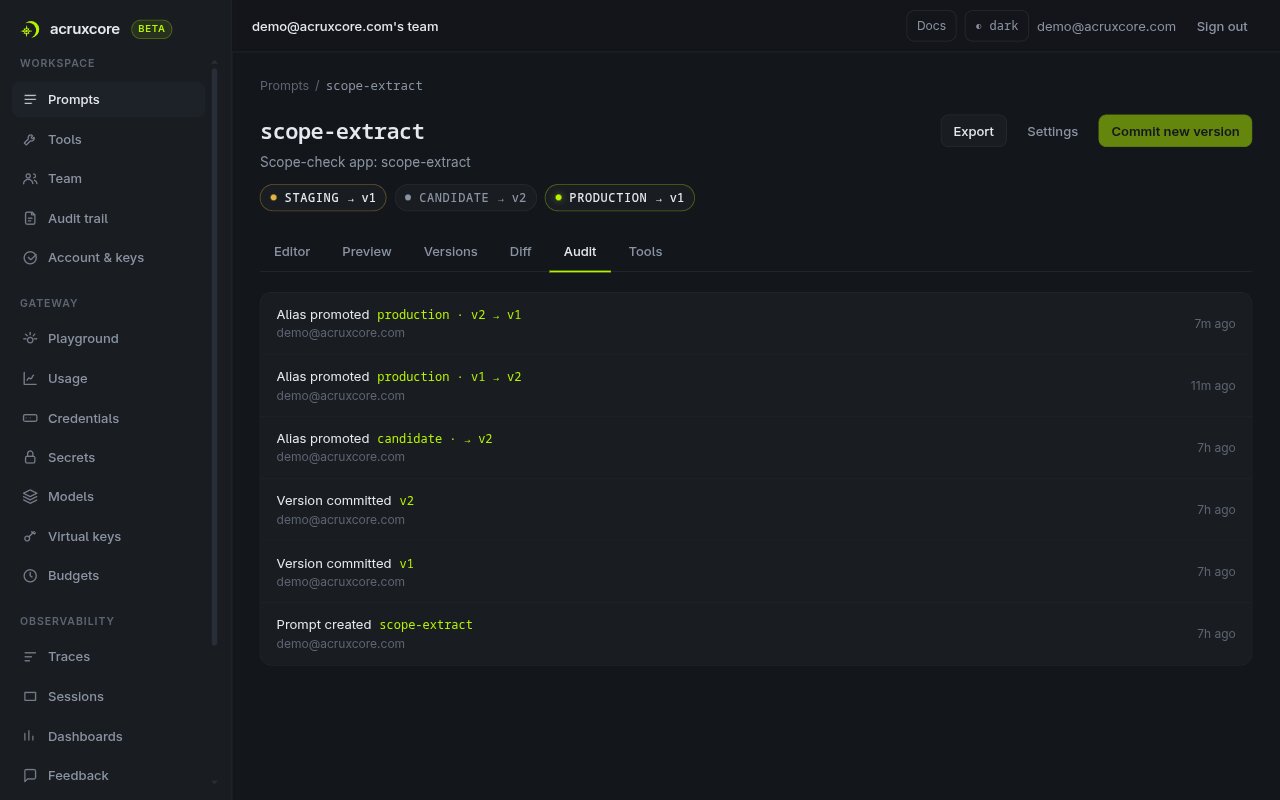
| History of promotions | Audit tab: who moved the alias, from which version to which | Rollback list of past commits |
| SDK cache before a promotion reaches a running app | 60 seconds | 5 minutes |
On LangSmith, push_prompt stopped with an ImportError until langchain-core was installed.
After we committed version 2 under a candidate tag, a read with no tag returned version 2. A
read of scope-extract:production returned version 1. So on LangSmith, code that does not pin a
tag can serve a draft to users.
On AcruxCore, the SDK's prompts.get_by_alias(name, alias) and prompts.render(name, alias)
both take an alias. When you commit a prompt for the first time, AcruxCore points a production
and a staging alias at version 1. Committing version 2 does not move those aliases. AcruxCore can also fill in the template variables on the server and return the
finished messages.
Show screenshots: AcruxCore audit tab and LangSmith rollback history
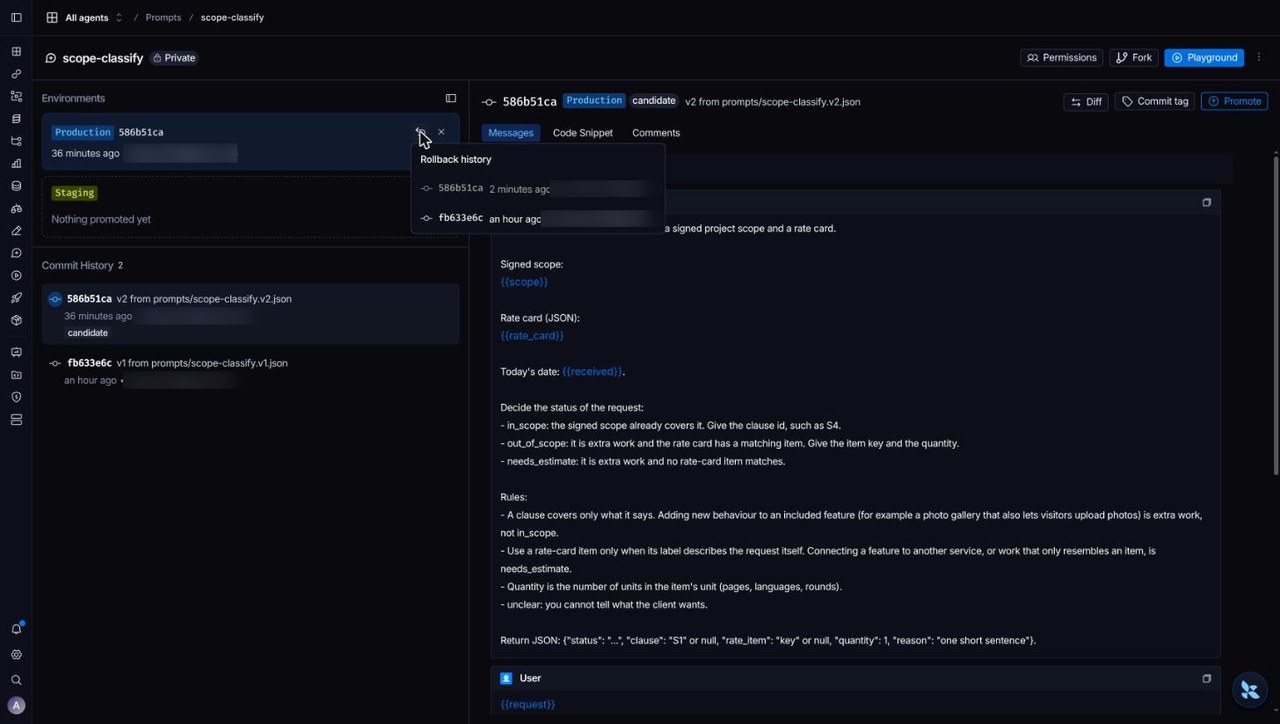
The cache times come from each SDK's source. In LangSmith 0.10.10,
DEFAULT_PROMPT_CACHE_TTL_SECONDS is 5 * 60. In the AcruxCore SDKs, cache_ttl defaults to
60,000 milliseconds.
Experiments over the dataset
An experiment answers one question: after you change a prompt, which messages got better and which got worse? We ran the app over the 30 messages with version 1, then with version 2, and opened each platform's comparison of the two runs.
| AcruxCore | LangSmith | |
|---|---|---|
| Upload the 30 test messages | 1 call, 1.0 s | 1 call, 2.2 s |
| Run your own app code as an experiment | Yes | Yes, evaluate |
| Clicks to the comparison of two runs | 3, from the Evaluations page | 4, from the dataset page |
| Show only the messages whose score changed | Yes, the comparison opens that way | Yes, one click on a score counter |
On AcruxCore, version 2 fixed 2 messages on the items score and broke 2 others. The comparison page opened on those 4 messages, with no further click.
Show screenshots: v1 vs v2 comparison in AcruxCore and LangSmith
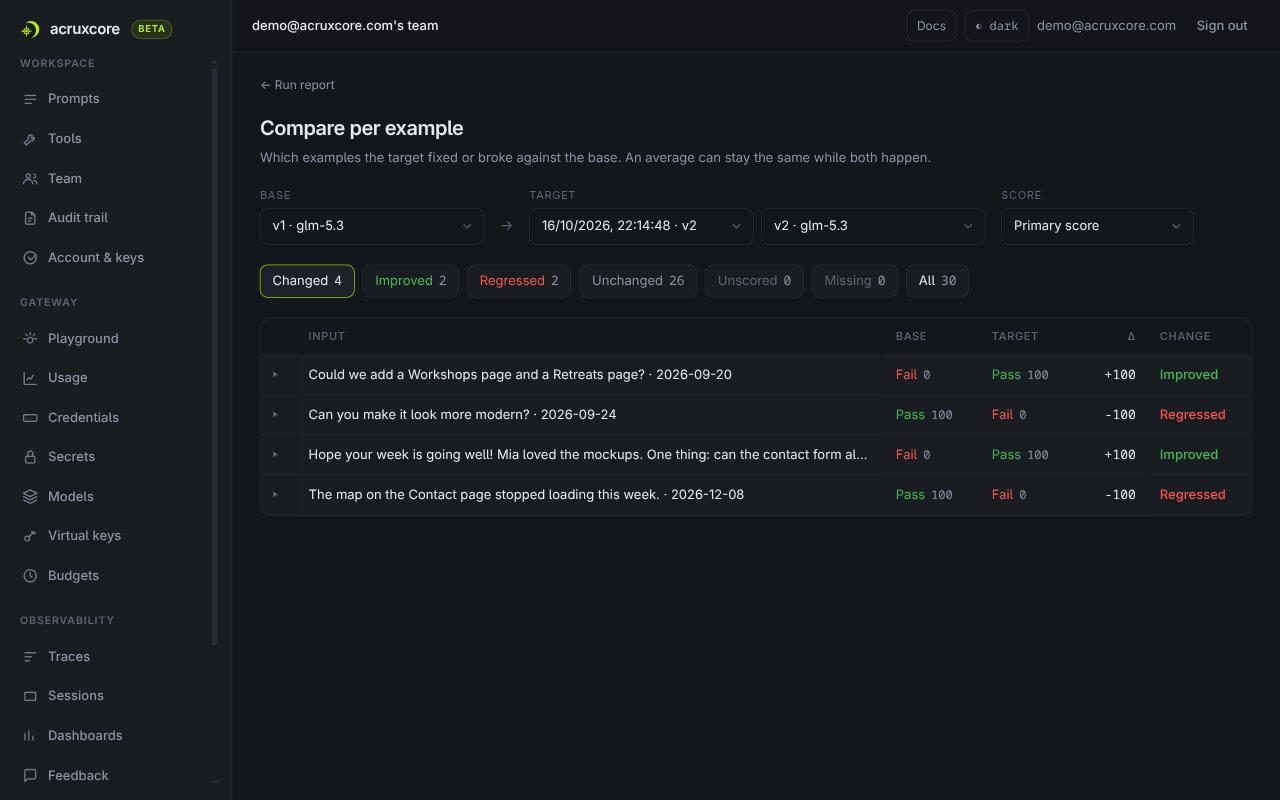
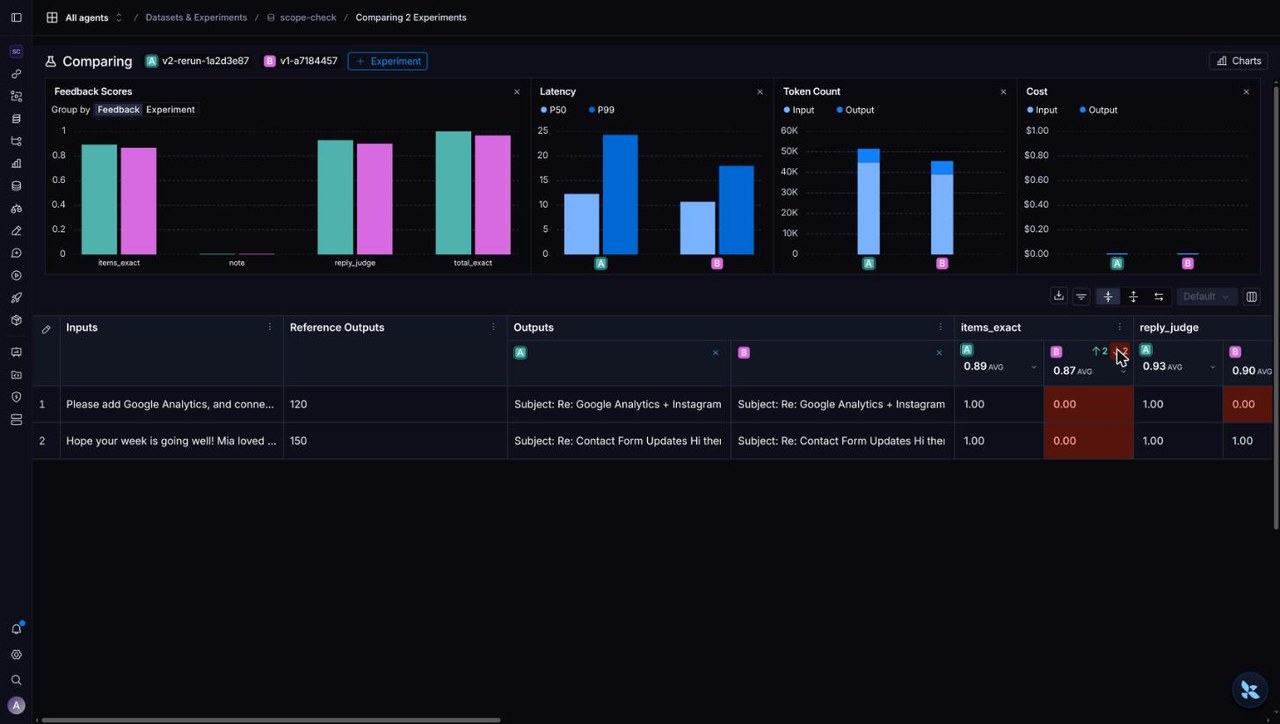
We do not compare the scores across the two platforms. glm-5.3 gives a slightly different
answer each time, so a score gap between platforms is noise.
AcruxCore runs experiments in two places. A server-side experiment runs a stored prompt across
versions and models, scored by an LLM judge or by a judge prompt you write. A local run executes
your own app code and scorers through experiments.run_local in the Python SDK or
experiments.runLocal in the TypeScript SDK, and uploads the results as a run. Our app has four
steps and two scorers in Python, so it used a local run.
Reviewing replies by hand
We asked one question about each of the 30 replies: "Would you send this reply to the client as is?"
| AcruxCore | LangSmith | |
|---|---|---|
| Review queue | No | Yes |
| Clicks per reply | 4: open the trace, open the reply step, ▲ or ▼, go back | 2: a verdict and "Next" |
| The verdict names the question | No; a ▲/▼ rating on the step | Yes, a feedback key |
| Fix a wrong answer | A comment and a label on the trace | "Add to Dataset" adds your edited version to the dataset |
Show screenshot: LangSmith annotation queue
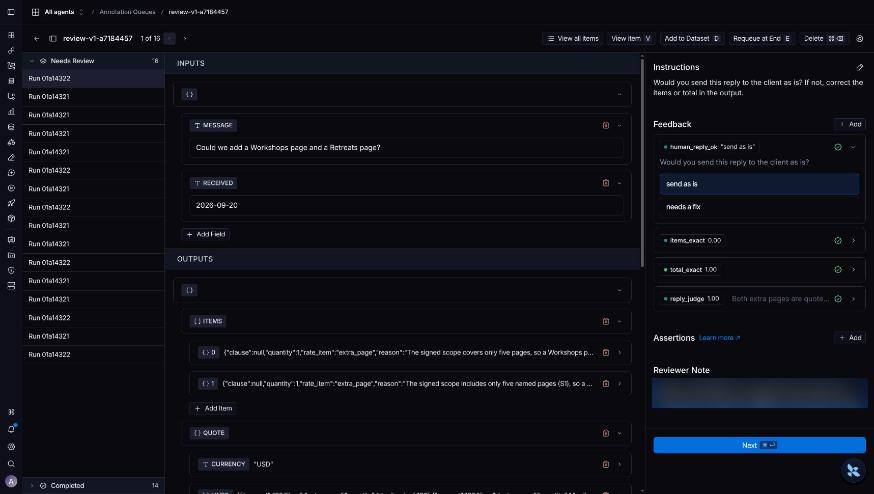
LangSmith's queue shows the next reply after each verdict, so a reviewer does not go back to a list. On AcruxCore, a reviewer works from the Traces list, which shows each trace's name rather than the client's message, so finding one message means opening rows.
Live traffic
We sent the 30 messages to both platforms in the same five minutes, one at a time, on 16 October 2026 between 17:17 and 17:22 UTC. Then we read the numbers back through each platform's API.
| AcruxCore | LangSmith | |
|---|---|---|
| Latency p50 / p95 | 7.65 s / 10.64 s | 7.61 s / 11.19 s |
| Model cost per trace, paid to z.ai | $0.00162 | $0.00169 |
The latency is almost all model time, because both apps called the same z.ai endpoint. The model cost is z.ai's bill for one message, not a platform fee. It differs because the model wrote replies of different lengths.
On AcruxCore, 85% of the input tokens were served from z.ai's prompt cache. AcruxCore priced those tokens at the cached rate of $0.26 per million, so the 30 traces cost $0.048 instead of $0.088 at the full input rate.
The gateway
A gateway sits between your app and the model providers. Your app sends every model call to one endpoint, and the gateway forwards it, records it and applies limits.
AcruxCore's gateway is an OpenAI-compatible endpoint. It is included in the hosted platform and in the self-hosted version. You register your own provider keys and the model names your app may call. The gateway then gives you:
- fallbacks to another model when a call fails;
- budgets and per-key request and token limits;
- virtual keys, which you give to an app in place of your provider key;
- an exact-match response cache;
- a priced trace span for every call, with no tracing code in your app.
LangSmith's LLM gateway is in beta, as of 25 October 2026. It takes Chat Completions, Messages and Responses requests with one LangSmith API key, and every call appears as a LangSmith trace. Its governance controls are spend limits, rate limits and data policies. Model fallbacks have their own page. The gateway docs do not describe a response cache; they pass through the provider's own prompt caching. LangSmith's gateway runs on LangSmith Cloud in every region, and on self-hosted LangSmith when an administrator turns it on.
Our test app called z.ai directly on both platforms, so neither gateway is in the numbers above.
Price and hosting
| Plan | 3 people, 100,000 traces a month | Trace data kept |
|---|---|---|
| AcruxCore (hosted) | $0; the hosted platform is free to use | Message content 90 days; tokens, cost and timing are not deleted |
| LangSmith Plus | $567 | 14 days; 180 days costs extra |
- LangSmith's pricing calculator gave $567 on 16 October 2026. Plus costs $39 a seat and includes 10,000 base traces a month. Each further trace costs 0.005 LSU, and 1 LSU is $1, so the 90,000 extra traces cost $450. With 3 seats at $39, the total is $117 plus $450, which is $567.
- These are base traces, which LangSmith keeps for 14 days. Keeping a trace for 180 days makes it an extended trace. Per the pricing page, the upgrade costs 0.0025 LSU ($0.0025) a trace on top of the base rate.
- On 2 November 2026, the pricing page calculator still showed "$39 / seat / mo · includes 10K traces total · 0.005 LSU / additional trace".
- LangSmith bills per trace. The steps inside a trace are free.
- The AcruxCore pricing page says the hosted service is free to use and that no paid plan exists, as of 26 October 2026.
- On both platforms, you pay the model provider yourself.
AcruxCore is open source under Apache 2.0, and the self-hosted version has every feature, for free. LangSmith's self-hosted version is an add-on to the Enterprise plan.
What LangSmith does that AcruxCore doesn't
- 👎 A review queue. Reviewers see one reply at a time, answer a named question, and can add the reply to a dataset in one click. AcruxCore has no queue.
- 👎 More SDK languages. LangSmith has SDKs for Go and Java as well as Python and TypeScript.
- 👎 More alert channels. LangSmith alerts on run count, cost, errors, feedback score and latency, and sends them to Slack, PagerDuty, Dynatrace or a webhook. AcruxCore alerts by email only.
- 👎 SSO and regions. LangSmith offers custom SSO on Enterprise and four hosted regions. AcruxCore has no SSO and does not state its hosted region.
- Published paid plans. LangSmith sells paid plans with published prices. The hosted AcruxCore platform is free to use, and no paid plan exists today.
What AcruxCore does that LangSmith doesn't
- 👍 Free self-hosting with every feature, under Apache 2.0.
- 👍 A gateway with a response cache, and not in beta.
- 👍 A tool catalog that the platform runs. You define a tool, version it and bind it to a prompt, and the gateway can run it. Each tool span records the tool version that ran. LangSmith's Fleet agents call built-in tool integrations and tools on remote MCP servers you connect. Its Playground saves tool definitions to a workspace registry, but the registry overwrites a tool in place rather than keeping versions.
- 👍 An audit log on every plan, which shows who moved each alias and between which versions. The audit trail guide shows it.
- 👍 A prompt read that always names an alias, so code cannot serve an untested version by default.
Which one to choose
Choose LangSmith if people on your team review replies by hand every day, if you need Go or Java, or if you need custom SSO or a chosen data region. Plan for $567 a month at 100,000 traces and three people, and 14 days of trace data.
Choose AcruxCore if you want the gateway, the tool catalog and the audit log without a paid plan, or you must self-host with every feature. Expect to review replies on the trace page, and to receive alerts by email.
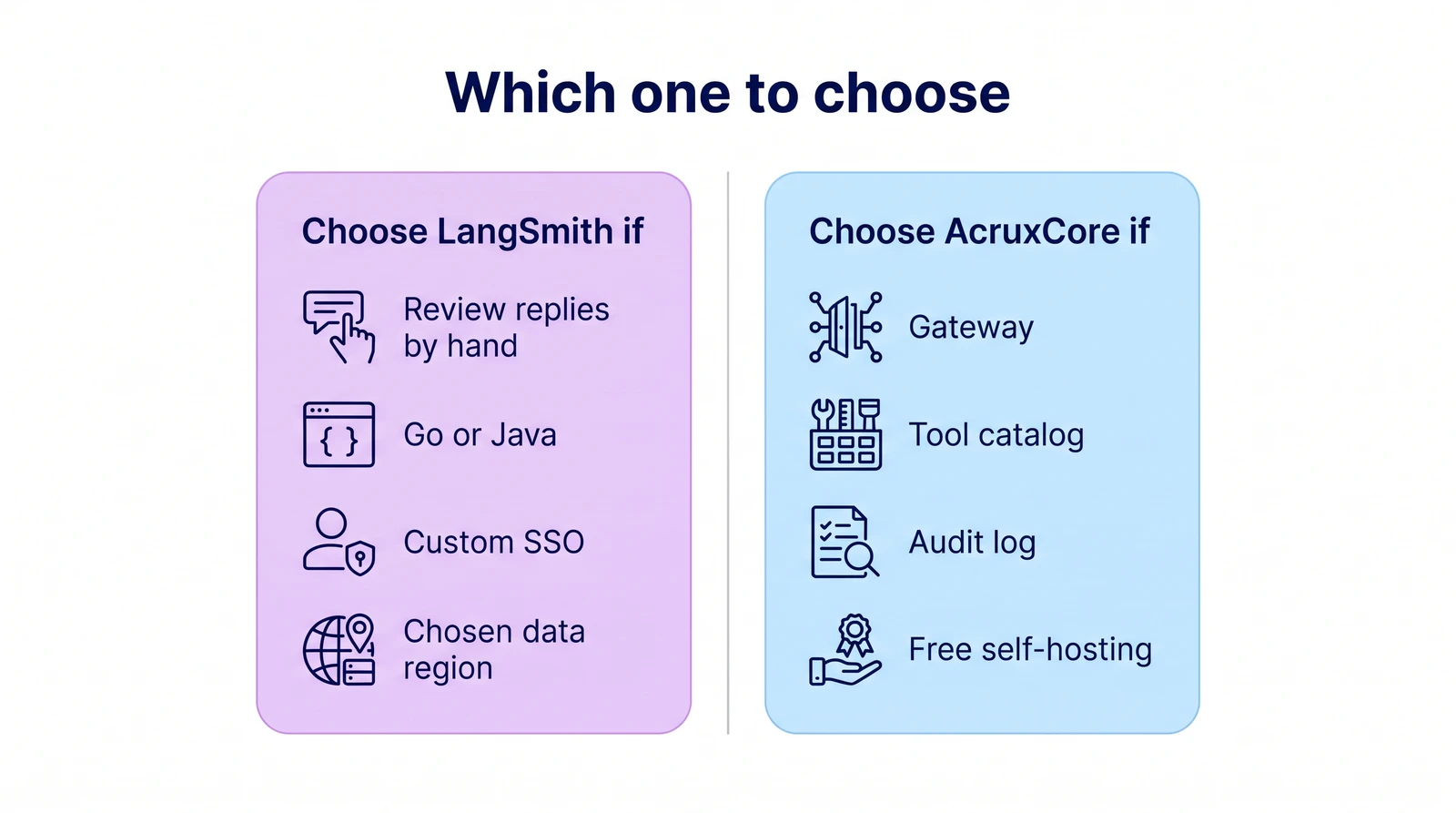
Key point: In this test the two platforms needed about the same tracing code and had similar live latency. The choice comes down to features and price: LangSmith has the review queue, Go and Java SDKs and SSO, and AcruxCore has the gateway, the tool catalog and free self-hosting.
FAQ
How much does LangSmith cost for 100,000 traces a month?
On the Plus plan, 100,000 traces a month for three people cost $567: $117 for three seats at $39 and $450 for the 90,000 traces above the 10,000 included. These are base traces, kept for 14 days.
Is LangSmith open source?
The LangSmith SDKs are MIT licensed, but the platform itself is not open source. AcruxCore is open source under Apache 2.0, with every feature.
Can you self-host LangSmith?
Yes, but self-hosted LangSmith is an add-on to the Enterprise plan. AcruxCore can be self-hosted for free with every feature.
How long does LangSmith keep trace data?
LangSmith keeps base traces for 14 days. Keeping a trace for 180 days makes it an extended trace. Per the pricing page, the upgrade costs 0.0025 LSU ($0.0025) a trace on top of the base rate.
Does LangSmith have an LLM gateway?
Yes. LangSmith's LLM gateway was in beta on 2 November 2026, with model fallbacks, spend limits, rate limits and data policies. Its docs do not describe a response cache, which AcruxCore's gateway has.
Is AcruxCore free?
The hosted AcruxCore platform is free to use, and no paid plan exists today. You pay your model provider yourself, as you do with LangSmith.
Run it yourself
acruxcore-vs-langfuse-vs-langsmith/— the AcruxCore leg and its run log: the app, the dataset, both prompt versions, and the raw output of every step.acruxcore_sdk_leg.py— the AcruxCore app.langsmith_leg.py— the LangSmith leg.RUNLOG.md— the LangSmith leg's run log.tool-calling-traces-langsmith-vs-acruxcore/python/— the tool-call scripts for both platforms.
Further reading
- AcruxCore vs Langfuse vs LangSmith adds Langfuse to the same test.
- Langfuse vs LangSmith runs the app on those two platforms only.
- LangSmith alternatives covers more tools.
- The AcruxCore Quickstart goes from sign-up to a traced, gateway-routed call.