AcruxCore vs Langfuse vs LangSmith: one app tested end to end on all three
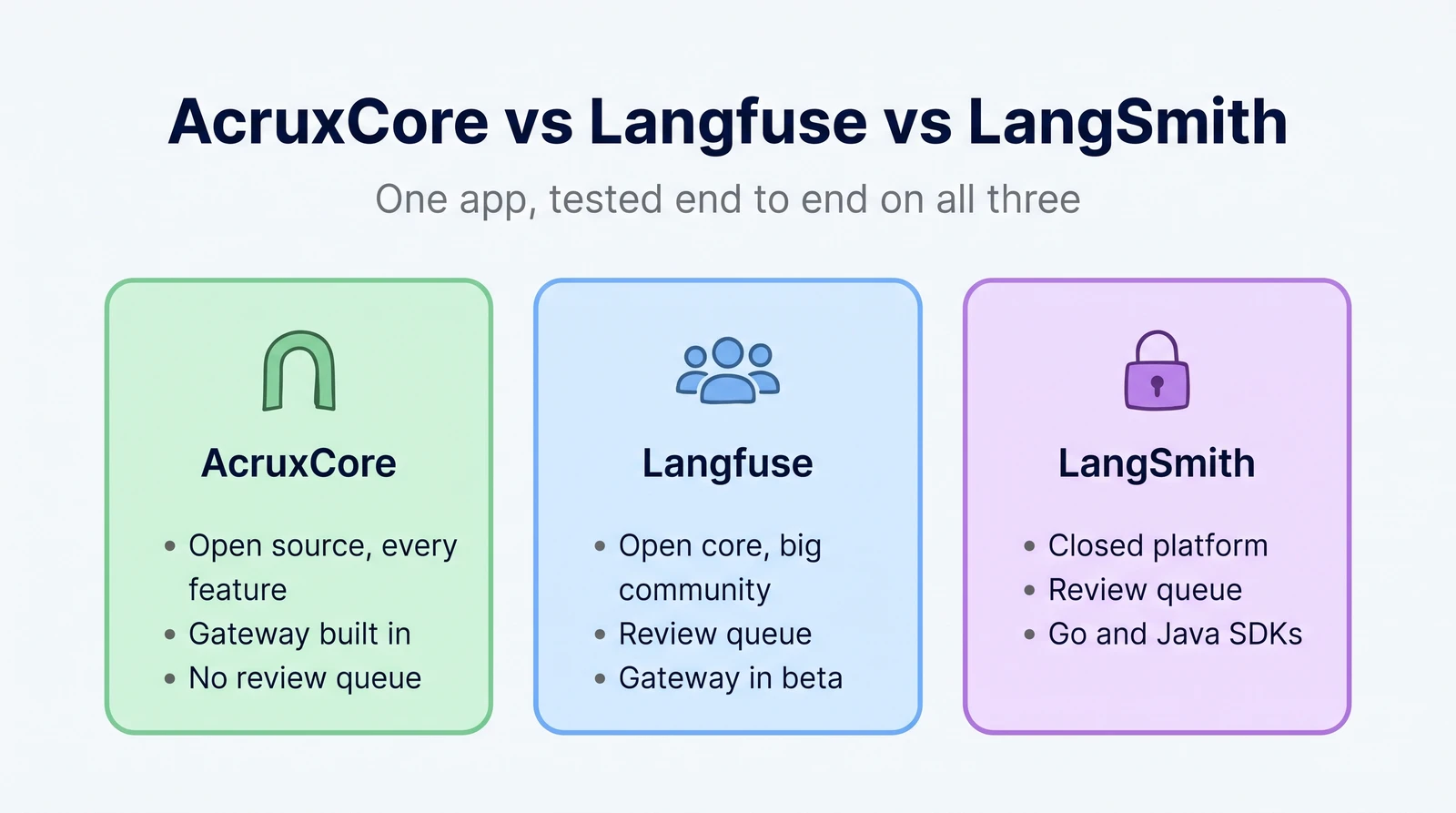
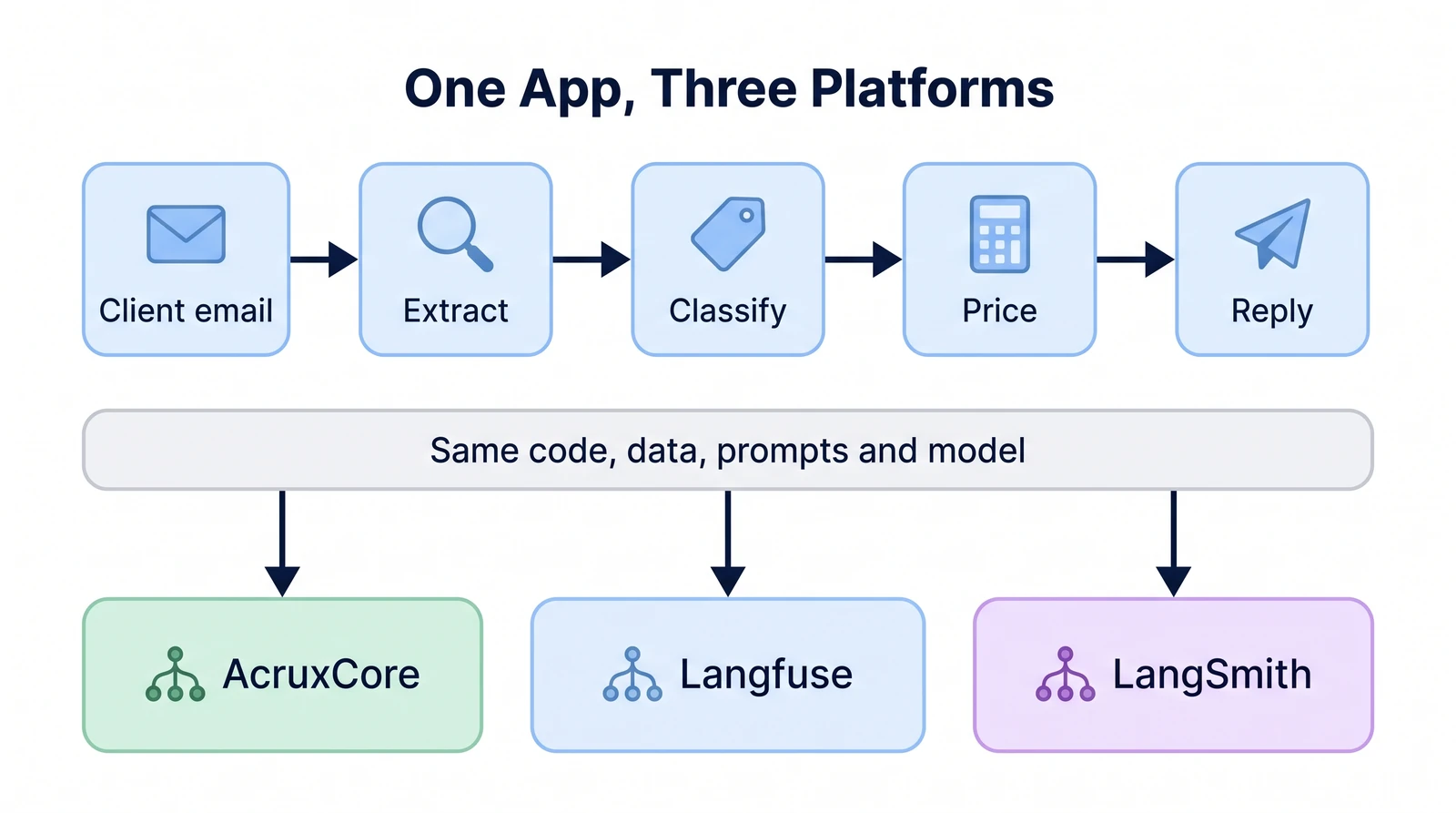
This post compares AcruxCore, Langfuse and LangSmith on the things a developer checks before choosing one. We also ran one app on all three platforms, with the same code, data, prompts and model, and measured each step. The app is a small agent that reads a client's email, checks each request against a signed project scope, prices the extra work, and writes a reply.
We build AcruxCore, one of the three tools compared here. We ran all three ourselves, and the scripts for every leg are linked below.
Which one to choose
Five features separate the three.
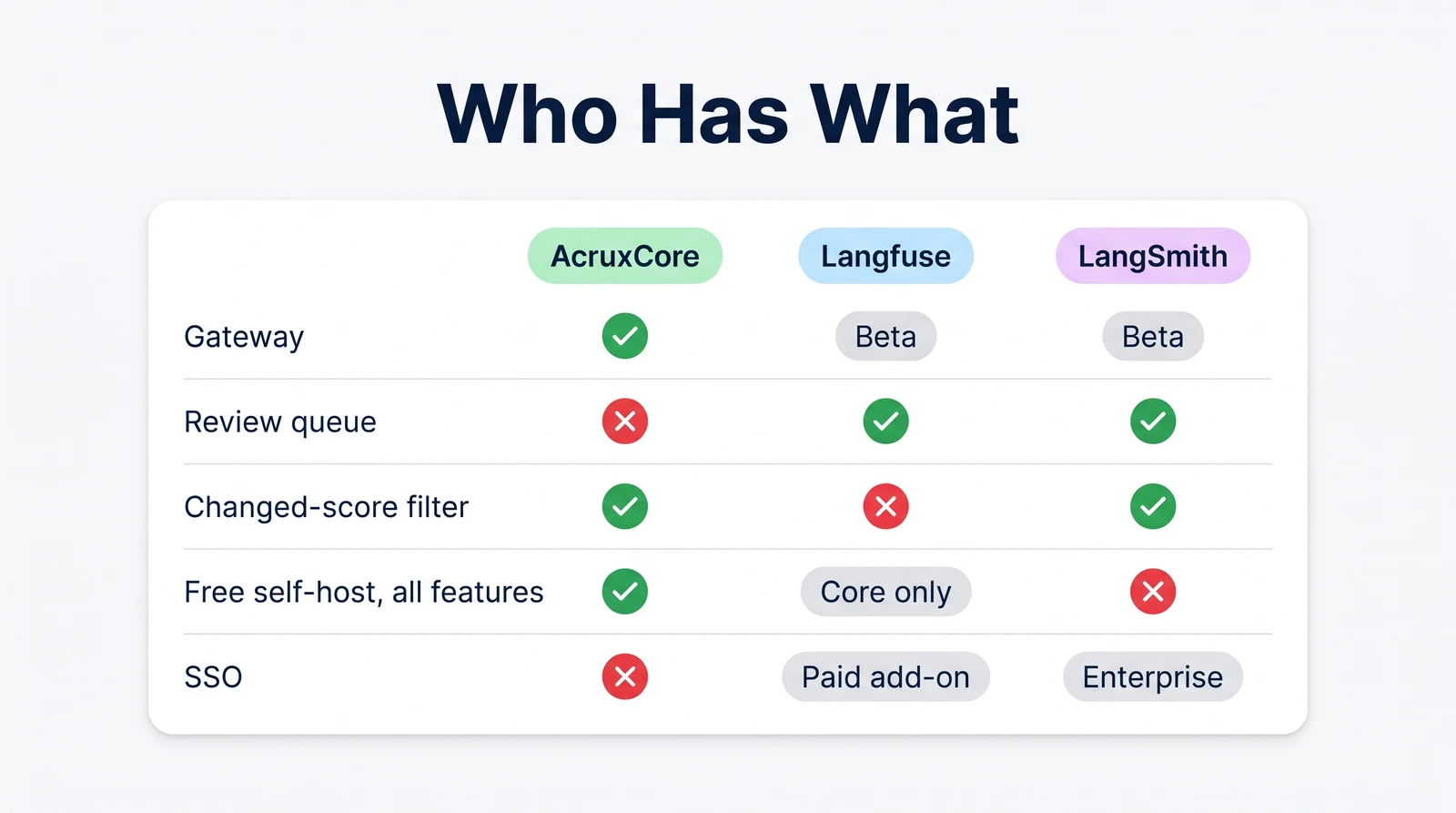
- AcruxCore if you want a free hosted service or a free self-host with every feature, including a gateway and an audit log, and you can work without a review queue or SSO.
- Langfuse if you want an open-source platform with a large community, a review queue and a low, known price.
- LangSmith if you want a review queue and the filter for changed scores in one product, or need Go or Java. At our profile of 100,000 traces a month and 3 people, it cost $567 a month, against $98.36 on Langfuse.
Differences at a glance
| AcruxCore | Langfuse | LangSmith | |
|---|---|---|---|
| License | Apache 2.0, every feature | MIT core; some features under a commercial license | SDKs MIT; the platform is not open source |
| Self-hosting | Free, every feature | Free core with organization-level roles; project-level roles, audit log and retention policies need a license | Enterprise plan only |
| Hosted price, 100,000 traces a month, 3 people | $0; the hosted platform is free to use, with no paid plan | $98.36 on the Core plan | $567 on the Plus plan |
| Hosted free plan | The whole hosted platform; the pricing page states no trace or seat limit | 50,000 units a month, 2 users (a unit is a trace, a step or a score) | 5,000 traces a month, 1 seat |
| Data kept on the plan priced above | Message content 90 days; tokens, cost and timing are not deleted | 90 days | 14 days; 180 days costs extra |
| Hosted regions | Not stated; no choice | US, EU, Japan | US, EU, Asia-Pacific |
| SDK languages | Python, TypeScript | Python, TypeScript | Python, TypeScript, Go, Java |
| OpenTelemetry ingest | Yes | Yes | Yes |
| OpenAI Agents SDK, LangChain and CrewAI integrations | Yes | Yes | Yes |
| Vercel AI SDK integration | No | Yes | Yes |
| Gateway in the request path | Yes: fallbacks, cache, budgets, rate limits | Yes, in beta: OpenAI and Anthropic, spend shown but not capped | Yes, in beta: routing, spend and rate limits |
| Evaluations: datasets, LLM judge, your own code, live traffic | Yes | Yes | Yes |
| MCP server for coding assistants | Yes: prompts (write and run), traces, experiments, tool catalog | Yes: prompts, traces, datasets, scores, review queues | Yes: prompts, traces, deployments, sandboxes |
| Review queue for people | No | Yes | Yes |
| Alerts | Email: budgets, evaluation rules, weekly digest | Cost, latency, scores; Slack, webhook, GitHub Actions | Cost, errors, latency, feedback; Slack, PagerDuty, webhook |
| SSO | No | Hosted: Pro ($199 a month) plus the Teams add-on ($300 a month), or Enterprise. Self-hosted: no licence key needed | Enterprise |
| Audit log | Every plan, also self-hosted | Enterprise | Enterprise |
| GitHub stars, 2 November 2026 | 12 | 36,883 | No public platform repository |
Sources: the Langfuse license, pricing, self-hosting and alerts pages; the LangSmith pricing, self-hosting, regions, gateway and alerts pages; the Langfuse AI Gateway, Langfuse MCP and LangSmith MCP pages; and acruxcore.com/pricing. The prices were read on 16 October 2026, the MCP pages on 18 October 2026, the star counts on 2 November 2026, the Langfuse gateway docs on 10 November 2026, and everything else on 17 October 2026.
AcruxCore
Pros
- The hosted service is free to use, and the pricing page states no trace or seat limit.
- Every feature is open source under Apache 2.0, and self-hosting is free, with no paid features.
- The gateway sits in the request path. It has fallbacks, a cache, budgets, rate limits and virtual keys (keys you give an app in place of your provider key). It traces every call with no wrapper in your code. Our test did not use it, to match the other two legs.
- The audit log, which records who changed what, is on every plan, hosted or self-hosted.
- The comparison of two experiment runs opens on the test messages whose score changed.
- Prompts use Jinja2-style templates with
ifandfor, and the server can fill them in. - It has a versioned tool catalog that the gateway runs, and a built-in prompt optimizer.
- Its MCP server lets a coding assistant run a stored prompt through the gateway and then read the trace that the run produced.
Cons
- It has no review queue. In our test, reviewing one reply by hand took 4 clicks, against 2 on Langfuse and LangSmith.
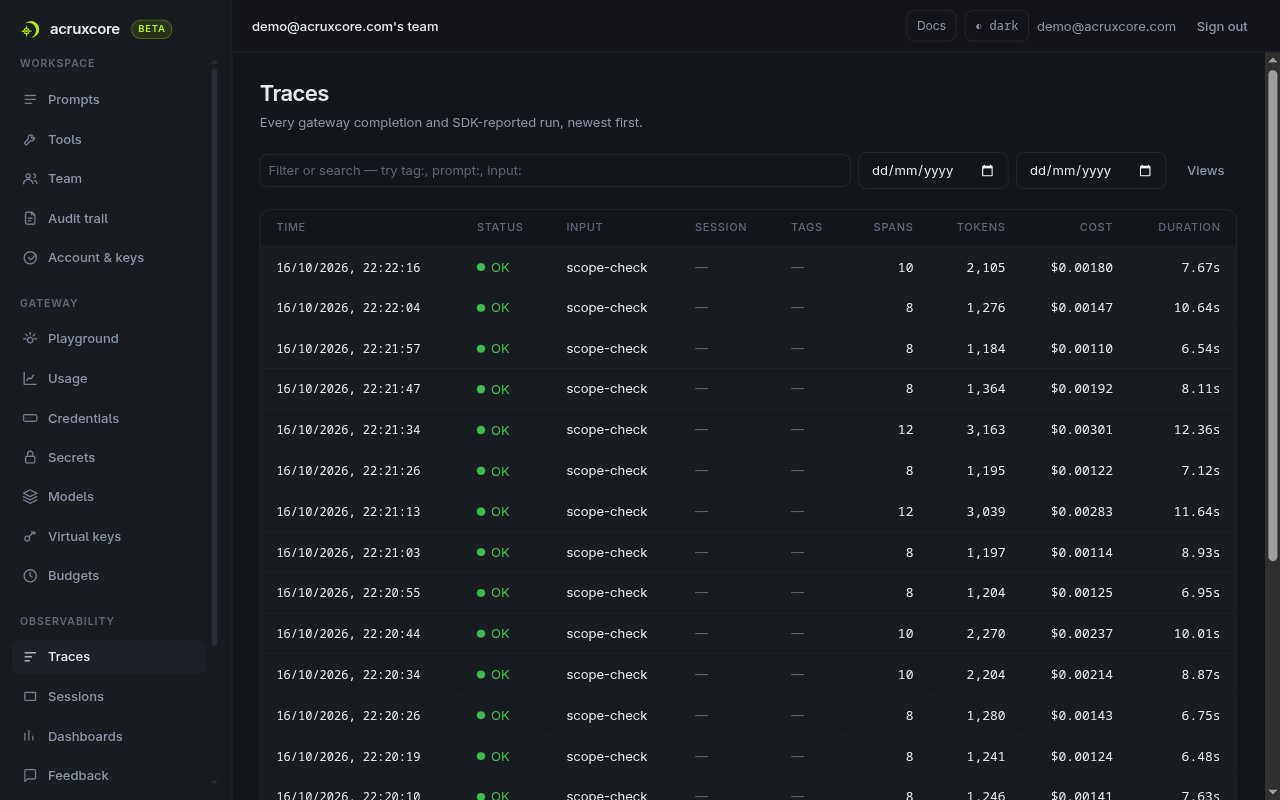
- The Traces list shows each trace's name, not the user's message, so finding one message means opening rows.
- It has no SSO, and the hosted service does not state its data region.
- The community is small: 12 GitHub stars.
- Alerts arrive by email only, and there is no Vercel AI SDK integration.
- The SDK has no wrapped OpenAI client, so the test app needed 4 more lines than on Langfuse.
- A model call links to its prompt version but does not print the prompt's name or version number.
Langfuse
Pros
- Our app needed the fewest lines of tracing code: 11.
- It has a review queue: 2 clicks per reply.
- The core is MIT-licensed and free to self-host.
- It has the largest community of the three: 36,883 GitHub stars.
- For 100,000 traces a month and 3 people, it costs $98.36 a month and keeps data for 90 days.
- A model call shows its prompt name and version as a link.
- Its MCP server works with prompts, traces, datasets, scores and review queues.
Cons
- Its gateway is a beta for OpenAI and Anthropic, with no spend caps or fallbacks yet.
- Its comparison of two experiment runs cannot hide the test messages whose score stayed the same.
- It bills each step and each score, so the bill grows with the number of steps in a trace.
- On Langfuse Cloud, SSO and project roles need the paid Teams add-on, and the audit log needs Enterprise. Self-hosted, SSO needs no licence key, and project roles and the audit log need one.
- A promotion asks for no confirmation, and the prompt page does not show past promotions.
- An experiment with a plain Python function runs one test message at a time.
LangSmith
Pros
- It is the only one of the three with both a review queue and a filter for the test messages whose score changed. AcruxCore has the filter but no queue. Langfuse has the queue but no filter.
- It has SDKs for Go and Java as well as Python and TypeScript.
- It has a gateway, in beta.
- The prompt page keeps a rollback history.
- Alerts reach Slack, PagerDuty and webhooks.
- Its MCP server works with prompts, traces, deployments and sandboxes.
Cons
- For 100,000 traces a month and 3 people, it costs $567 a month, more than five times the Langfuse price, and keeps data for 14 days.
- The platform is not open source, and self-hosting needs the Enterprise plan.
- Pushing a prompt from code needs the
langchain-corepackage. - A prompt read with no tag returns the newest commit, not the production one, so a draft can reach users. Langfuse returns the production version.
- The SDK caches a prompt for 5 minutes, so a promotion takes up to 5 minutes to arrive.
How we tested
- The app: a small agent in four steps (extract, classify, price, reply), in one file,
pipeline.py, with no tracing code in it. More about the app. - The data: 30 client messages with the expected items and total, three scorers, and two versions of the prompts. All three platforms got the same files.
- The model: every call, the judge included, went to z.ai
glm-5.3withreasoning_effort="low", straight from the app. - The platforms: Langfuse and LangSmith on their hosted EU regions, on the free plans. AcruxCore on its hosted service at acruxcore.com.
- The AcruxCore leg: a clean environment with Python 3.12,
acruxcore0.18.0,openai2.48.0,httpxandpython-dotenv.
Tracing
| AcruxCore | Langfuse | LangSmith | |
|---|---|---|---|
| Lines of tracing code for this app | 15 | 11 | 18 |
| Wrapped OpenAI client | No | Yes | Yes |
| Decorator that makes a function a step | Yes | Yes | Yes |
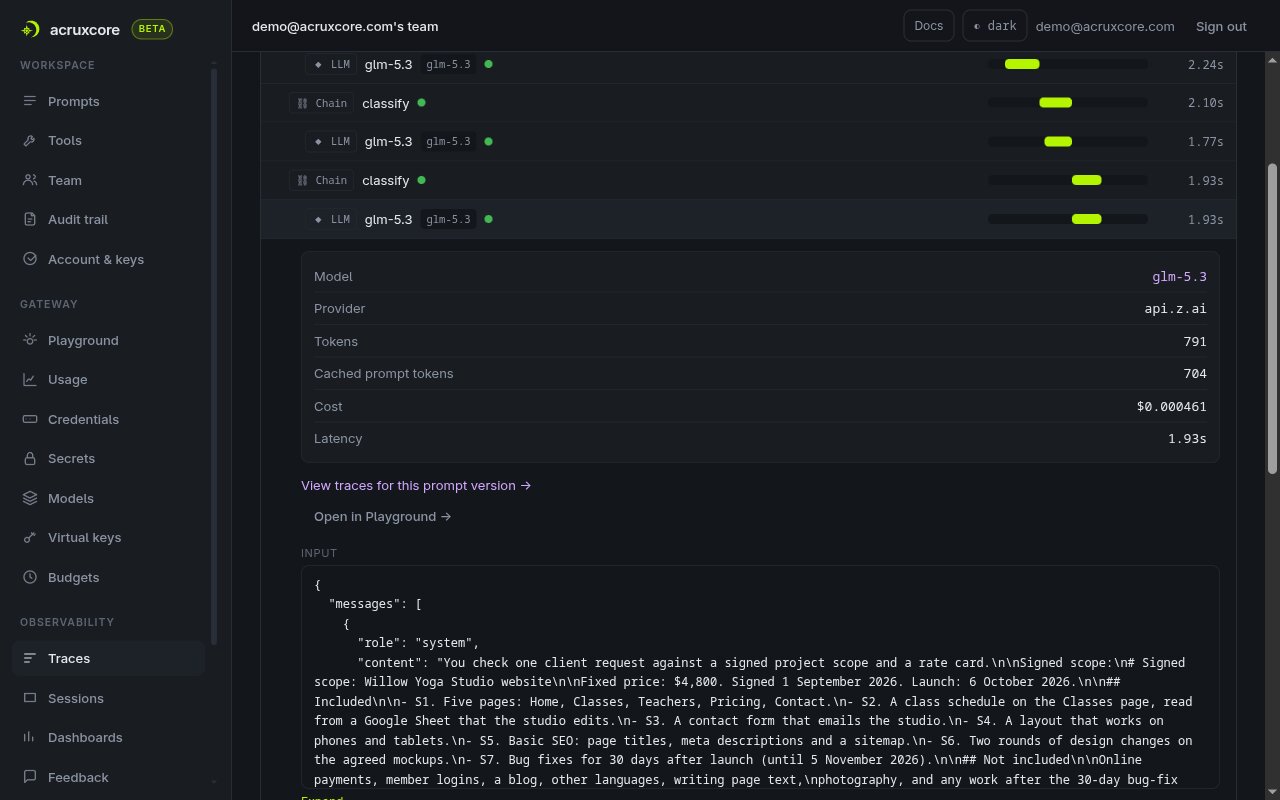
| Model call shows its prompt version | A link, "View traces for this prompt version"; no name or number | "prompt: scope-extract - v1", as a link | Plain metadata text, not a link |
| Gateway that records calls with no wrapper | Yes | Yes, in beta | Yes, in beta |
These are all 15 lines of the AcruxCore instrumentation:
from types import SimpleNamespace
from acruxcore import AcruxCoreSync

hub = AcruxCoreSync(ACX_KEY, ACX_BASE_URL, timeout=180,
                    provider={"base_url": BASE_URL, "api_key": API_KEY})

def _create(*, model, messages, acx_prompt_version=None, **params):  # a z.ai call, traced
    result = hub.gateway.chat(model, messages, prompt_version_id=acx_prompt_version, **params)
    return SimpleNamespace(choices=[SimpleNamespace(message=SimpleNamespace(content=result.content))])

client = SimpleNamespace(chat=SimpleNamespace(completions=SimpleNamespace(create=_create)))

def step(name: str, kind: str):
    return hub.traces.step(name, kind=kind)

def make_app(alias: str = "production", only: set[str] | None = None):
    def get_prompt(name: str):  # `only` limits `alias` to some prompts; the rest stay on production
        version = hub.prompts.get_by_alias(name, alias if not only or name in only else "production")
        return version.messages, {"acx_prompt_version": version.id}
    return build_app(get_prompt, client, step)
ACX_KEY,ACX_BASE_URL,BASE_URLandAPI_KEYcome from environment variables.build_appis the shared app inpipeline.py, the same for all three platforms.AcruxCoreSyncis the SDK's blocking client, for code that is not async.- The
providersetting gives the SDK our z.ai URL and key, so each model call goes straight to z.ai, as on the other two platforms.hub.gateway.chatis the SDK's chat method. With aproviderset, it calls that provider directly and records the call as a span, so the call does not pass through the AcruxCore gateway. traces.stepis the decorator. Each step becomes a span, and each model call becomes a span under its step._createand theclientline are the 4 lines that Langfuse does not need. The AcruxCore SDK has no wrapped OpenAI client, so these lines give the SDK's chat call the OpenAI shape that the app expects.
acruxcore_sdk_leg.py — the full AcruxCore leg.
All three platforms stored the same tree: the agent, scope-check, at the root, one span per step, one model
call inside each step, and the price step marked as a tool.
Show screenshots: AcruxCore trace tree and LLM span panel
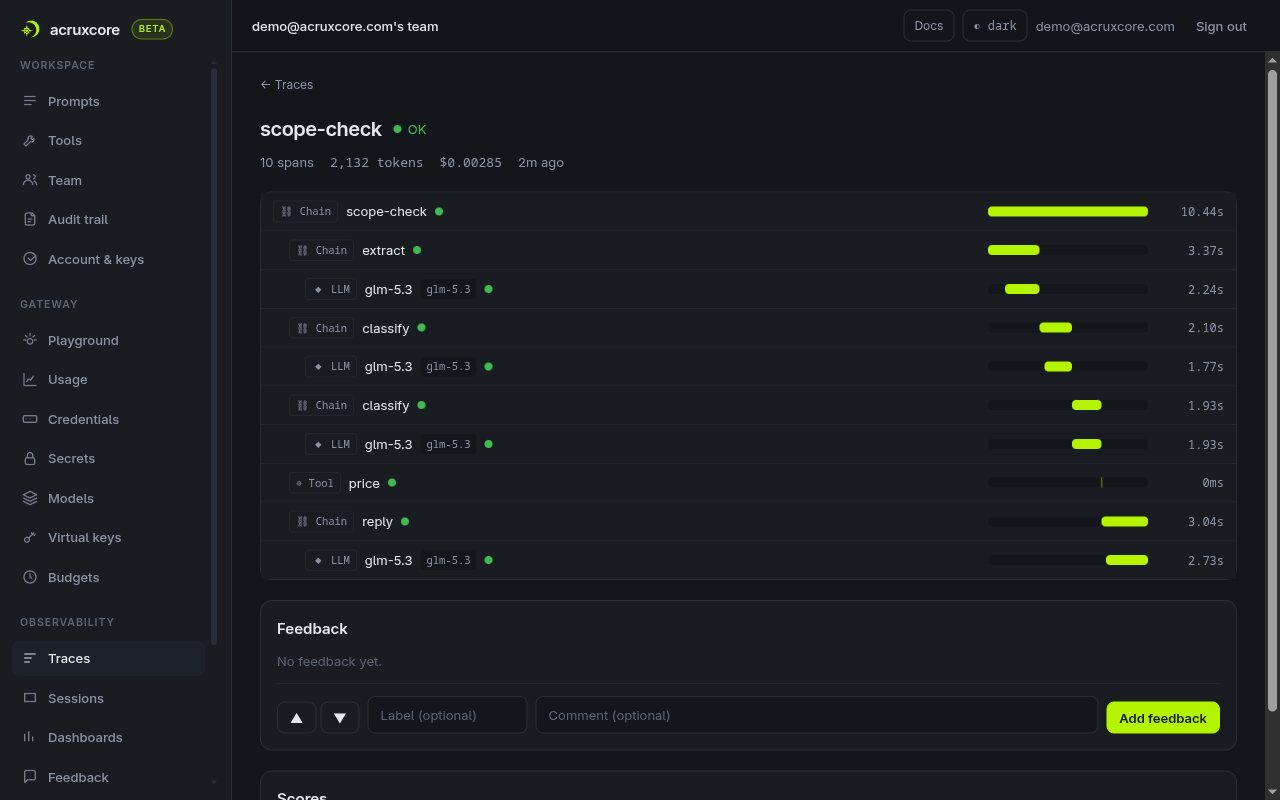
The AcruxCore gateway is an OpenAI-compatible endpoint in the request path:
- You point the OpenAI client at AcruxCore, and each call arrives as a priced span. Your code needs no wrapper.
- The gateway passes
reasoning_efforton to the model, so a call through the gateway runs the model with the same settings. One extract call used 3 reasoning tokens with"low"and 149 without it. - We did not use the gateway for this test. The other two legs called z.ai directly, and the extra network hop would have added to AcruxCore's latency only.
Prompts, promotion and rollback
| AcruxCore | Langfuse | LangSmith | |
|---|---|---|---|
| How a chat prompt is stored | A list of role and content messages | A list of role and content messages | A serialized LangChain object |
| Push a prompt from code | Python SDK or REST | Python SDK | Needs the langchain-core package |
| Promote a version | 4 clicks, with a confirmation | 3 clicks, no confirmation | 3 clicks, with a confirmation |
| Roll back | 2 clicks on the same tab | 4 clicks | 3 clicks |
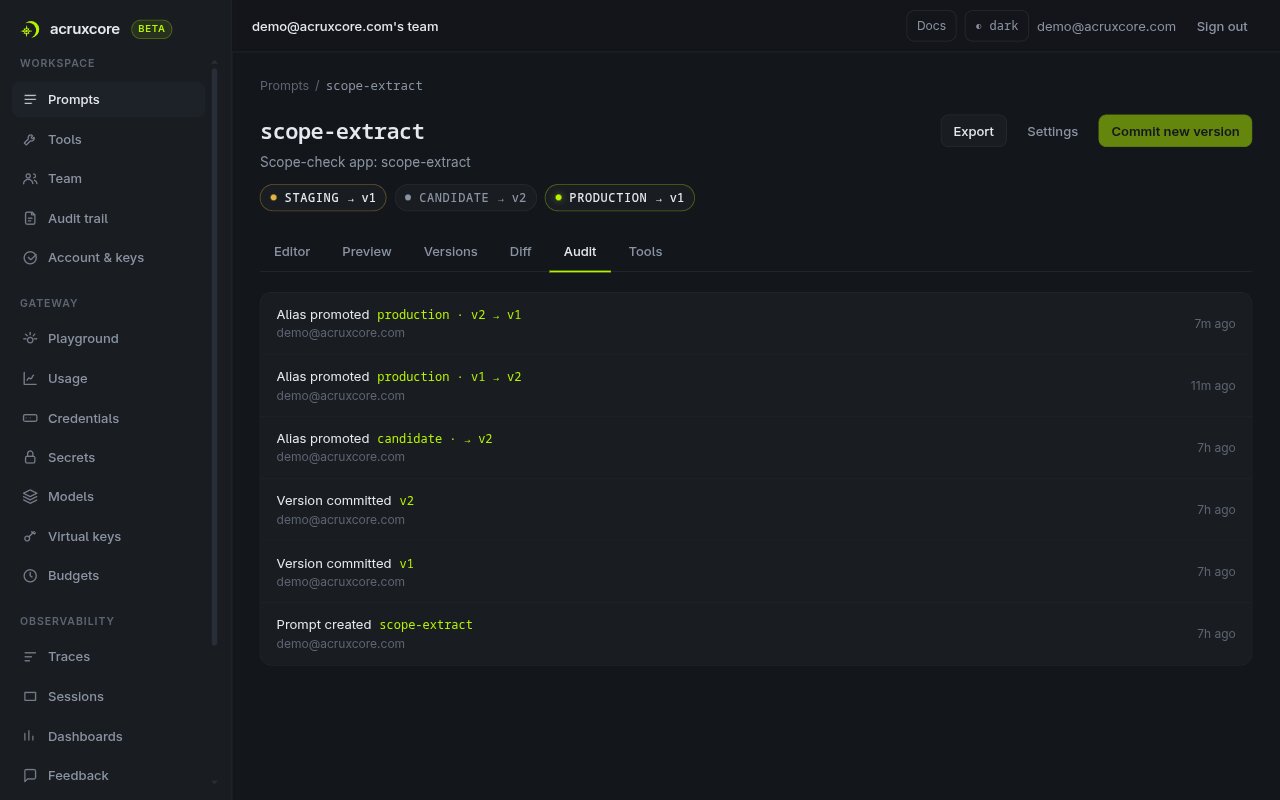
| History of promotions | Audit tab: who moved the alias, and when | Not shown | Rollback list of past commits |
| SDK cache before a promotion reaches the app | 60 seconds | 60 seconds | 5 minutes |
- AcruxCore listed each prompt's variables from its
{{ }}placeholders. - AcruxCore created a
productionand astagingalias on version 1 of each prompt. Committing version 2 did not move them. hub.prompts.get_by_alias(name, alias)returns the version that the alias points to. AcruxCore can also fill in the variables on the server and return the finished messages.
Show screenshot: AcruxCore audit tab with promote and rollback
Experiments over the dataset
An experiment answers one question: after you change a prompt, which messages got better and which got worse? We tested it like this:
- The dataset is 30 client messages for a fictional yoga-studio website, in
messages.json. Each message has the expected answer: the extra-work items and the total price. - Three scorers check each answer: are the items exactly right, is the total exactly right, and does an LLM judge accept the reply.
- v1 is the first version of the prompts. v2 is a rewrite of the extract and classify prompts, made after reading v1's mistakes.
- On each platform, we ran the app over the 30 messages once with v1 and once with v2, and then opened the platform's comparison of the two runs.
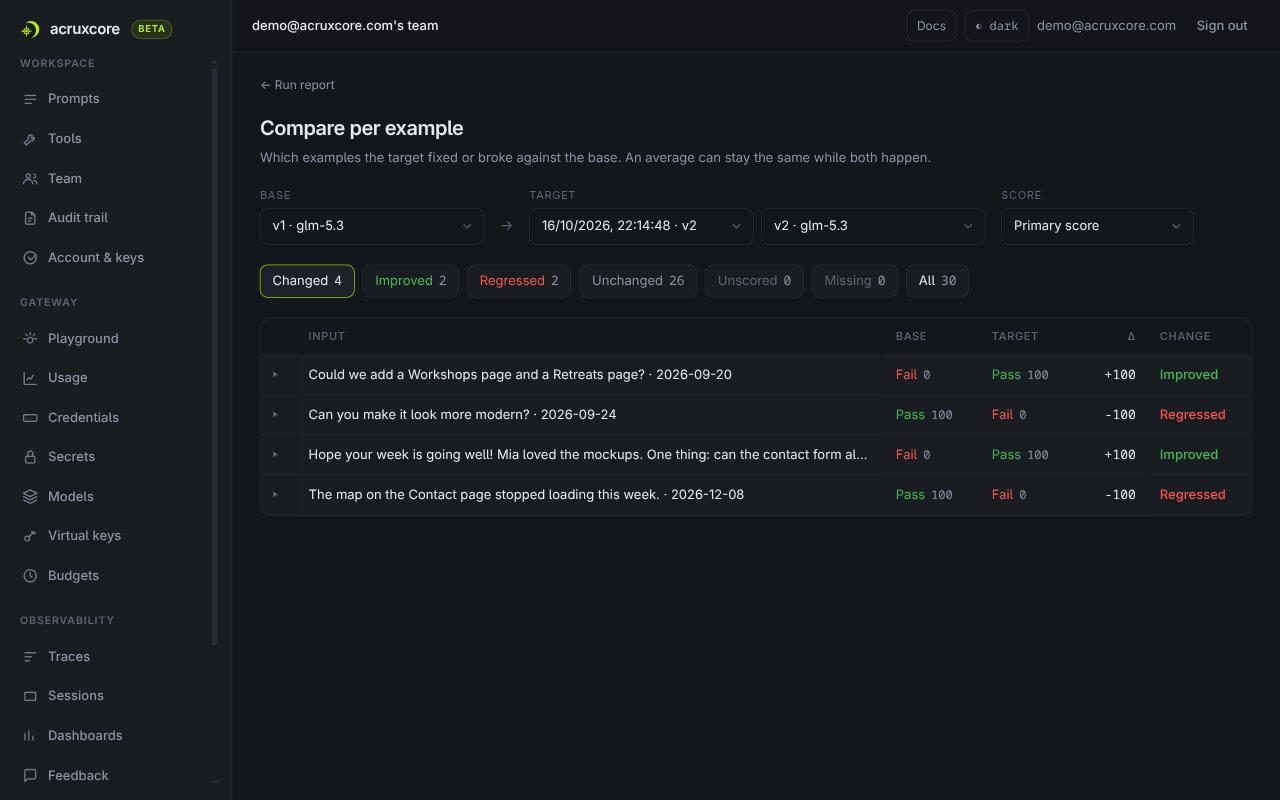
On AcruxCore, v2 fixed 2 messages and broke 2 others. The comparison has to show those 4 messages. The table shows how each platform handled that.
| AcruxCore | Langfuse | LangSmith | |
|---|---|---|---|
| Upload the 30 test messages | 1 call, 1.0 s | 30 calls, 7.3 s | 1 call, 2.2 s |
| Run your own app code as an experiment | Yes, run_local; our test made the same 3 REST calls itself | Yes, run_experiment | Yes, evaluate |
| Experiment runner in the SDK | Yes, run_local; a plain function runs 4 at a time by default | Yes; a plain function runs one message at a time | Yes; a plain function runs 4 at a time |
| Clicks to the comparison of two runs | 3, from the Evaluations page | 4, from the dataset page | 4, from the dataset page |
| See only the messages whose score changed | Yes, the comparison opens that way | No; scan all 30 rows | Yes, one click |
- We do not compare the scores across platforms. All three ran the same prompts on the same
model, and
glm-5.3gives a slightly different answer each time, so score gaps between platforms are noise. The scores of every run are in the run log. - AcruxCore also has a server-side experiment, which runs one stored prompt over a dataset with an LLM judge. That kind cannot run this app, because the app has four steps and two of its scorers are Python code.
messages.json— the 30 test messages and their expected answersRUNLOG.md— the scores of every run
Show screenshot: AcruxCore v1 vs v2 comparison per example
Reviewing replies by hand
We asked one question about each of the 30 replies: "Would you send this reply to the client as is?"
| AcruxCore | Langfuse | LangSmith | |
|---|---|---|---|
| Review queue | No | Yes | Yes |
| Clicks per reply | 4: open the trace, open the reply step, ▲ or ▼, go back | 2: a verdict and "Mark Completed" | 2: a verdict and "Next" |
| The verdict names the question | No; a ▲/▼ rating on the step | Yes, a score configuration | Yes, a feedback key |
| Fix a wrong answer | A comment and a label on the trace | "Correct output" saves your text | "Add to Dataset" adds your edited version to the dataset |
- AcruxCore's Traces list shows each trace's name, not the client's message, so finding one message means opening rows.
- We would send 28 of the 30 AcruxCore v1 replies unchanged.
Live traffic
We sent the 30 messages to all three platforms during the same 5 minutes, one at a time, and read the numbers back through each platform's API.
| AcruxCore | Langfuse | LangSmith | |
|---|---|---|---|
| Latency p50 / p95 | 7.7 s / 10.6 s | 7.2 s / 10.8 s | 7.6 s / 11.2 s |
| Model cost per trace, paid to z.ai | $0.0016 | $0.0015 | $0.0017 |
| Dashboards with no setup | Yes | Yes | Yes |
- The latency is almost all model time, because all three called the same z.ai endpoint.
- We sent this traffic on 16 October 2026, 17:18–17:22 UTC. The model's speed changes during the day. At 06:03 UTC the same app had a p50 of 16.8 s on Langfuse and 16.9 s on LangSmith (Langfuse vs LangSmith), so compare the columns with each other, not with latencies from another hour.
- The model cost is z.ai's bill for one message, not a platform fee. It differs because the model wrote replies of different lengths.
- On all three platforms, we entered z.ai's prices for
glm-5.3: $1.40 per million input tokens, $0.26 per million cached input tokens, and $4.40 per million output tokens. - On AcruxCore, 85% of the input tokens were cached. At the full input price, the 30 traces would have cost $0.088 instead of $0.048.
- AcruxCore's Dashboards page splits requests, errors, tokens, cost and latency by day, model, session, prompt version or step.
Show screenshot: AcruxCore Traces page for the live run
Price for 100,000 traces a month
| Plan | 3 people | Data kept |
|---|---|---|
| AcruxCore (hosted) | $0; the hosted platform is free to use, with no paid plan | Message content 90 days; tokens, cost and timing are not deleted |
| Langfuse Core | $98.36, or $119.69 when each trace also gets three scores | 90 days |
| LangSmith Plus | $567 | 14 days; 180 days costs extra |
- Prices were read on 16 October 2026 from acruxcore.com/pricing and the Langfuse and LangSmith pricing pages.
- On all three, you pay the model provider yourself.
- Langfuse bills every step in a trace, so its price grows with the number of steps. LangSmith bills per trace.
- LangSmith's $567 is 3 seats at $39 plus 90,000 traces above the included 10,000 at 0.005 LSU ($0.005) each. These are base traces, kept for 14 days. Keeping traces for 180 days costs an extra fee that the pricing page does not state.
Key point: All three platforms stored the same trace tree for our app, and their median latencies on live traffic were within 0.5 s of each other. The three differ in the gateway (AcruxCore, and LangSmith in beta), the review queue (Langfuse and LangSmith) and the price.
FAQ
Is AcruxCore free?
Yes. The hosted platform is free to use, with no paid plan. Self-hosting is also free, and every feature is open source under Apache 2.0.
Which of the three has a review queue?
Langfuse and LangSmith have a review queue, and AcruxCore does not. In our test, reviewing one reply took 2 clicks on Langfuse and LangSmith, and 4 clicks on AcruxCore.
Which of the three has a gateway?
All three. AcruxCore's gateway has fallbacks, a cache, budgets and rate limits. LangSmith's gateway is in beta, with routing, spend limits and rate limits. Langfuse's gateway opened in public beta on 4 November 2026 for OpenAI and Anthropic, and spend caps and fallbacks are still on its roadmap.
Is LangSmith open source?
No. The LangSmith SDKs are MIT-licensed, but the platform is not open source, and self-hosting needs the Enterprise plan.
Which is cheaper, Langfuse or LangSmith?
For 100,000 traces a month and 3 people, Langfuse Core cost $98.36 a month and LangSmith Plus cost $567. Langfuse keeps the data 90 days on that plan, and LangSmith keeps base traces 14 days.
Run it yourself
acruxcore-vs-langfuse-vs-langsmith/— the app, the AcruxCore leg, the dataset, both prompt versions, andRUNLOG.mdwith the raw output of every step.langfuse-vs-langsmith/— the Langfuse and LangSmith legs, with their own run log.
- One platform at a time: AcruxCore vs Langfuse and AcruxCore vs LangSmith.
- More tools compared: 10 LLM observability tools tested hands-on, 7 LangSmith alternatives and 7 Langfuse alternatives.