AcruxCore vs MLflow: two gateways, one with guardrails
MLflow is the open-source ML and GenAI platform first built at Databricks. It has shipped since
2018 and had about 28,500 GitHub stars and 447 contributors on 25 October 2026. Its GenAI side
is newer: a Prompt Registry, a tracing store, LLM-as-judge evaluation, and an AI Gateway
that sits in the request path. AcruxCore's gateway sits there too, so this comparison is
between two request-path gateways. We sent the same support prompt,
vip-support-triage, through both. The prompt changes tone for VIP customers and lists their
open tickets. We registered and versioned it, called it through each gateway, linked the trace
to its prompt version, and built an evaluation dataset.
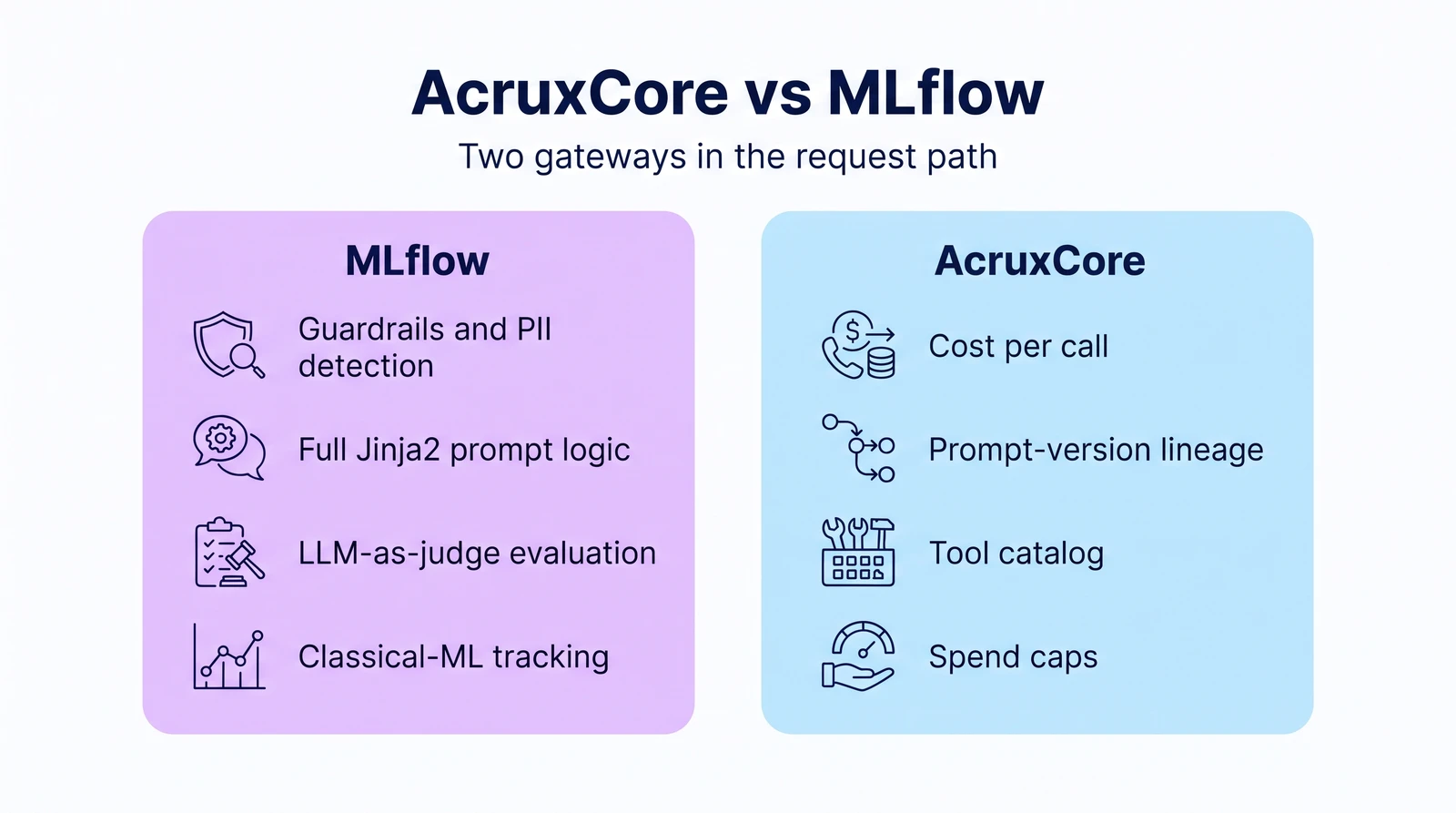
The short answer: MLflow has Safety, PII and custom guardrails on every gateway endpoint, full Jinja2 prompts, and an experiment tracker for classical ML, and AcruxCore has no guardrails. AcruxCore returns cost on every gateway response and runs the tools in its catalog. Linking a trace to its prompt version takes a separate SDK call on MLflow and one argument on AcruxCore.
AcruxCore is our product. The MLflow and AcruxCore scripts are linked in each section.
How we tested
- MLflow: version 3.15.1, self-hosted.
mlflow serverran in a Docker container on the same machine as the test scripts, athttp://localhost:5000. The AI Gateway is served by that same tracking-server process, not a separate one. The instance had no login screen, so we worked as the anonymous local user that a first-time self-hoster sees. The server's worker count was not recorded. - Model in the screenshots: the same prompt and the same customer message on both
platforms. AcruxCore's stored prompt uses
openai/gpt-4o-mini. MLflow AI Gateway's OpenRouter model picker is a curated list that did not offergpt-4o-mini, so the MLflow screenshots and the MLflow SDK output below useopenai/gpt-4o. - Model in the latency benchmark: both gateways used a native OpenAI provider on
gpt-4o-mini, so every leg ends atapi.openai.com. - Dates: the hands-on steps and screenshots are from 8 August 2026, on MLflow 3.15.1. The latency figures come from three benchmark runs committed on 7 September 2026. The MLflow version for those runs was not recorded separately.
- AcruxCore: the benchmark called a local AcruxCore gateway at
http://localhost:3001. Hardware not recorded.
At a glance
| Aspect | MLflow | AcruxCore |
|---|---|---|
| Where the platform sits | In the request path: an AI Gateway with usage tracking, budget policies and guardrails | In the request path: routing, caching, budgets |
| Prompt templating | Full Jinja2, {% if %}/{% for %}, created in a UI form or the SDK | Nunjucks {% if %}/{% for %}, UI + SDK creation |
| Sending a live call | Cost per span from 3.10 with the [genai] extra, per docs; none on our install, which showed tokens + latency | Cost, cache, latency all shown inline per call |
| Prompt-version lineage | A separate link_prompt_versions_to_trace() call after the request | One prompt_version_id argument on the gateway call, or none with a prompt reference |
| Tool handling | MCP Registry: catalogs external MCP servers, doesn't execute a tool itself | Versioned catalog, executed calls, analytics |
| Evaluation & datasets | Built-in LLM-as-judge + custom code judges; dataset list page didn't refresh after creating one | Version × model sweep from trace feedback |
| Guardrails | Safety, PII detection and custom, per gateway endpoint, before or after the model call | None |
| Spend controls | Budget policies: Alert fires a webhook, Reject returns HTTP 429 on later requests (per docs, not tested) | Spend cap per team or virtual key, checked before the provider call, plus RPM/TPM limits |
| MCP server | Experimental: the default genai group has tools for traces, scorers, experiments and runs; an optional ml group has experiments, runs, models and deployments; no Prompt Registry tools | Hosted or local: commit, promote and run stored prompts, read traces, run experiments |
- Pick MLflow if you want Safety and PII guardrails and full Jinja2 templates on a platform that is also your classical-ML experiment tracker.
- Pick AcruxCore if you want cost in every gateway response, prompt-version lineage without a second SDK call, and a tool catalog that runs and measures tool calls.
License, pricing, team structure, security, and community stats: see AcruxCore vs MLflow on the compare page.
Two gateways in the request path
MLflow's AI Gateway is a proxy. You create a named endpoint, pick a provider and model, and get back an OpenAI-compatible URL. Every call through it is usage-tracked and traced on the server, the same shape as AcruxCore's gateway.
Show screenshot: MLflow AI Gateway endpoint overview
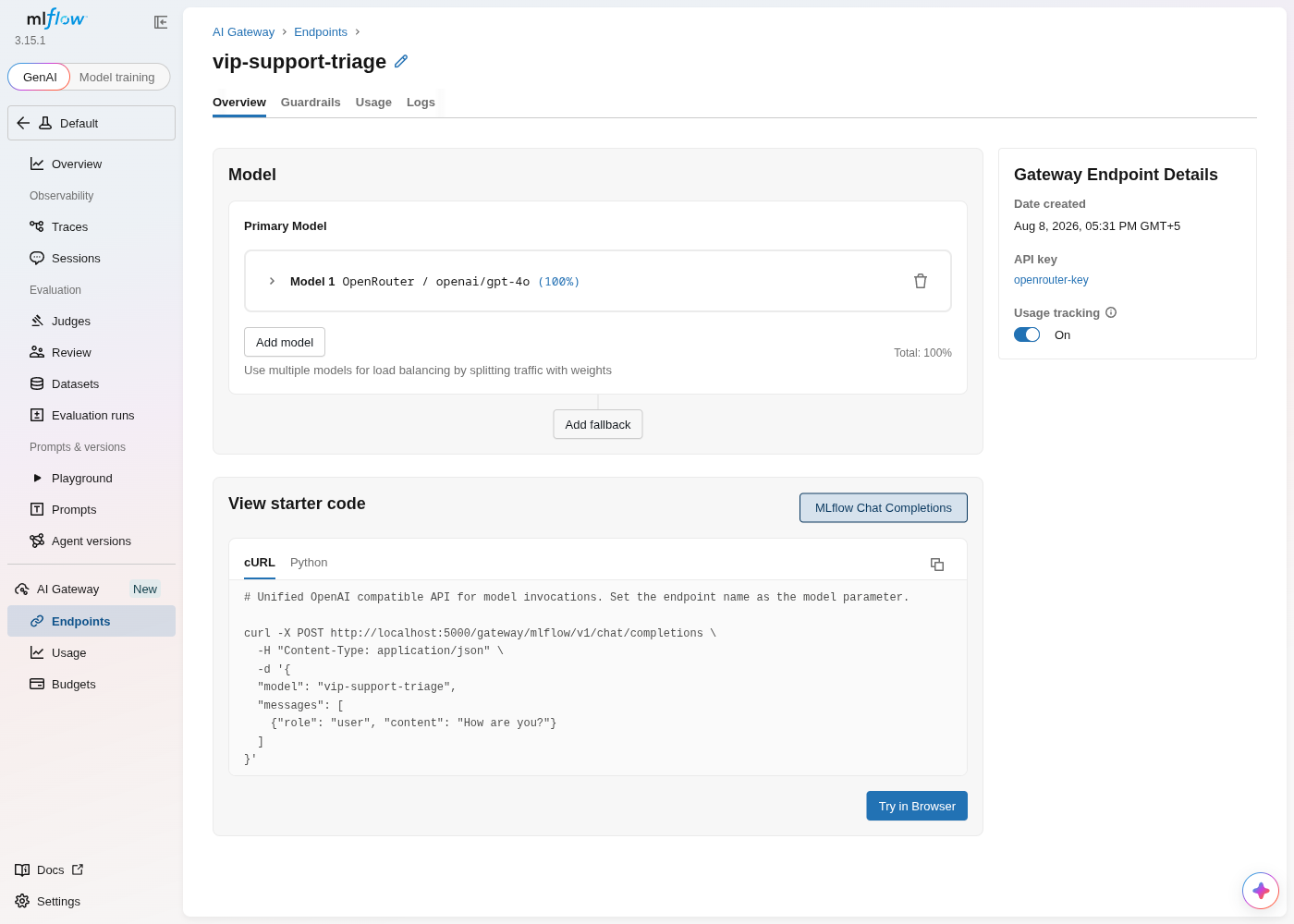
We created the endpoint and called it with a plain curl, with no SDK and no auth header beyond
what the endpoint already stores. The completion came back with "provider": "openrouter" in
the response.
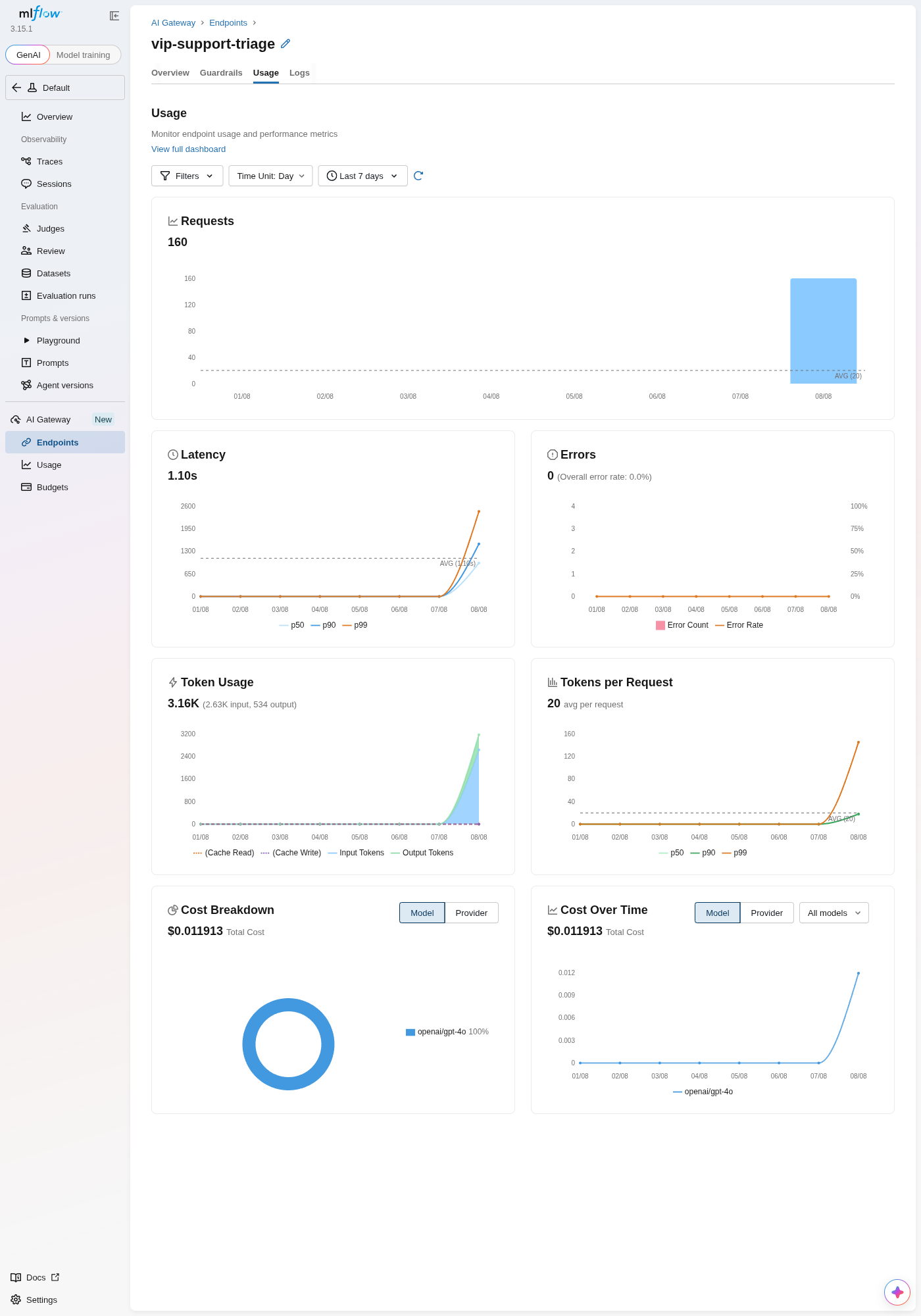
The endpoint also has an aggregate Usage dashboard: requests, p50/p90/p99 latency, token usage, and cost broken down by model.
Show screenshot: MLflow AI Gateway usage and cost dashboard
| Feature | MLflow | AcruxCore |
|---|---|---|
| Where it sits | In the request path: a named Gateway endpoint | In the request path: every call routes through it |
| Provider/model picker | Curated list per provider; gpt-4o-mini was missing from the OpenRouter list even though OpenRouter serves it | Any model string your registered credential supports |
| Aggregate cost/usage view | Per-endpoint dashboard: requests, latency percentiles, tokens, cost by model | Team-wide Gateway Telemetry |
| Per-call cost shown inline | Partial: per span from 3.10 with the [genai] extra, per docs; none on our install | Yes |
Spend controls: what each platform configures
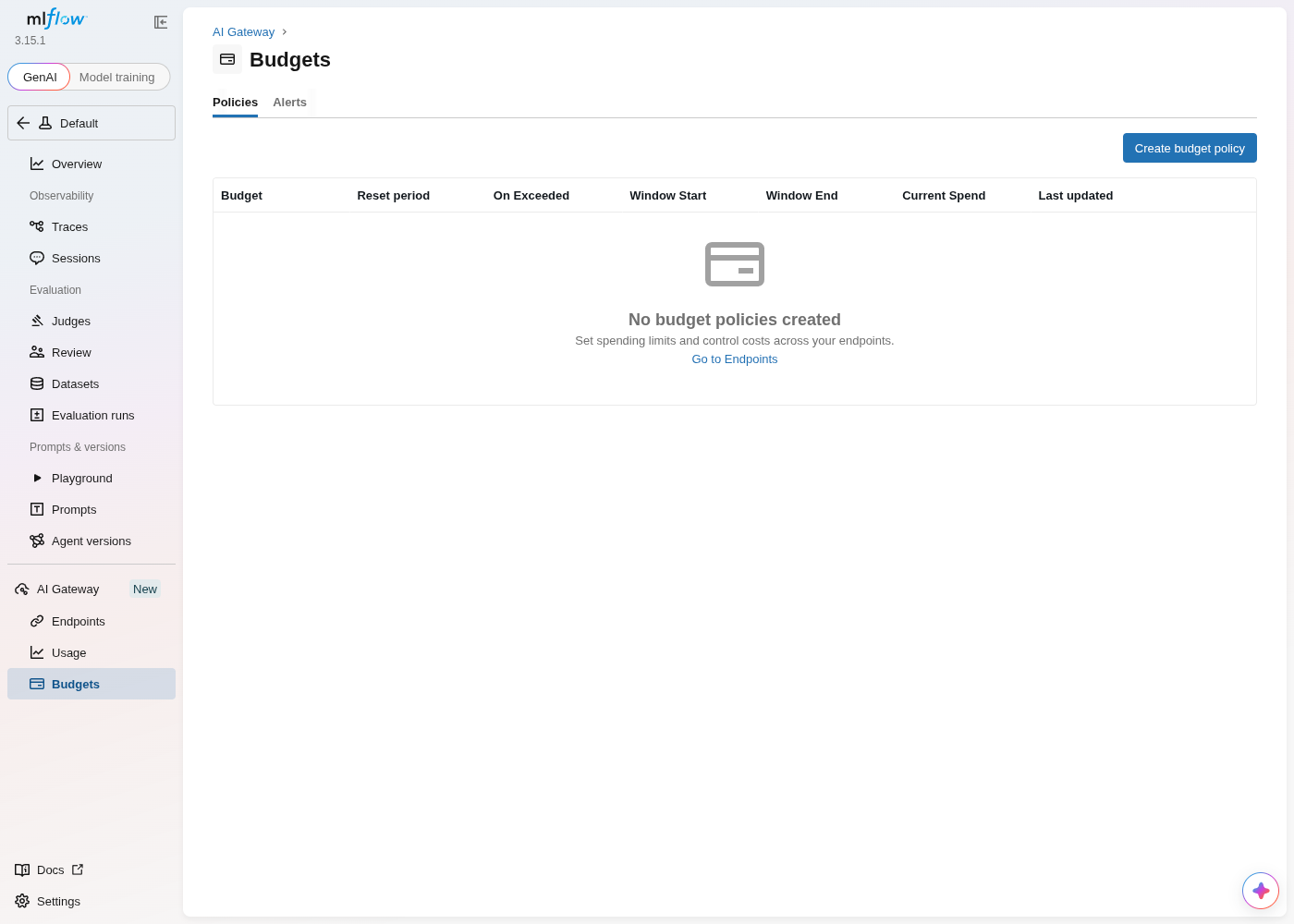
MLflow's Budgets page, under AI Gateway, creates budget policies. No policy existed on this build, and we did not create one, so this section compares what each product documents and configures, not two enforcement runs. MLflow's docs describe two actions (checked on 2 November 2026):
- Alert "fires a webhook notification. Requests continue normally."
- Reject "blocks subsequent requests with HTTP 429." The docs add that "the request that causes the spend to exceed the budget is allowed to complete."
- A budget resets daily, weekly or monthly, and "can be scoped to a specific workspace" when workspaces are enabled.
AcruxCore's cap is scoped to a team or to a single virtual key, over a day, week, month, or the
key's whole lifetime. Before the provider is called, the request reserves its estimated cost
against the cap, and a request that would cross it comes back 402 BUDGET_EXCEEDED instead of
being billed. Owners and admins get an email at 80% of the cap and again when it's used up.
Separately, a virtual key can carry RPM and TPM limits, which return 429 on the same pre-call
path.
Show screenshot: Budgets on MLflow
| Feature | MLflow | AcruxCore |
|---|---|---|
| Cap scope | Global, or one workspace | Per team, or per virtual key |
| Reset period | Daily, weekly or monthly | Day, week, month, or total |
| When the cap is hit | Alert: webhook, requests continue. Reject: later requests get HTTP 429 | 402 BUDGET_EXCEEDED before the provider call |
| Warning before the cap | Not described; an Alert fires once the threshold is exceeded | Email to owners and admins at 80% |
| Request rate limiting | Not described in MLflow's gateway docs | Per-virtual-key RPM and TPM, 429 before the provider call |
Prompt authoring & versioning
MLflow's empty Prompts page opens with "Create your first prompt". Below it, a card offers "Get
help registering a prompt", and an "Or create a prompt manually" button opens a form. We
registered ours with mlflow.genai.register_prompt().
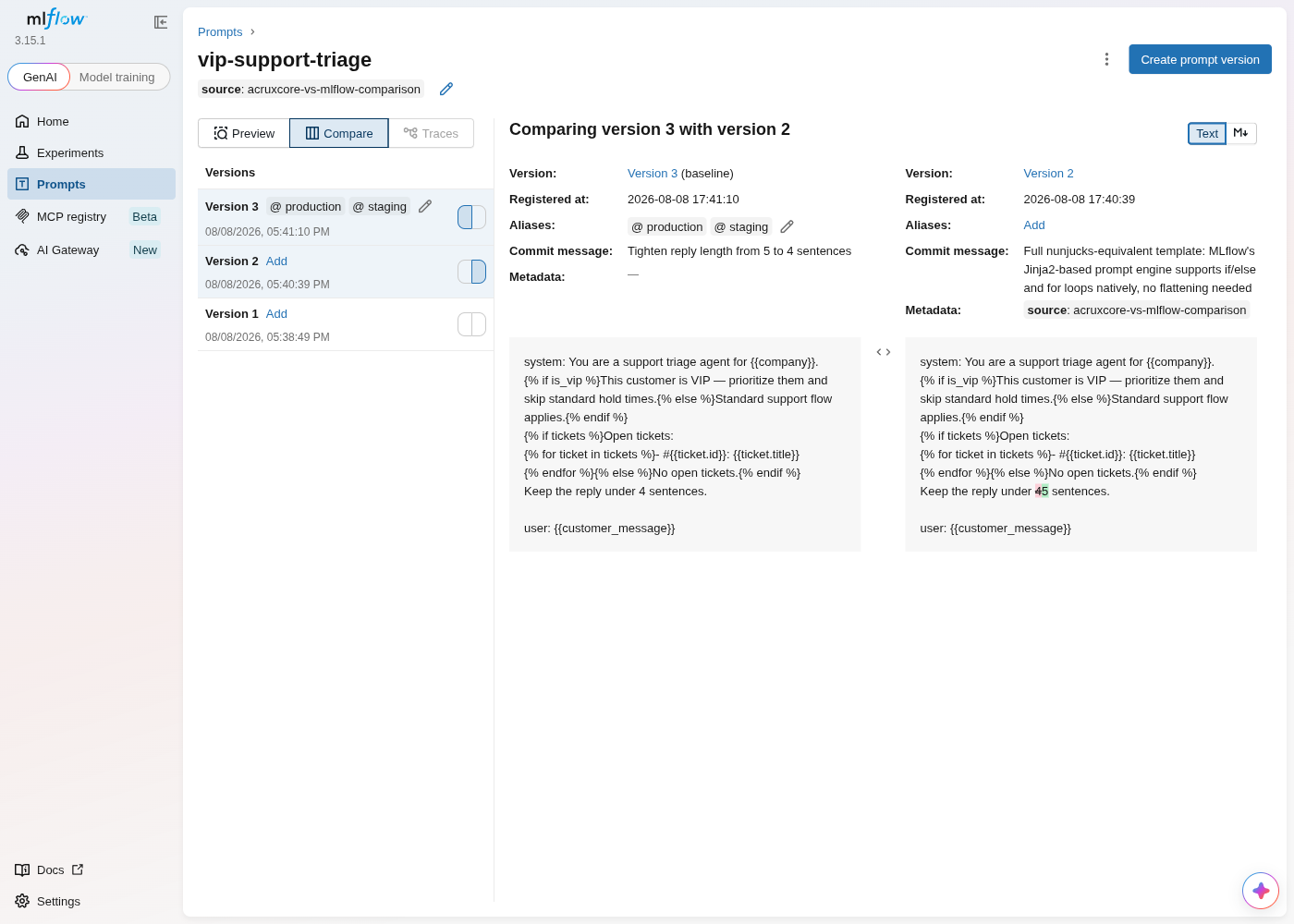
That call accepts full Jinja2, not only flat {{variable}} substitution. We registered the
prompt's {% if is_vip %}...{% else %}...{% endif %} and
{% for ticket in tickets %}...{% endfor %} logic as written, with no flattening.
Show screenshots: prompt version and diff view on MLflow
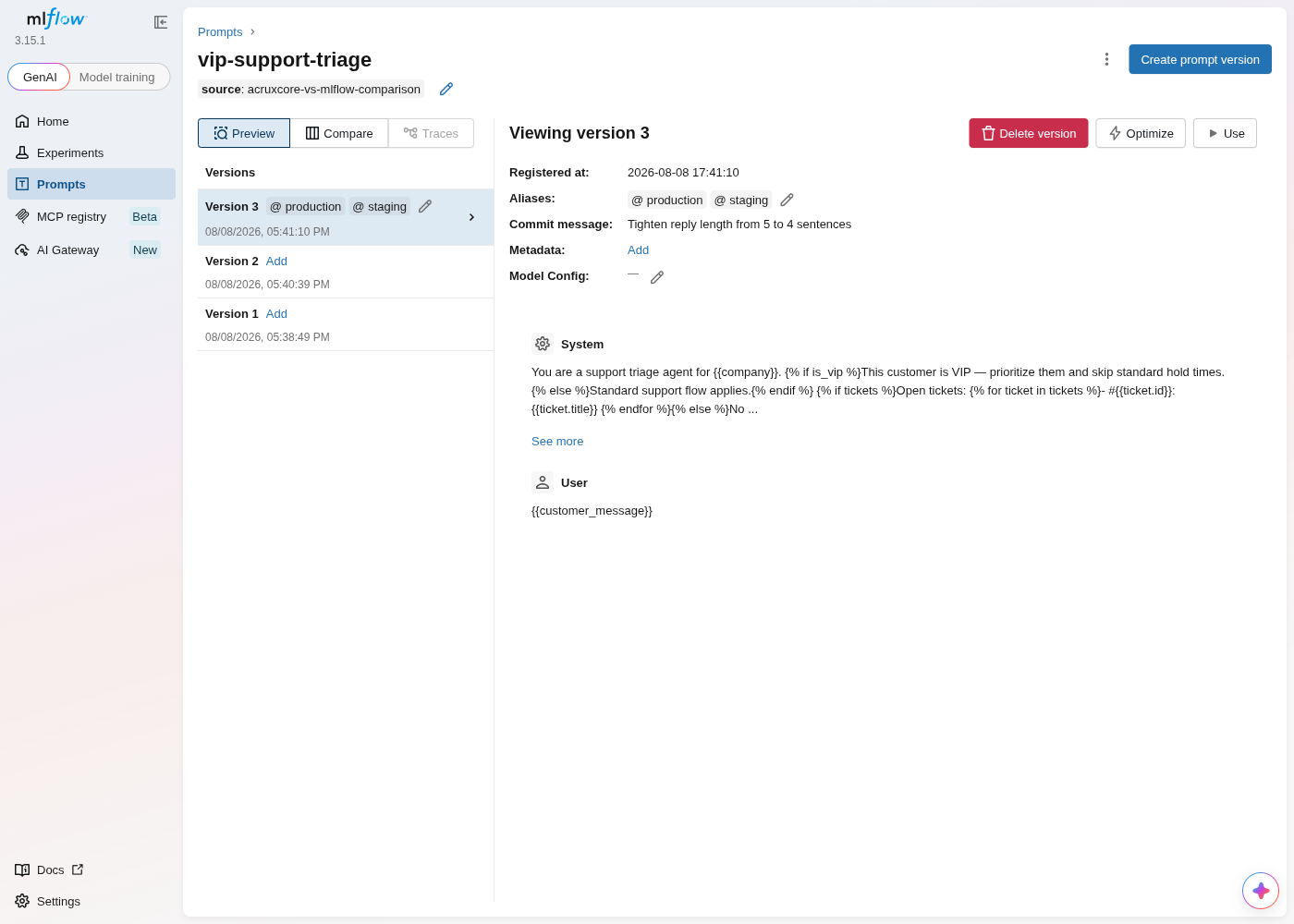
MLflow also has @production / @staging aliases. They do the same job as AcruxCore's
aliases. You set them with set_prompt_alias() or from the version's "Add/edit alias" dialog.
| Feature | MLflow | AcruxCore |
|---|---|---|
| Conditional templating | Full Jinja2, verified hands-on: {% if %}/{% for %} both work | Nunjucks {% if %}/{% for %}, rendered server-side |
| Creating a prompt | UI form or SDK | UI form or SDK |
| Version comparison | Word-level diff | Diff tab, unified word-level diff |
| Live/staging labels | @production/@staging aliases, set in the UI or SDK | production/staging aliases, promoted from the Versions tab |
Sending a live call
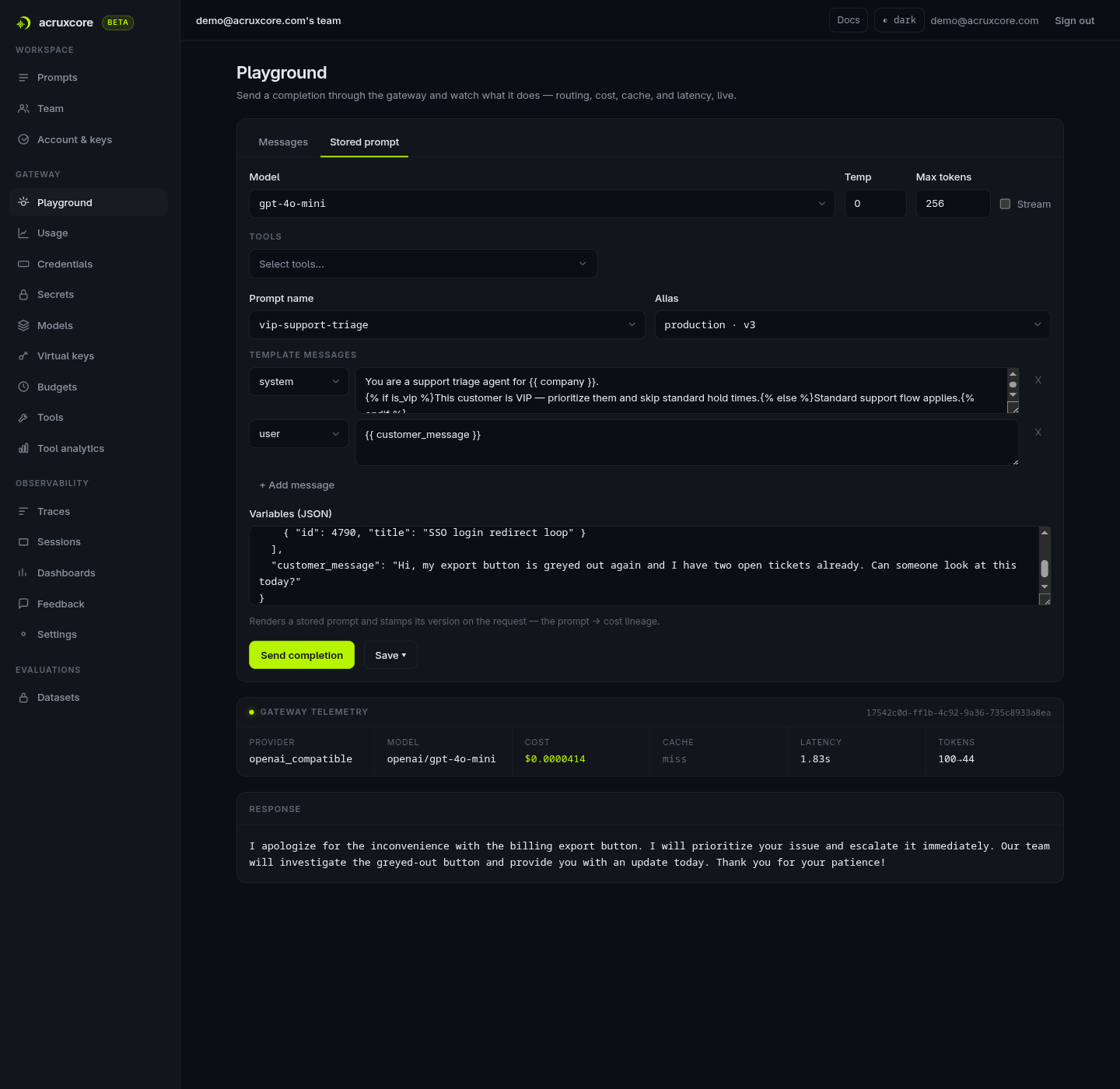
We sent the rendered prompt through the Gateway endpoint's OpenAI-compatible
/gateway/mlflow/v1/chat/completions route. The trace shows tokens, latency, and the full
request and response. Our self-hosted run showed tokens and latency but no cost. MLflow's
docs say cost is recorded per
span from 3.10 when the server has the [genai] extra, and shows $0.00 when the model has no
price entry. We did not re-test with that extra. The aggregate Usage dashboard above does
compute cost.
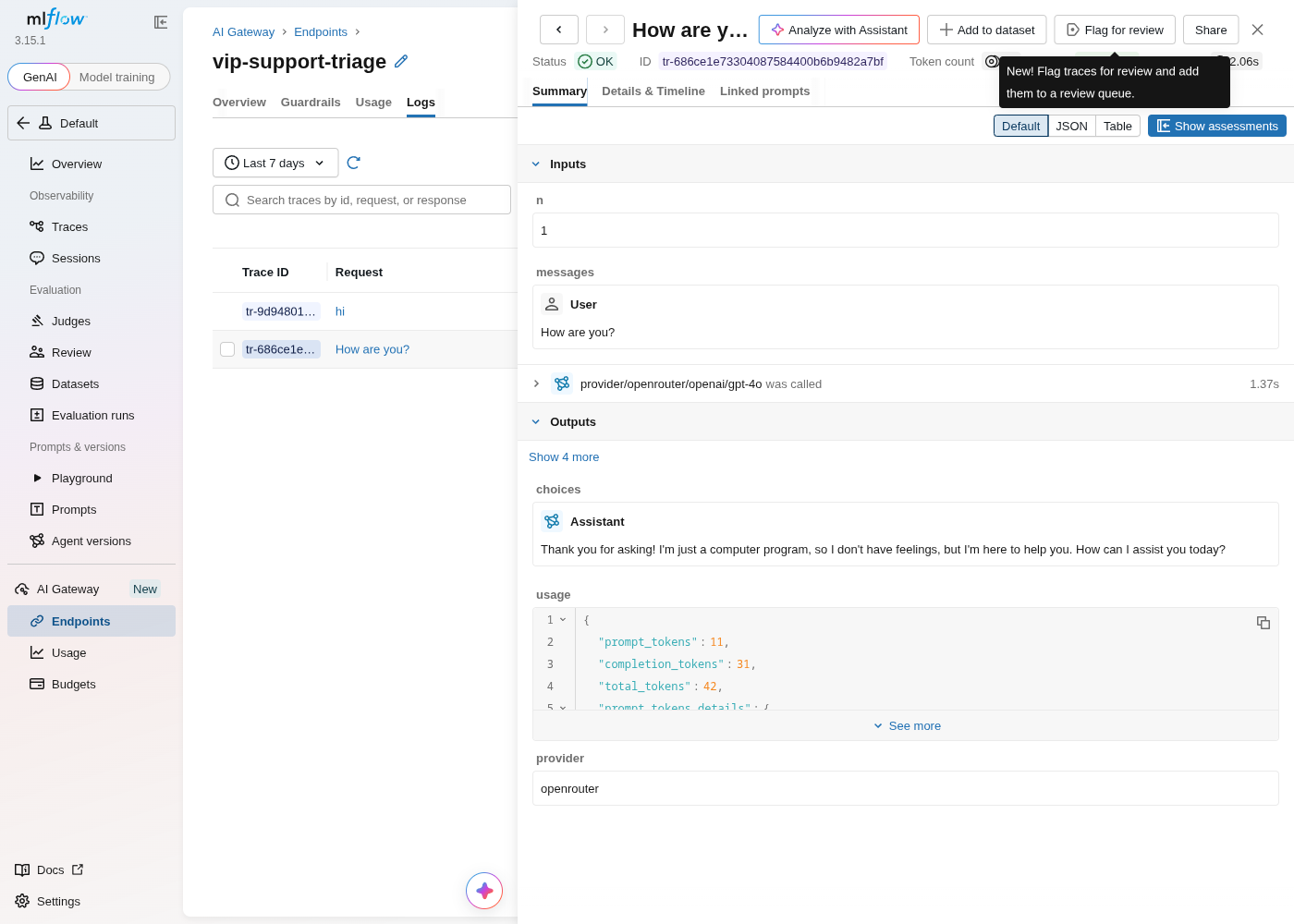
Show screenshots: a live gateway call on both platforms
| Feature | MLflow | AcruxCore |
|---|---|---|
| Per-call telemetry | Partial: tokens + latency inline; cost per span from 3.10 with the [genai] extra, per docs; none on our install | Cost, cache status, and latency all shown inline |
| Requires a provider key | Yes (stored on the endpoint at creation time) | Yes |
Tracing & observability
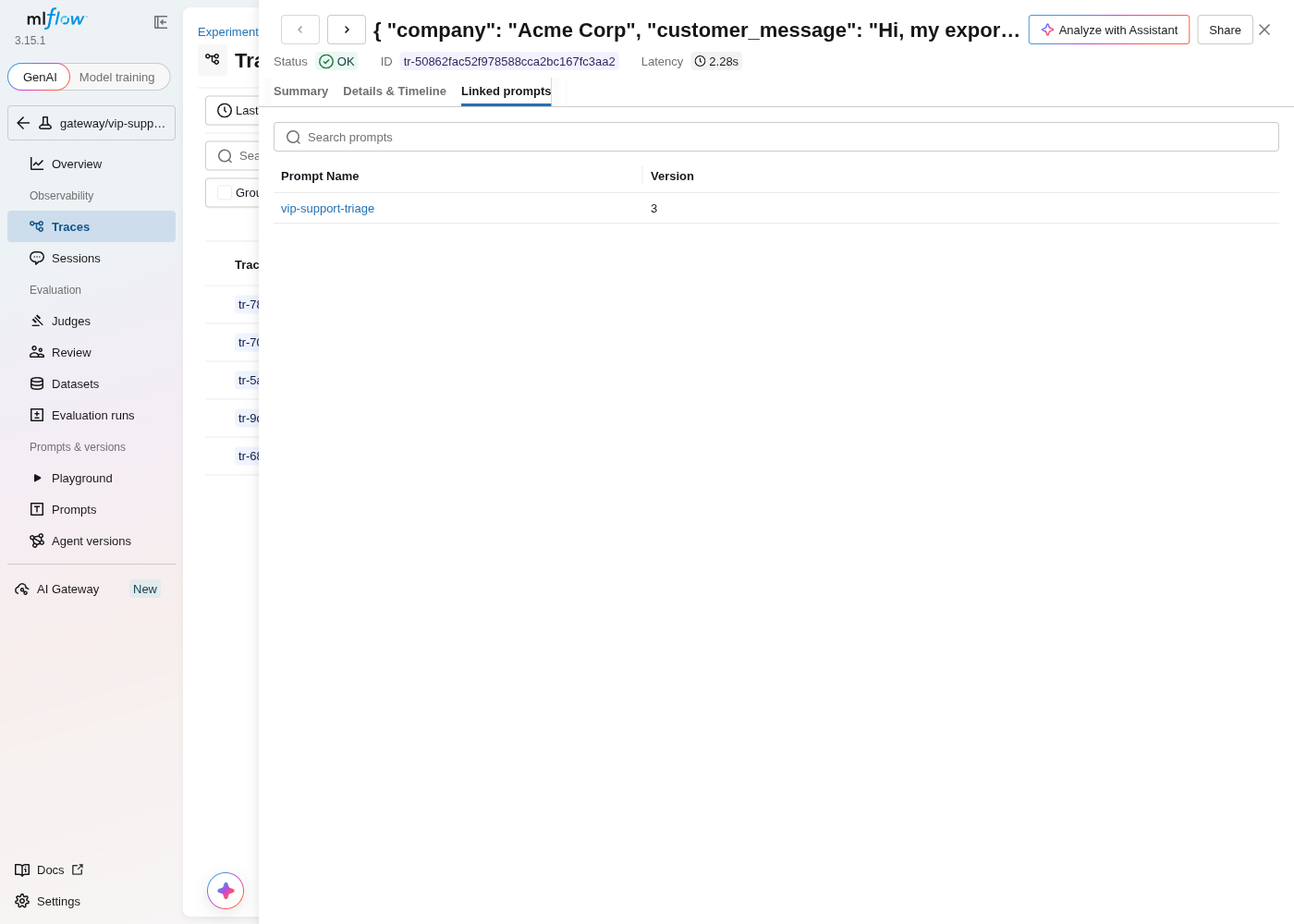
Both gateways trace every call automatically. The difference is the link back to the prompt
version. On MLflow it needs an explicit client.link_prompt_versions_to_trace() call after the
request completes. Our script (mlflow_gateway_run.py) renders the prompt locally, calls the
Gateway, then makes that linking call, and the link shows up under the trace's Linked
prompts tab.
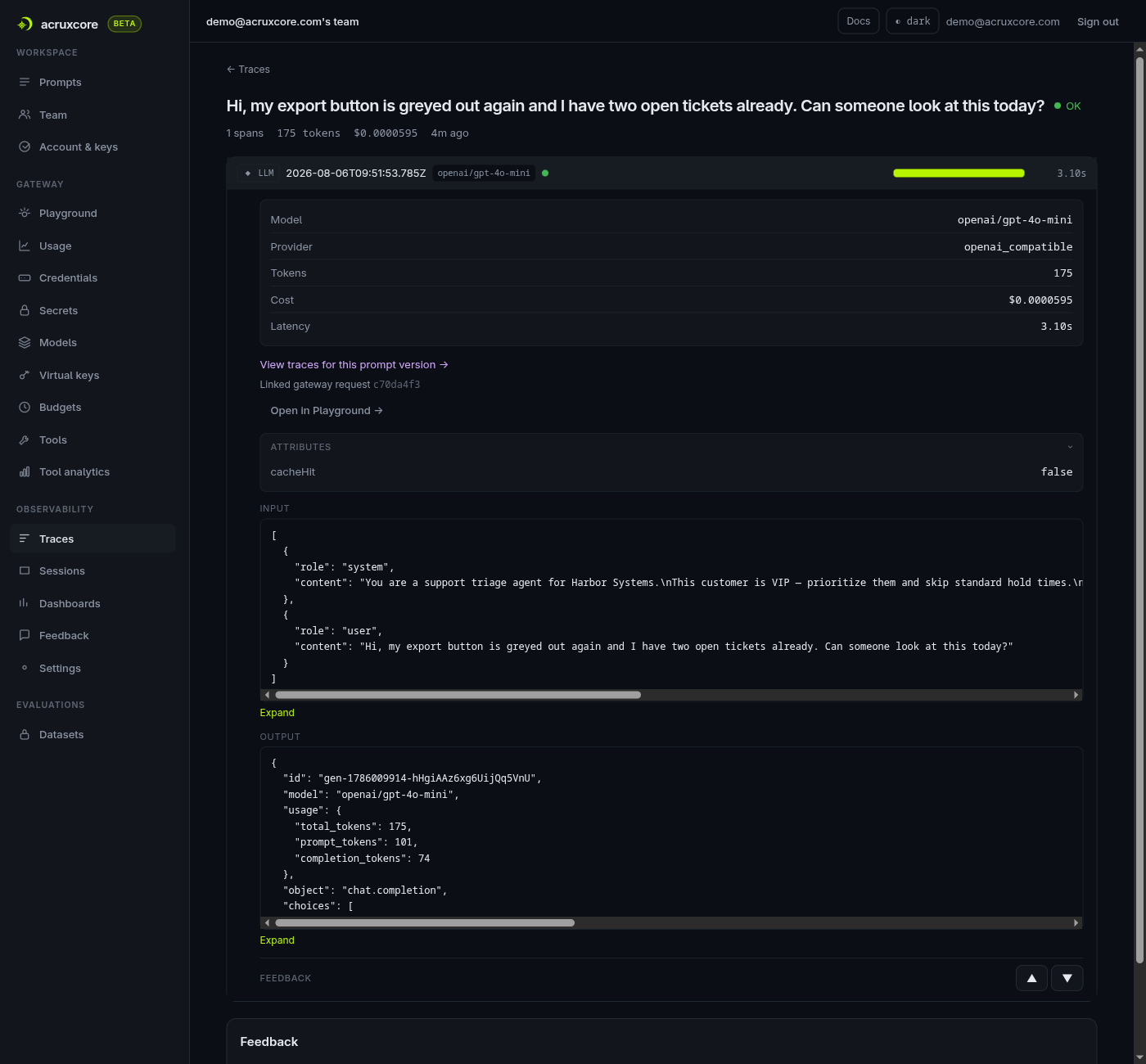
On AcruxCore, the link comes from the gateway call. Our script renders first and passes
prompt_version_id=rendered.version_id, one argument on the same call. A gateway call that
names the stored prompt with a prompt reference renders it on the server and records the
version with no argument at all.
Show screenshots: a trace linked to its prompt version on both platforms
| Feature | MLflow | AcruxCore |
|---|---|---|
| Trace shape | Single span per gateway call | Single span per gateway call |
| How the call is traced | Automatic, as part of the Gateway call | Automatic, as part of the gateway call |
| Prompt-version lineage | A separate link_prompt_versions_to_trace() call | prompt_version_id on the gateway call, or automatic with a prompt reference |
Tools: a registry of MCP servers, or a catalog that runs tools
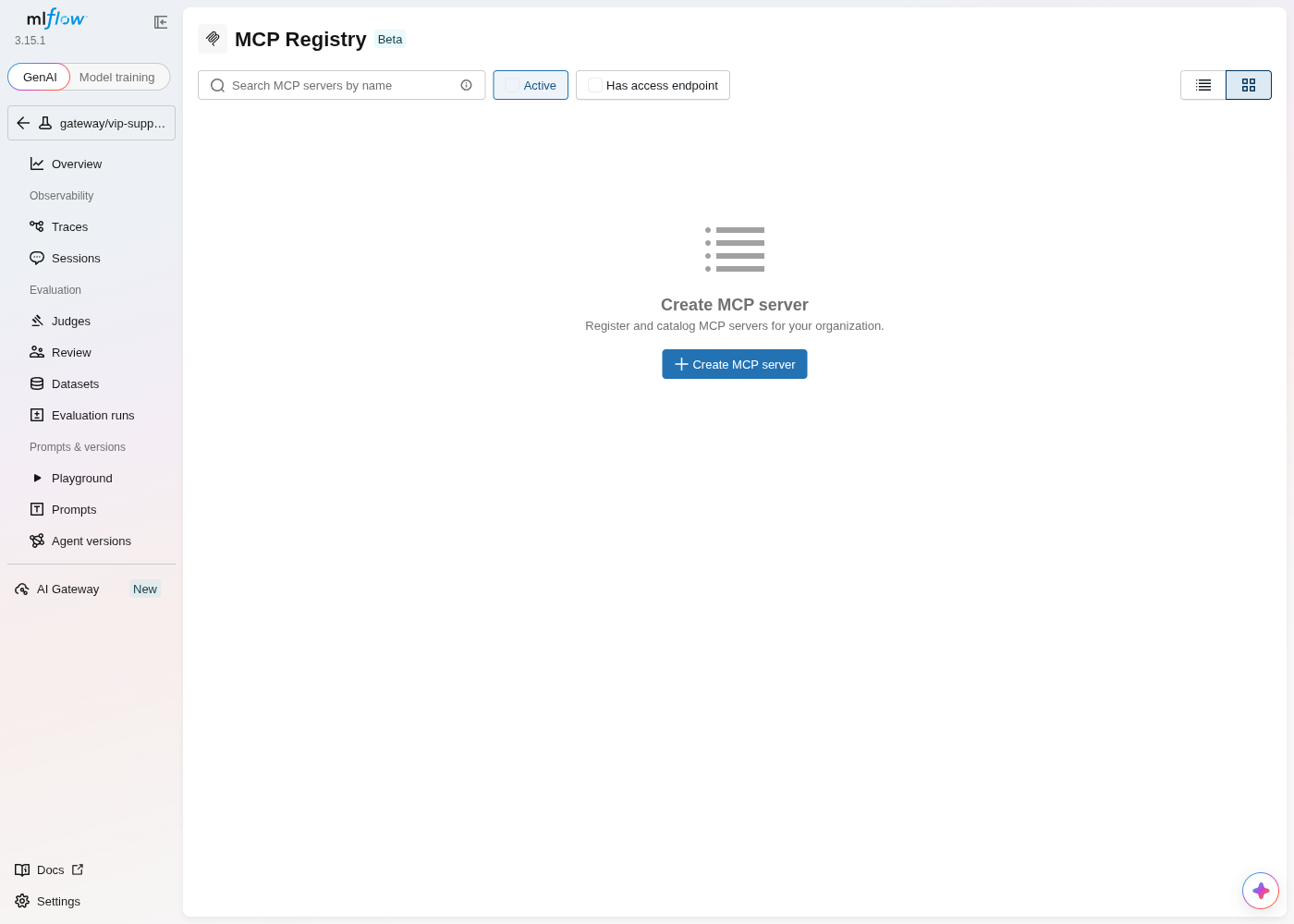
MLflow's answer here is an MCP Registry (Beta). You register an external
Model Context Protocol server by pasting its server.json
manifest: name, source repo, icon, tags. It is a discovery catalog for MCP servers your agents
can connect to, not a catalog of individual tools that it runs.
Show screenshot: MCP Registry on MLflow
The two answer different questions. MLflow's registry answers "which MCP servers exist and are they reachable?" AcruxCore's catalog answers "what did this tool call cost, and how often does it fail?" Nothing in MLflow's MCP Registry executes a tool call or records its latency, and nothing in AcruxCore's catalog discovers external MCP servers.
| Feature | MLflow | AcruxCore |
|---|---|---|
| What's catalogued | External MCP servers, via a server.json manifest | Individual tool schemas, defined and versioned in-platform |
| Execution | None: a discovery registry, not an execution path | Gateway-executed calls |
| Analytics | Not applicable | Calls, error rate, and latency per tool |
Evaluation & datasets
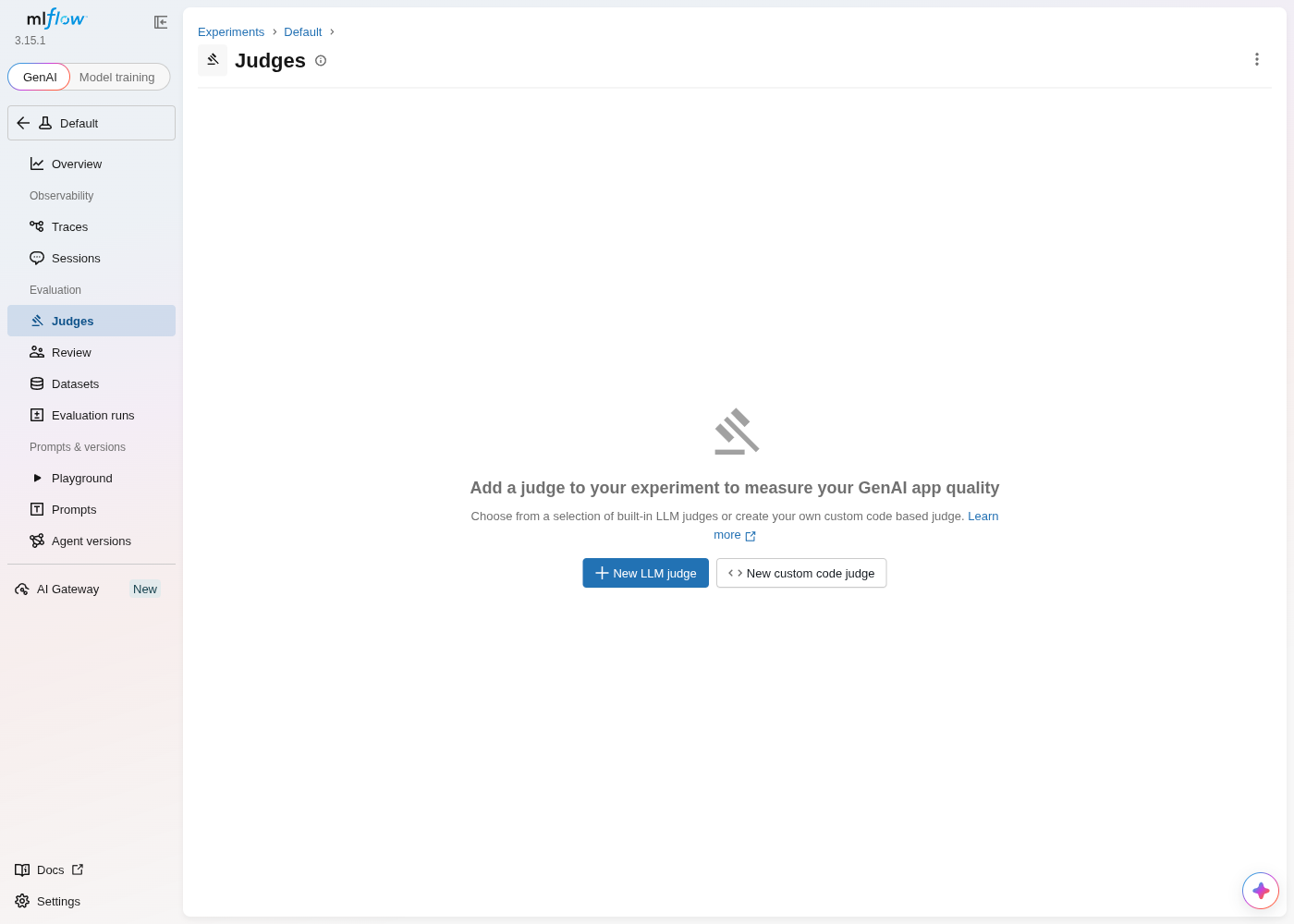
MLflow has built-in LLM-as-judge and custom code judges, with two entry points on an empty state. Datasets can be created from the UI or from any trace with "Add to dataset".
Show screenshots: Judges and a populated evaluation dataset on MLflow
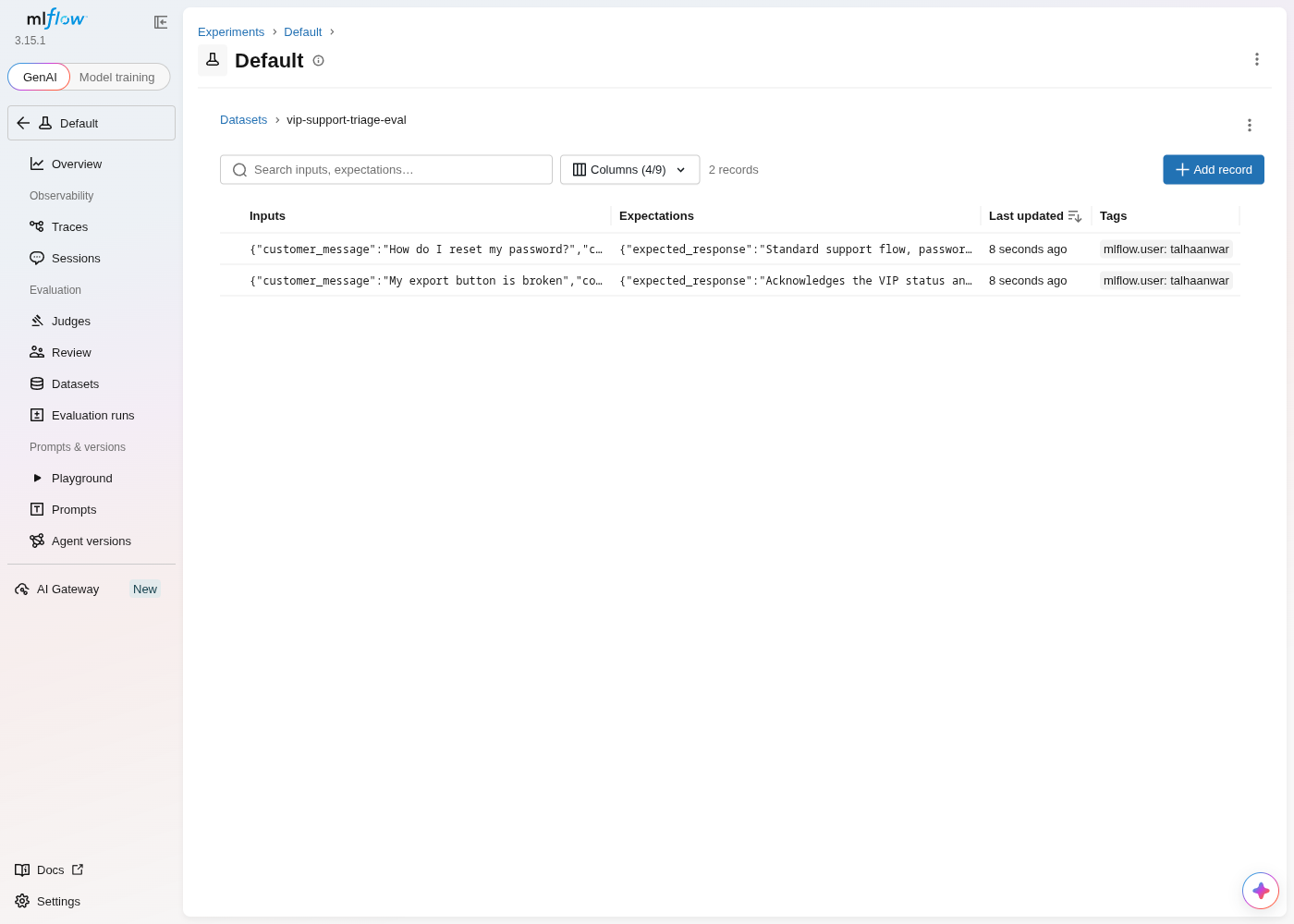
One bug hit hands-on: after we created and named the dataset, the Datasets list page kept
showing its empty "Create an evaluation dataset" state, and reloading didn't fix it. The
dataset existed the whole time. mlflow.genai.datasets.search_datasets() returned it, and its
own detail page rendered when linked directly. The list view never picked it up in this build.
| Feature | MLflow | AcruxCore |
|---|---|---|
| LLM-as-judge | Built-in judges, plus custom code judges | Built-in judge on experiment runs and live traffic, or your own judge prompt; code scorers in the SDK |
| Dataset creation | UI form, or "Add to dataset" from any trace | Span-level trace feedback, manual entry, API, or a CSV/JSON file |
| Datasets list page | Bug on 3.15.1: didn't show a dataset that existed server-side | Not applicable |
SDK & developer experience
MLflow's SDK has a call for each step: load_prompt(), start_span(), and a separate
link_prompt_versions_to_trace(). AcruxCore's script makes two calls, hub.prompts.render()
and hub.gateway.chat(), and the second one also records the trace and its prompt version.
prompt = mlflow.genai.load_prompt("prompts:/vip-support-triage@production")
rendered = prompt.format(**VARIABLES)

with mlflow.start_span(name="vip-support-triage-gateway-call") as span:
    resp = requests.post(f"{TRACKING_URI}/gateway/mlflow/v1/chat/completions",
                          json={"model": "vip-support-triage", "messages": rendered})
    trace_id = span.trace_id

mlflow.MlflowClient().link_prompt_versions_to_trace(
    trace_id=trace_id, prompt_versions=[prompt]
)
rendered = await hub.prompts.render("vip-support-triage", "production", VARIABLES)
result = await hub.gateway.chat(
    rendered.model, rendered.messages,
    temperature=0, max_tokens=256,
    prompt_version_id=rendered.version_id,
)
Output from each script. The two ran on different models (see How we tested), so compare the fields, not the replies.
Show output: mlflow_gateway_run.py and acx_sdk_run.py
{
  "content": "I apologize for the inconvenience. I'll prioritize your request and have our support team review your open ticket #4821 regarding the billing export button...",
  "model": "openai/gpt-4o",
  "prompt_tokens": 95,
  "completion_tokens": 45,
  "elapsed_s": 2.232,
  "trace_id": "tr-50862fac52f978588cca2bc167fc3aa2"
}
{
  "content": "I apologize for the inconvenience with the billing export button. I will escalate this issue immediately...",
  "model": "openai/gpt-4o-mini",
  "prompt_tokens": 100,
  "completion_tokens": 51,
  "cost_usd": 0.0000456,
  "trace_id": "a5a2324c-4c48-4e40-8bfb-2b8379772d67"
}
mlflow_gateway_run.py— the MLflow run.acx_sdk_run.py— the AcruxCore run.
| Feature | MLflow | AcruxCore |
|---|---|---|
| SDK model | Separate render / call / link-to-trace calls | Render, then gateway-chat with the version id (traces automatically) |
| Cost in the return value | No: not in the gateway's response body | Yes: cost_usd on every gateway response |
Latency overhead — measured
Because both gateways sit in the request path, their hop can be timed the same way. The
benchmark sent one fixed call ("Reply with the single word: pong." on gpt-4o-mini) directly
to api.openai.com, through MLflow's AI Gateway endpoint, and through AcruxCore's gateway. Both
gateways ran locally (see How we tested) and forwarded to a native OpenAI provider. Each run
has 100 interleaved rounds, and we ran it three times.
| Run | Direct-call median | MLflow gap | AcruxCore gap |
|---|---|---|---|
| 1 | 611 ms | +225 ms, CI [+112, +275] | +21 ms, CI [+5, +35] |
| 2 | 611 ms | +157 ms, CI [+73, +250] | +43 ms, CI [+22, +58] |
| 3 | 613 ms | +135 ms, CI [+63, +255] | +36 ms, CI [+23, +55] |
- MLflow's gap was +135 to +225 ms, and no interval crossed zero.
- AcruxCore's gap was +21 to +43 ms, and no interval crossed zero.
- We did not record how many workers the MLflow server ran, so these figures describe MLflow as we ran it, not a tuned deployment.
Our other benchmarks do not agree with this run, so treat the MLflow figure as unsettled. Our August full-cycle benchmark loaded the stored prompt and sent it as one merged message. In the latest of its four runs, MLflow's gateway measured −81 ms against a direct call, with an interval of −155 to +34 ms. For AcruxCore, our newest measurement of a local gateway on its own, on 25 October 2026, found +9 ms with an interval of −15 to +28 ms (method).
latency_bench.py — the latency benchmark.
Friction hit during this run
MLflow
- 👍 No login wall on self-host: straight into a working instance.
- 👍 Full Jinja2 templates, with no flattening.
- 👍 A Gateway endpoint with a working curl snippet on its overview page.
- 👎 The OpenRouter model picker doesn't include
gpt-4o-mini, even though OpenRouter's own live catalog serves it. The picker is a curated static list, not a mirror of the provider's catalog. - 👎 The Datasets list page didn't show a dataset that existed server-side.
- 👎 Linking a trace to its prompt version needs a separate SDK call that is easy to forget.
AcruxCore
- 👍 The trace and its prompt-version link come from the gateway call itself.
- 👍 Cost is on every gateway response, not only in an aggregate dashboard.
- 👎 No content guardrails to turn on for an endpoint.
What MLflow does that AcruxCore doesn't
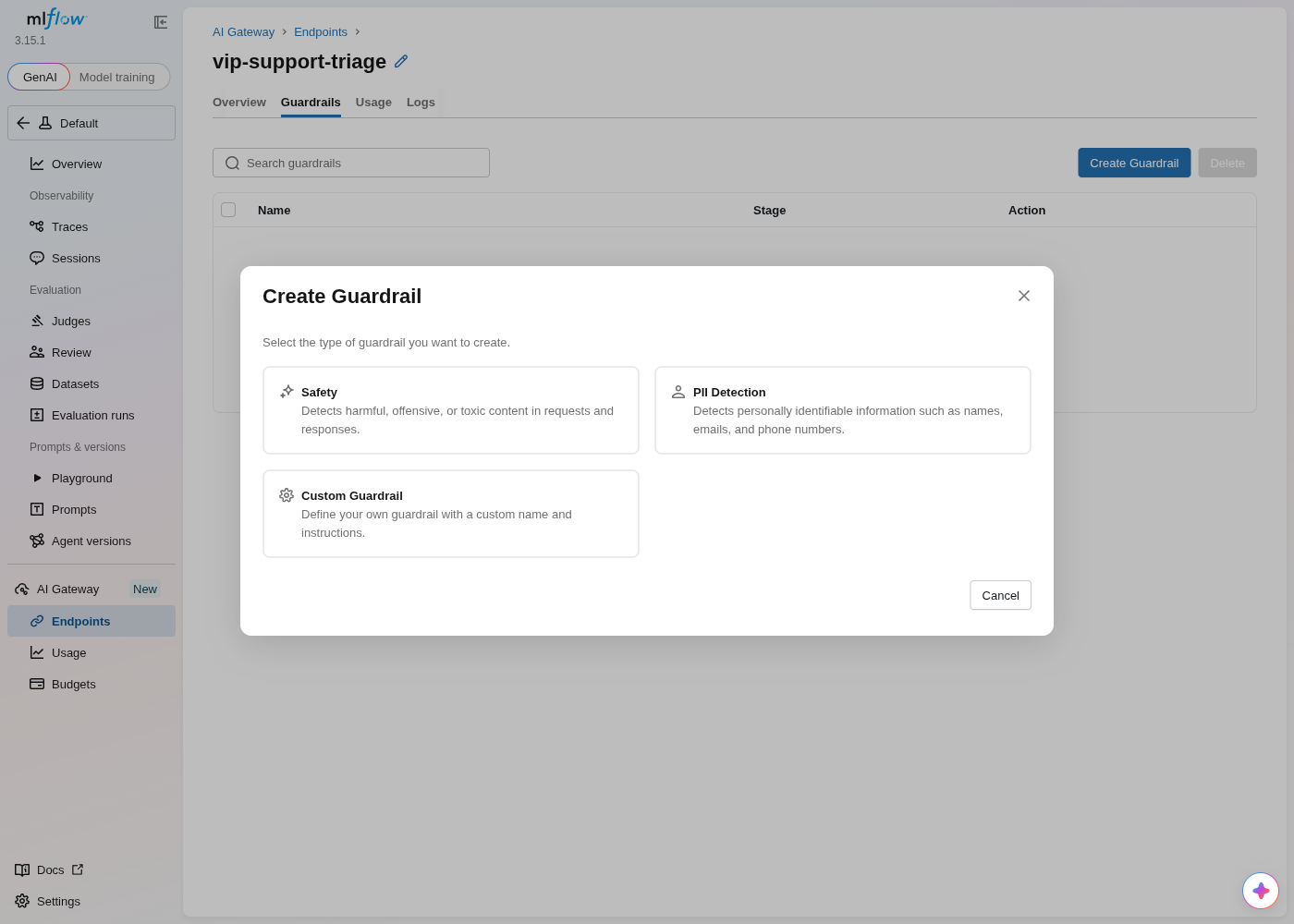
Guardrails: Safety and PII detection, built into every Gateway endpoint. Each endpoint has its own Guardrails tab, and creating one offers three types. A Safety guardrail "detects harmful, offensive, or toxic content". A PII Detection guardrail "detects personally identifiable information such as names, emails, and phone numbers". A custom guardrail takes your own instructions. MLflow's docs say a guardrail runs either before the request reaches the model or after the response, and that post-LLM guardrails are not applied to streaming requests (checked on 2 November 2026). AcruxCore has no equivalent: nothing checks a call's input or output for unsafe content or personal data.
Show screenshot: guardrail types on MLflow
An MCP Registry, and a built-in AI assistant. MLflow's MCP Registry (covered in Tools above) has no AcruxCore equivalent. Every page also has a docked "MLflow Assistant" chat panel that answers questions about your own experiments, traces and evaluations. The experiment overview has a one-click "Detect Issues" button that uses AI to flag latency and correctness problems across recent traces.
AcruxCore has none of these four: no guardrails, no catalog of external MCP servers, no in-product AI assistant, and no automated issue detection.
Is AcruxCore an MLflow alternative?
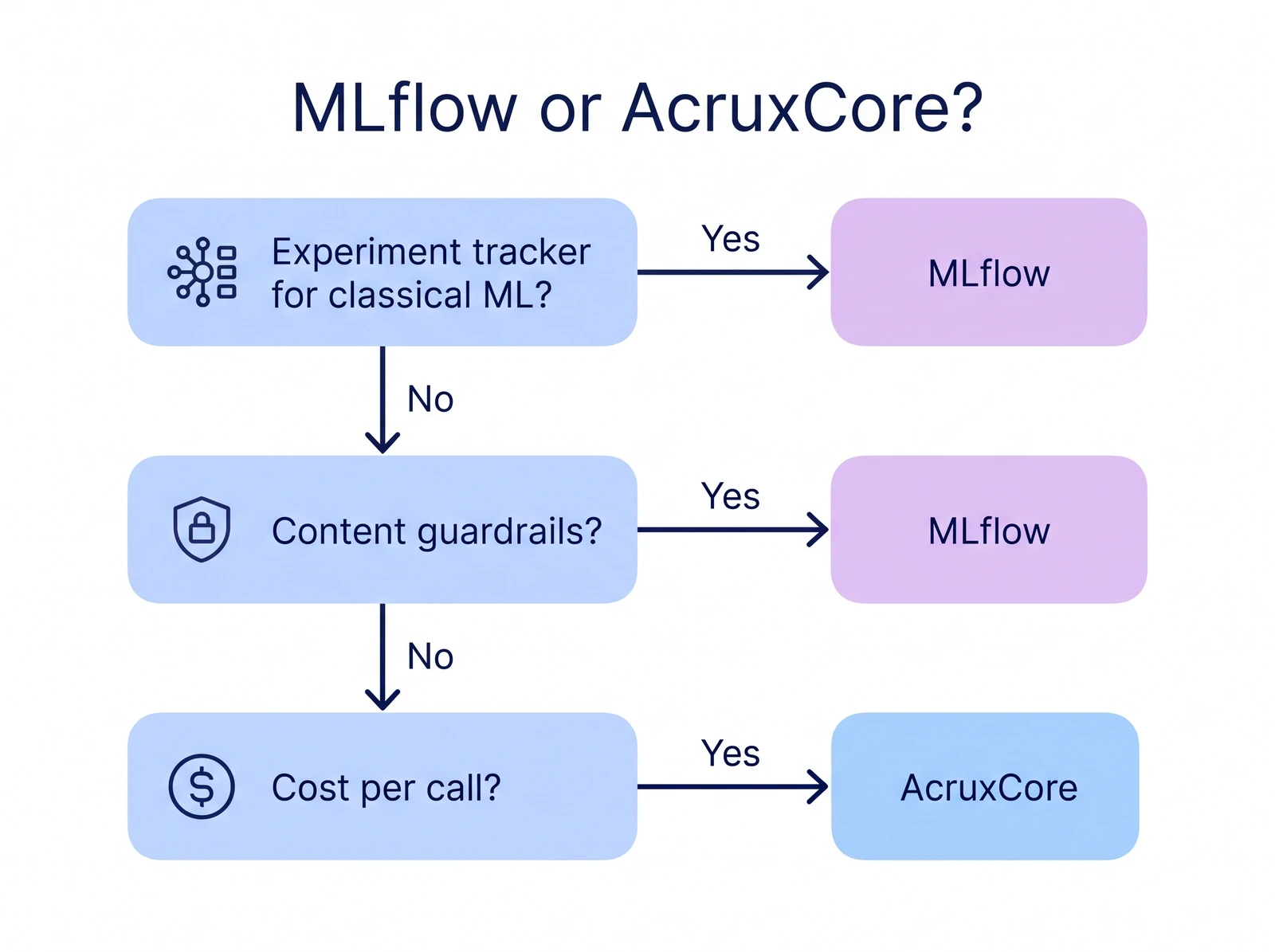
Partly. MLflow is also an experiment tracker for classical ML. If you already run MLflow for that, nothing here suggests removing it.
As an LLM gateway, MLflow has the same design as ours, and the differences sit around the call. MLflow has Safety, PII and custom guardrails on every endpoint, and budget policies that alert or reject later requests. AcruxCore has spend caps checked before the call and per-key rate limits, but no content guardrail. AcruxCore returns cost in each gateway response and links the trace to its prompt version on the same call, where MLflow's response body carries only tokens and lineage needs a second call.
To choose, start at the top and stop at the first question you answer yes to.
| MLflow | AcruxCore | |
|---|---|---|
| Strongest at | Guardrails and PII detection, full Jinja2 prompt logic, a request-path gateway, LLM-as-judge evaluation, classical-ML tracking | Cost shown on every call, prompt-version lineage on the gateway call, a tool catalog that executes and measures calls |
| Weakest at | Prompt-version linking needs a separate call, a dataset-list UI bug hit hands-on | No guardrails, no registry of external MCP servers |
Key point: Pick by what you need around the call. MLflow adds content guardrails to its gateway and keeps prompts next to your ML experiments. AcruxCore adds cost per call, lineage on the same call, and tools that its gateway runs.
FAQ
Does MLflow have an AI gateway?
Yes. MLflow's AI Gateway gives each named endpoint an OpenAI-compatible URL, and every call through it is usage-tracked and traced. In our self-hosted run it was served by the tracking server process.
Does MLflow have guardrails?
Yes. Each gateway endpoint can have a Safety guardrail, a PII Detection guardrail or a custom guardrail. A guardrail runs before the request reaches the model or after the response, and post-LLM guardrails are not applied to streaming requests.
Can MLflow cap spending on its gateway?
MLflow's docs describe budget policies with two actions. Alert fires a webhook and requests continue. Reject blocks later requests with HTTP 429. We did not test either.
Does the MLflow Prompt Registry support Jinja2?
Yes. We registered a prompt with {% if %} and {% for %} blocks as written. We created ours
with mlflow.genai.register_prompt().
Does MLflow link traces to prompt versions?
Yes, with a separate link_prompt_versions_to_trace() call after the request. The link then
appears on the trace's Linked prompts tab.
Other head-to-heads: AcruxCore vs Opik and AcruxCore vs Arize Phoenix. Gateways you run with your own keys are ranked in 13 OpenRouter alternatives. MLflow is also covered in 9 Braintrust alternatives and 10 LLM observability tools tested hands-on.