LLM-ops platform
View all authors

AcruxCore vs Agenta: built-in evaluators vs a gateway

· 20 min read
LLM-ops platform

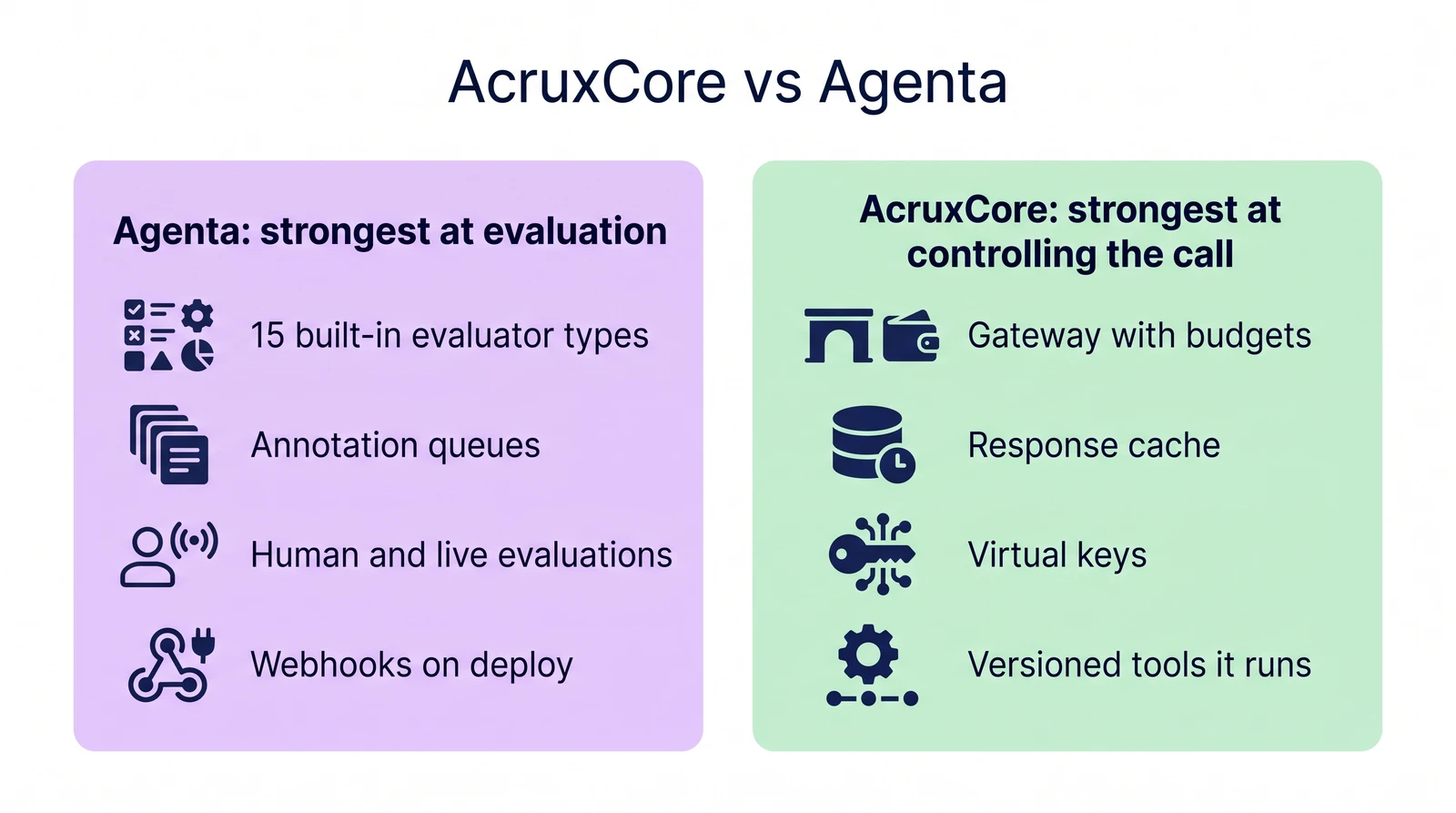
AcruxCore vs Agenta. Agenta is strongest at evaluation: 15 built-in evaluator types, annotation queues, human and live evaluations, and webhooks on deploy. AcruxCore is strongest at controlling the call: a gateway with budgets, a response cache, virtual keys, and versioned tools it runs.

Agenta is an open-source platform from Agentatech UG. Its README describes a workspace where you build agents by chatting with them. You then talk to those agents in Slack, Telegram or WhatsApp. Behind the agent pages, Agenta also ships a prompt registry, a playground, evaluation, annotation queues and tracing. Agenta documents those parts in its v1.0 docs, which it marks as no longer actively maintained. Those parts still ship in version 0.122.7, the version we ran. This post compares those parts with AcruxCore, because those are the parts the two products share.

We ran Agenta 0.122.7 on one machine with its own Docker Compose file. The prompt, the customer message and the model were the same on both sides. Each section below shows what we saw on Agenta, then what AcruxCore does with the same prompt.

Self-hosting LLM observability: seven open-source tools measured

· 17 min read
LLM-ops platform

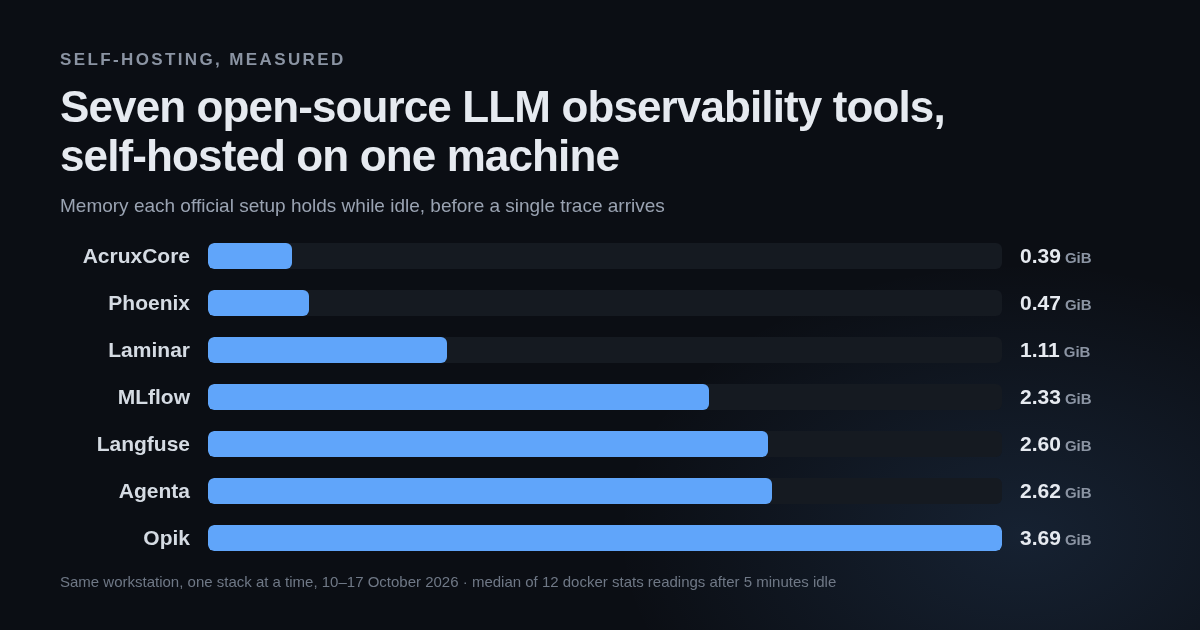
Bar chart of idle memory for seven self-hosted LLM observability stacks: AcruxCore 0.39 GiB, Phoenix 0.47, Laminar 1.11, MLflow 2.33, Langfuse 2.60, Agenta 2.62, Opik 3.69

Open-source LLM observability tools describe self-hosting the same way. You clone the repo, run one docker compose up, and open the dashboard. Most self-host pages say nothing after that step.

The compose file behind that command fixes several things the self-host page does not list. The file sets how many containers you run and which databases come with them. Those containers set how much memory the server needs before the first trace arrives. The file's volume mounts decide whether your data survives a restart.

We ran the official self-host setup of seven tools in October 2026: Langfuse, Opik, Phoenix, MLflow, Laminar, Agenta and AcruxCore. Each ran alone on the same machine. Each received the same 1,000 traces.

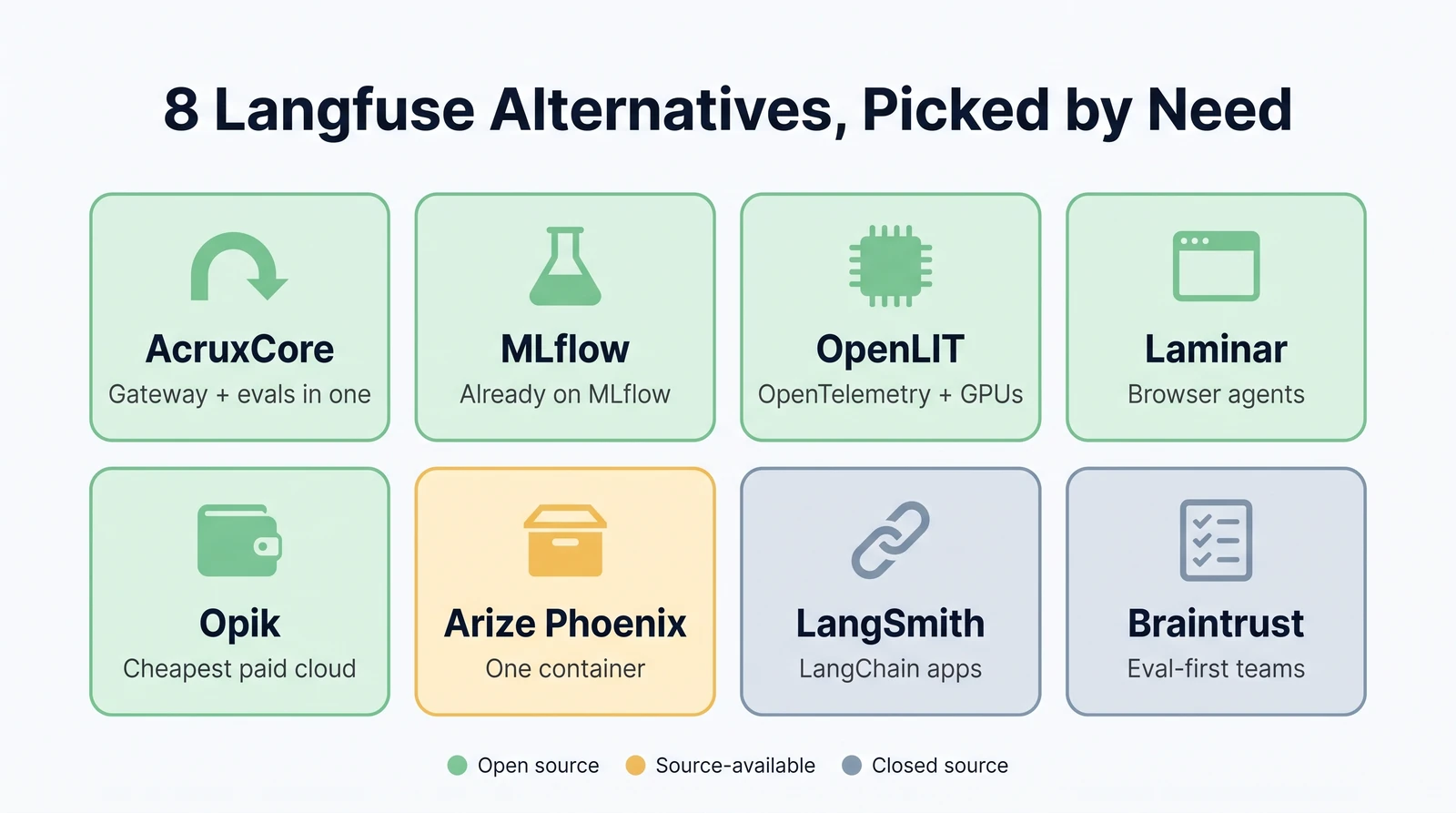
AcruxCore vs Langfuse vs LangSmith: one app tested end to end on all three

· 17 min read
LLM-ops platform

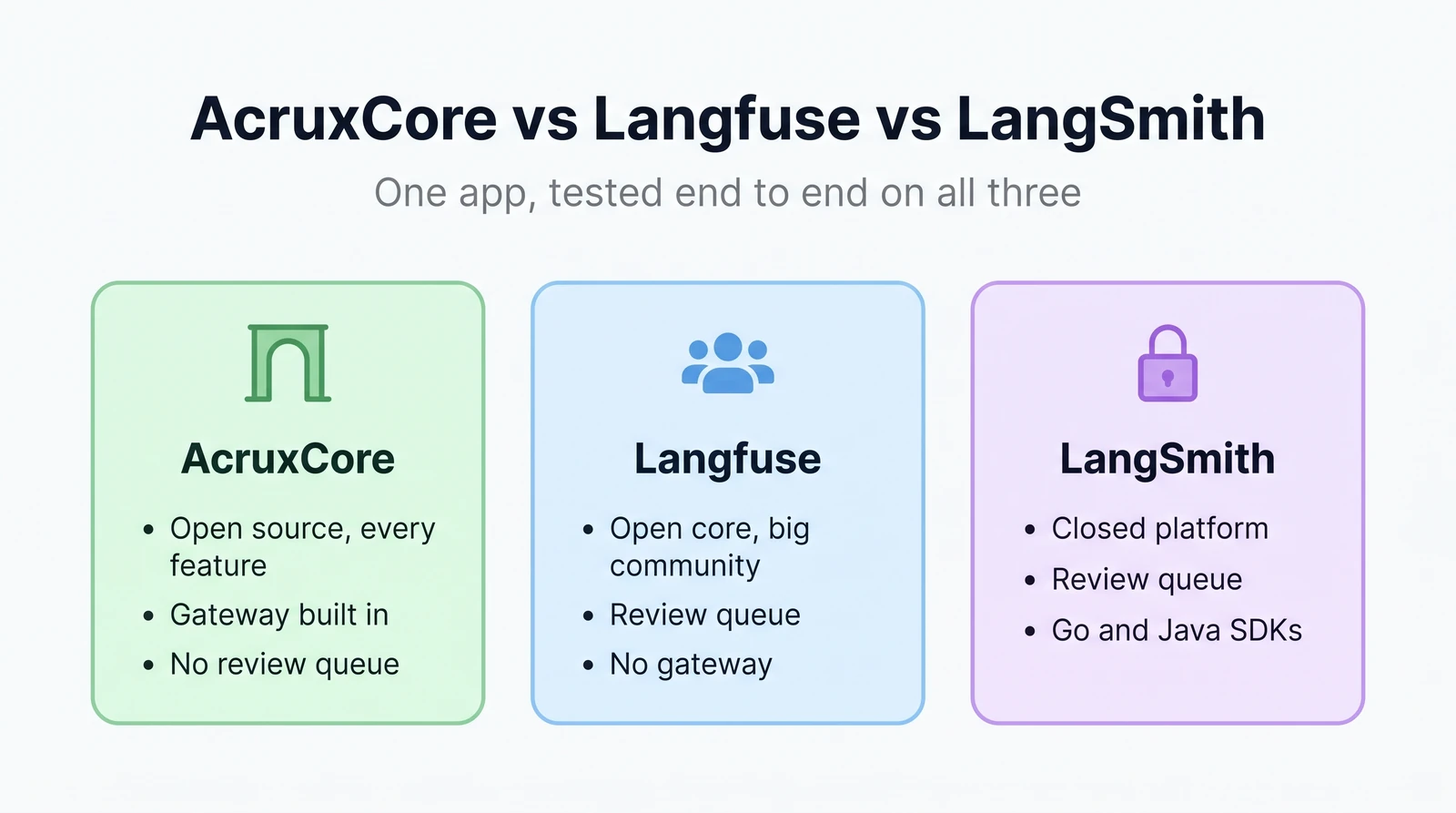
AcruxCore vs Langfuse vs LangSmith, one app tested on all three. AcruxCore: open source with every feature, gateway built in, no review queue. Langfuse: open core with a big community, review queue, no gateway. LangSmith: closed platform, review queue, Go and Java SDKs

This post compares AcruxCore, Langfuse and LangSmith on the things a developer checks before choosing one. We also ran one app on all three platforms, with the same code, data, prompts and model, and measured each step. The app is a small agent that reads a client's email, checks each request against a signed project scope, prices the extra work, and writes a reply.

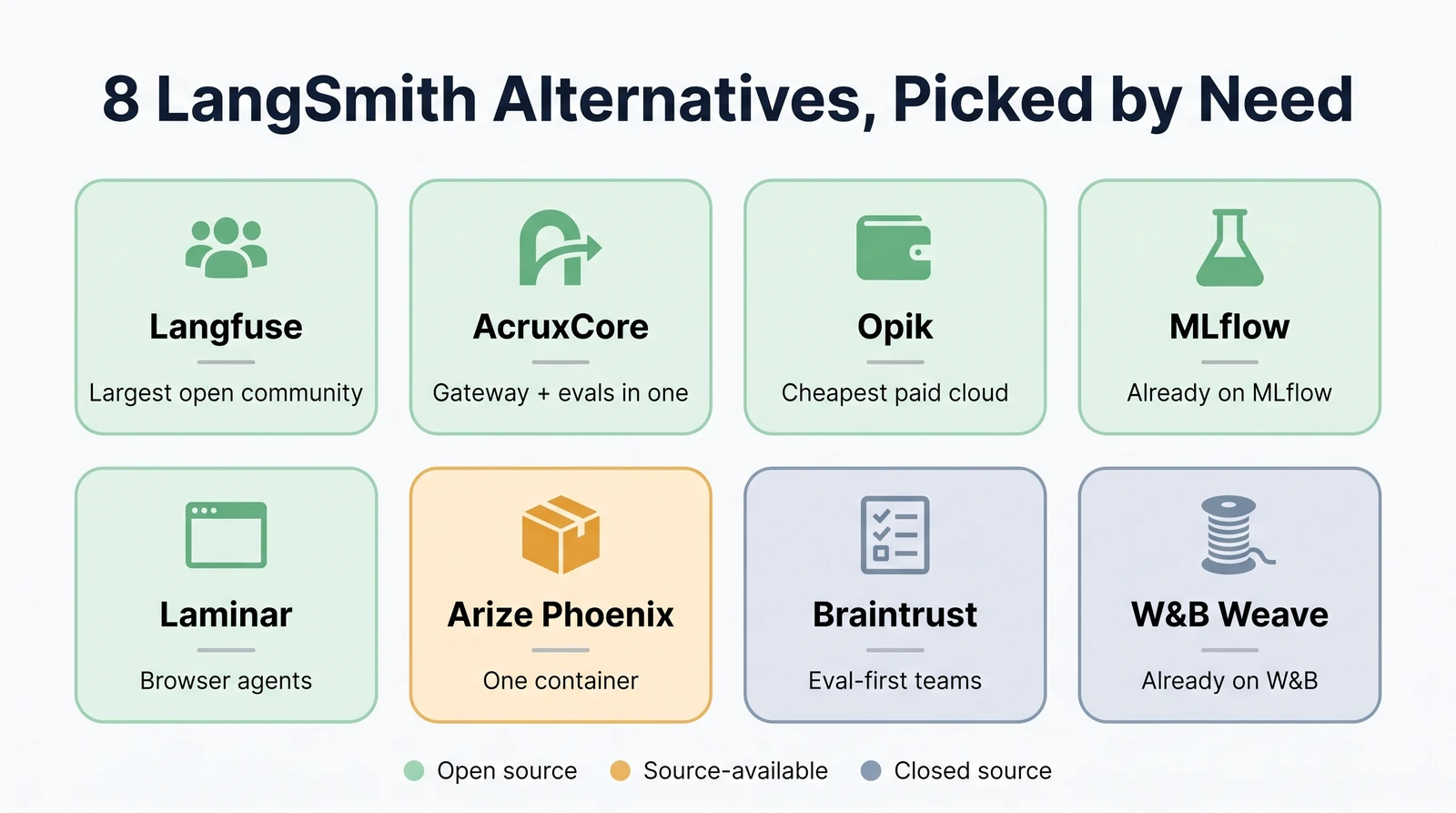
Langfuse vs LangSmith: one app tested end to end on both

· 17 min read
LLM-ops platform

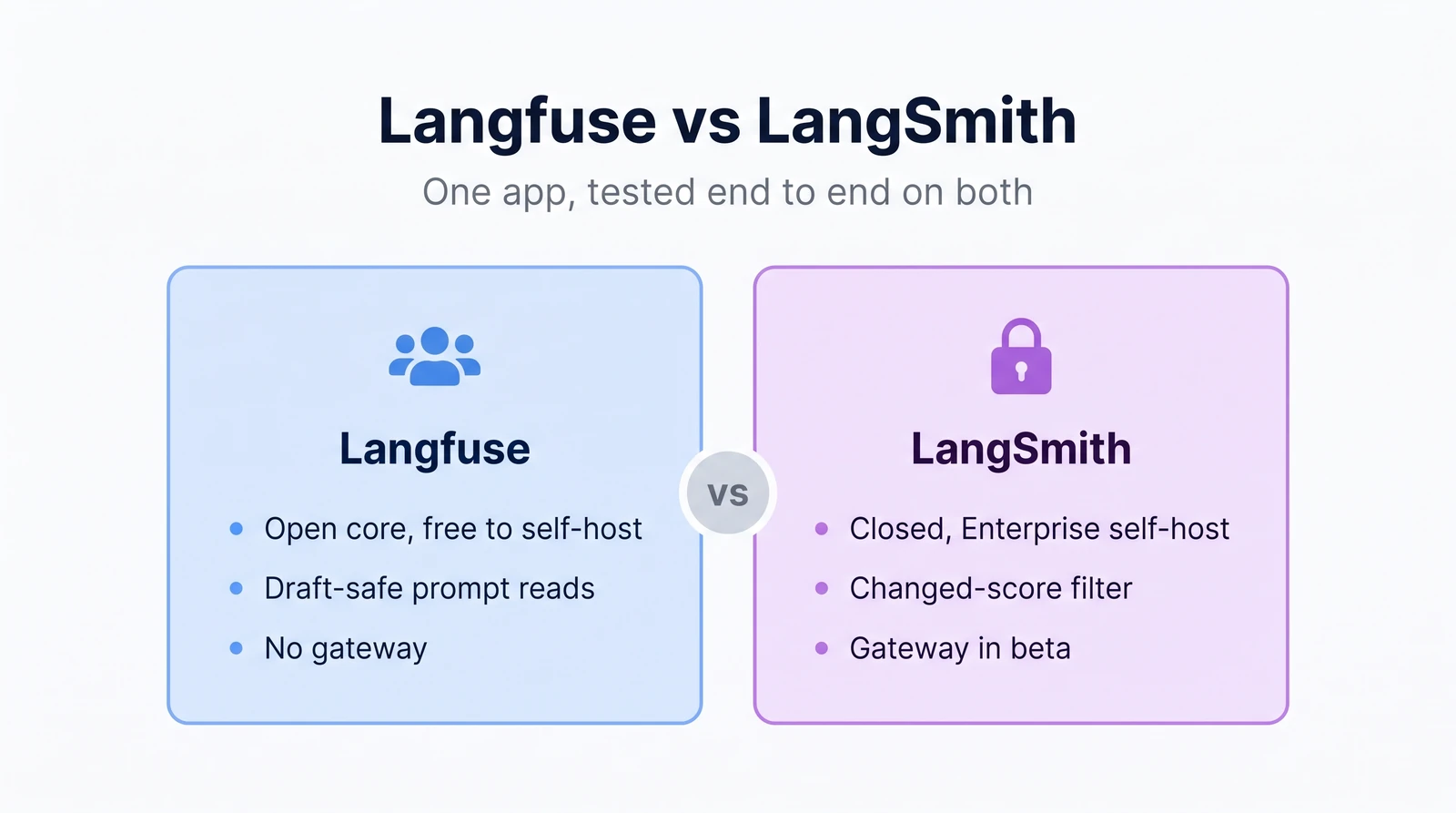
Langfuse vs LangSmith, one app tested on both. Langfuse: open core and free to self-host, draft-safe prompt reads, no gateway. LangSmith: closed with Enterprise-only self-hosting, a changed-score filter, a gateway in beta

This post compares Langfuse and LangSmith on the things a developer checks before choosing one. We also ran one app on both hosted platforms, with the same code, data, prompts and model, and measured each step. The app is a small agent that reads a client's email, checks each request against a signed project scope, prices the extra work, and writes a reply.

AcruxCore vs Braintrust: what changes when the platform runs your tool code

· 26 min read
LLM-ops platform

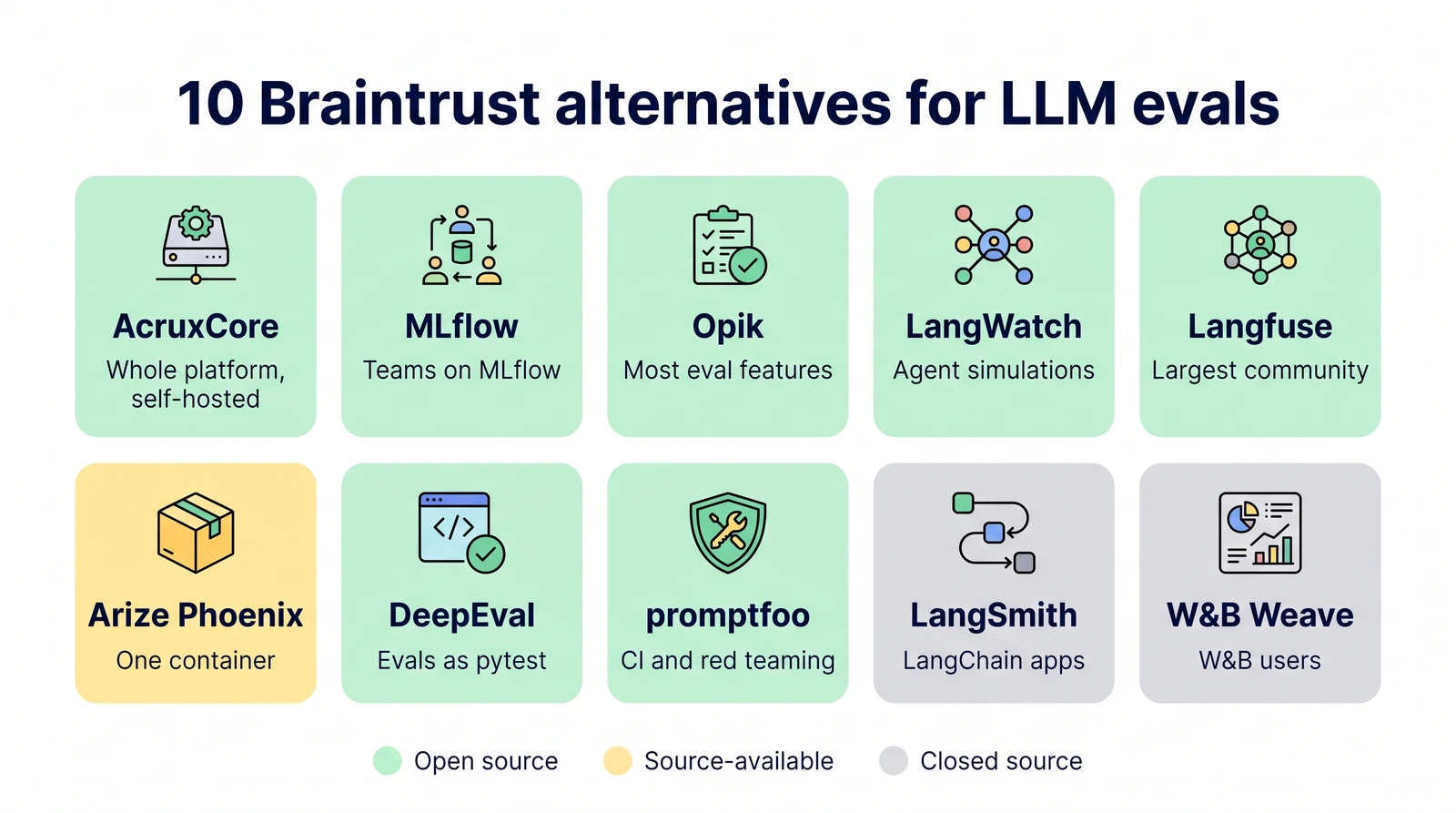
Braintrust is the first hosted-only platform in this series, and the first that runs your tool code instead of only storing the tool's schema. Six platforms have been compared here before Braintrust: Langfuse, Phoenix, Opik, Helicone, MLflow and Laminar. Every one of them stores a tool's JSON Schema at most. Braintrust takes your Python, bundles it, and runs it on its own infrastructure. That one decision sets the Python version you may use, sets whether your handler can open a file, and sets where your data has to live. This comparison is built around that decision. To compare Braintrust with all the other alternatives at once, see 10 Braintrust alternatives.

Braintrust is not open source, and self-hosting needs the Enterprise plan. There is no free self-hosted install to test against, so everything below ran on their hosted Starter tier.

AcruxCore vs Laminar: SQL over traces vs a prompt gateway

· 23 min read
LLM-ops platform

Laminar (lmnr) is a Y Combinator S24 project that calls itself observability purpose-built for AI agents — a Rust ingest server, ClickHouse for spans, Quickwit for search, and an OpenTelemetry SDK that instruments fifteen-plus agent frameworks from one line of code — Vercel AI SDK, Claude Agent SDK, OpenAI Agents SDK, LangChain DeepAgents, Mastra, Pydantic AI, Browser Use, Stagehand, Playwright, LiteLLM, OpenCode and OpenHands among them. It is the most differently shaped tool we have compared AcruxCore against. Its project sidebar has dashboards, traces, evaluations, datasets, labeling, a SQL editor, playgrounds, a debugger and settings — and no prompt registry anywhere. That is not an oversight; it is the product being about agent runs rather than about the calls inside them. Both projects are Apache 2.0, so this is a comparison of shape, not of who is open.
AcruxCore vs MLflow: two gateways, one with guardrails

· 20 min read
LLM-ops platform

MLflow is the open-source ML/GenAI platform originally built at Databricks, and by far the largest, oldest project we've compared AcruxCore against — 27,000+ GitHub stars, 444 contributors, shipping since 2018. Its GenAI side is newer: a Prompt Registry, a tracing store, LLM-as-judge evaluation, and — the real surprise of this comparison — an AI Gateway that sits in the request path, the same design AcruxCore uses. We built the same prompt — vip-support-triage, a support agent that changes tone for VIP customers and lists their open tickets — on both platforms, then ran the identical sequence on each: create the prompt, version it, send a live call through a gateway, inspect the trace, build a dataset, and call it from an SDK script.