How much overhead does an LLM gateway add?
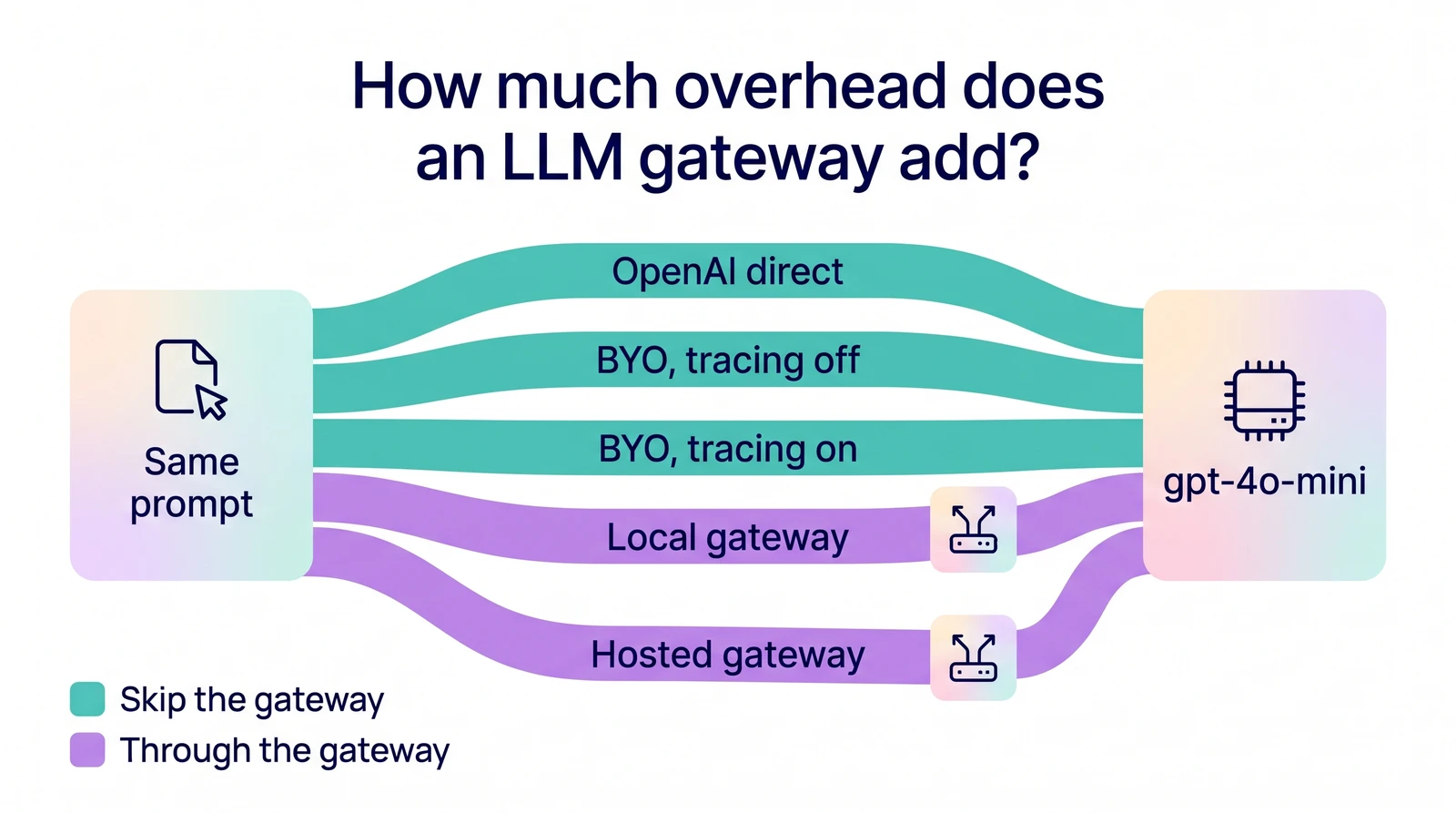
An AcruxCore gateway running on the same machine as your app added a median of 9 ms to an OpenAI call that takes about 640 ms. The 95% confidence interval runs from −15 ms to +28 ms, so this test cannot tell the gateway apart from a direct call. Calling OpenAI with your own key through the SDK, with no gateway, also adds nothing measurable, with tracing on or off.
A gateway gives you one endpoint for every provider, cost accounting, caching, virtual keys, and budgets, and it also adds a network hop. We measured five ways to reach the same model — through our gateway, around it with your own key, and raw — to see where the milliseconds go.
The setup
The trick to a fair latency test is holding everything constant except the thing
you're measuring. All five paths below hit the same upstream — OpenAI
gpt-4o-mini — using the same OpenAI account and key, with the exact same
prompt and parameters:
{
  "model": "gpt-4o-mini",
  "messages": [{ "role": "user", "content": "Reply with the single word: pong." }],
  "max_tokens": 5,
  "temperature": 0
}
Because every path ends at the same OpenAI model, the model's own response time is a shared constant across all five. Whatever difference is left over is the path.
The five paths:
- OpenAI direct — call
api.openai.comstraight from the test machine. The baseline. - BYO, tracing off — the SDK's
hub.gateway.chat()with aproviderconfig, which posts to OpenAI directly and skips our gateway, with auto-tracing switched off. - BYO, tracing on — the same call with the SDK's default tracing, which reports a trace to AcruxCore after the model answers.
- Local gateway — the same call through an AcruxCore gateway running on the test machine, which forwards to OpenAI.
- Hosted gateway — the same call through our hosted gateway at
api.acruxcore.com, which forwards to OpenAI.
Each path ran 60 interleaved rounds (the paths take turns, and the running order rotates every round, so no path is always first and a passing network blip hits all five equally), after a warm-up we discarded. Connections were pooled. The local gateway ran a production build, not a dev server. We report medians with a 95% confidence interval, and the p95/p99 tails — averages hide the spikes that actually annoy users.
The five paths, side by side
Four bars sit between 620 and 640 ms: OpenAI direct, both BYO variants, and the local gateway. Only the hosted gateway sits further out. The rest of this post explains both results.
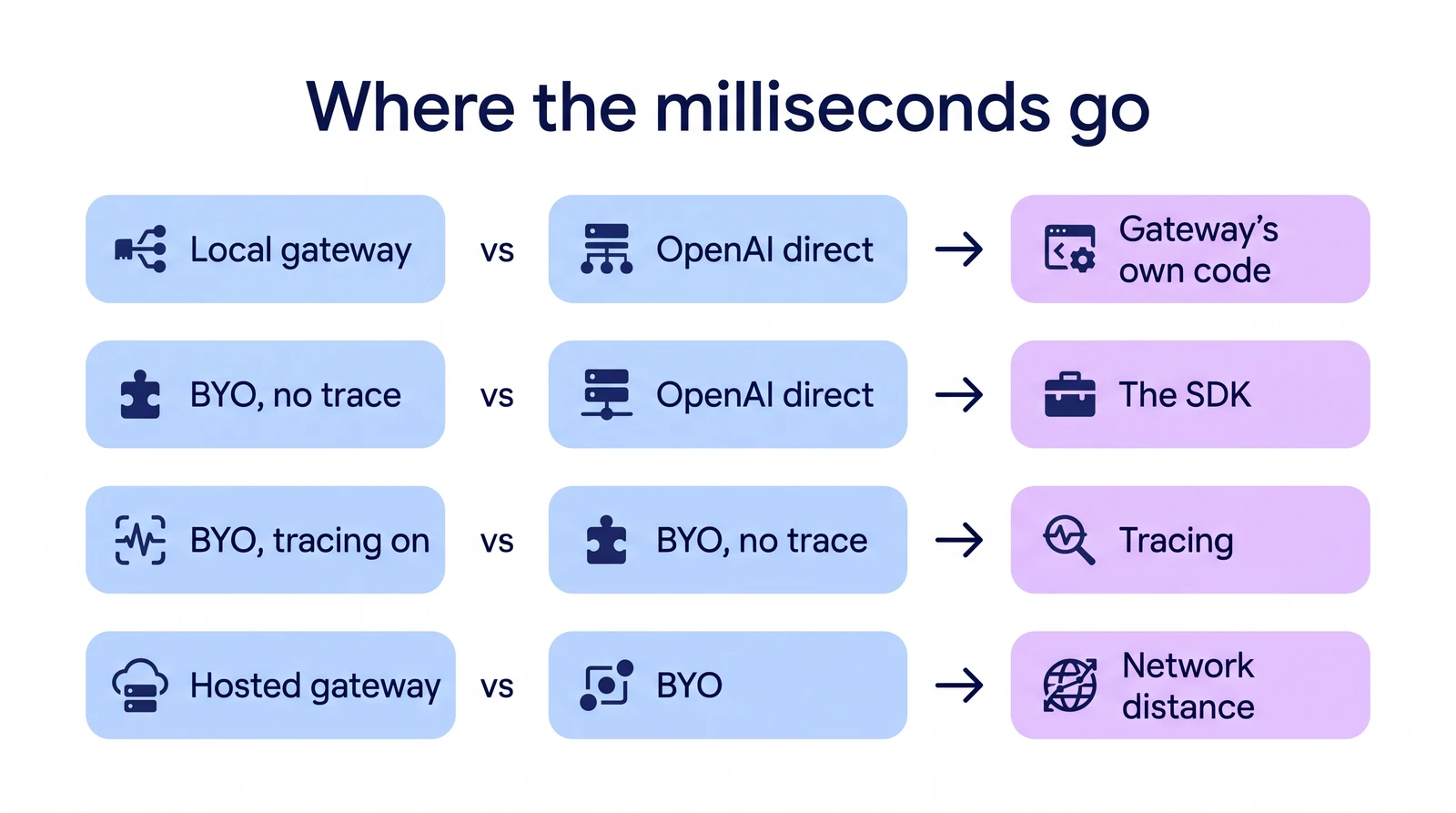
Each comparison below subtracts one path from another, so each pair isolates one part of the call.
The gateway's own code adds no measurable time
Start with the clean comparison — OpenAI direct versus the same call through a gateway on the same machine. Same machine means the gateway's call to OpenAI travels the identical network path as the direct baseline, so the gap between them is purely the gateway's own code.
Because the paths run in the same round, we can subtract them per round, which cancels any blip they shared:
| comparison | median gap | 95% confidence interval |
|---|---|---|
| Local gateway − OpenAI direct | +9 ms | −15 ms to +28 ms |
The interval crosses zero. Routing, resolving your model name, applying your key, recording the call, and accounting the cost add no time that 60 rounds can separate from network noise. The upper bound is 28 ms, under 5% of a ~640 ms call. The gap moves by tens of milliseconds from one run to the next, so read the interval, not the single median.
Skipping the gateway doesn't make the call faster
Hand the SDK a provider config and it posts to OpenAI directly — your provider
key never reaches our servers, and there is no hop:
const result = await hub.gateway.chat({
  model: 'gpt-4o-mini',
  messages,
  provider: { baseUrl: 'https://api.openai.com/v1', apiKey: process.env.OPENAI_API_KEY },
});
Measured against raw fetch to OpenAI, that call is indistinguishable from
having no SDK at all:
| comparison | median gap | 95% confidence interval |
|---|---|---|
| BYO (no trace) − OpenAI direct | −5 ms | −29 ms to +21 ms |
The interval straddles zero. Read it the honest way: the SDK adds nothing measurable to a direct provider call. The local gateway doesn't either, so on the same machine BYO saves no measurable time. The reason to choose BYO is that your provider key stays on your own machines.
Key point: On the same machine, the SDK calling OpenAI directly (BYO) is no faster than the local AcruxCore gateway. BYO keeps your provider key on your own machines.
Tracing never blocks the response either way. The SDK reports its own trace
in the background — a queue that drains after hub.gateway.chat() has already handed the
answer back, on no fixed timer — so turning tracing on or off on the BYO path
makes no measurable difference to the request:
| comparison | median gap | 95% confidence interval |
|---|---|---|
| BYO (tracing on) − BYO (no trace) | −15 ms | −41 ms to +15 ms |
That interval crosses zero too: tracing on and tracing off are, statistically, the same request.
Both takeaways here are portable, and neither is the raw millisecond count. The gateway's code costs tens of milliseconds at most. A hop across the internet costs hundreds — so anything your application doesn't read back synchronously has no reason to travel synchronously either.
Don't forget the tail
Medians tell you the typical case, but users remember the slow one:
| Path | median | p95 | p99 |
|---|---|---|---|
| BYO, tracing on | 621 ms | 783 ms | 832 ms |
| Local gateway | 632 ms | 919 ms | 1012 ms |
| BYO, no trace | 634 ms | 845 ms | 1075 ms |
| OpenAI direct | 639 ms | 753 ms | 891 ms |
| Hosted gateway | 1176 ms | 1376 ms | 1526 ms |
The tail is wider than the median suggests for every path — plan for the p99, not the median, when a call like this sits on a user-facing route. With only 60 rounds per path, treat these tails as a rough shape rather than a precise claim.
A larger run is in full-cycle latency across six LLM-ops platforms. That benchmark ran 100 rounds four times, on real OpenAI billing, against five other LLM-ops platforms, and it plots every round. Most of its paths also fetch a stored prompt before the completion, so its gateway numbers measure a different request from the one in this post.
What this means for you
- The gateway's own code adds no measurable time — at most 28 ms in this run, for provider routing, cost tracking, caching, budgets, and fallback.
- Skipping the gateway is about where your key lives, not speed — BYO keeps your provider key on your own machines, and saves no measurable time.
- Tracing costs nothing extra on the BYO path — it runs on a background queue, so leaving it on doesn't change what your user waits on.
- Most real-world latency is network distance, which you control by deploying close to your callers. The hosted gateway's ~550 ms gap over BYO today is geography, not code.
For a walk-through of the BYO path end to end — your own key, your own embeddings, prompts and traces still working — see build a RAG agent without the gateway. For the other side of the trade, see routing your calls through the gateway.
Want to reproduce this? The benchmark script, its results.json and summarize.mjs
are on GitHub. summarize.mjs turns any run's results.json into the tables above.
Every path used the same model, key, prompt, and parameters, over pooled
connections, 60 interleaved rounds with a rotating order.
llm-gateway-overhead/typescript/ — the benchmark script, its results.json and summarize.mjs.