One gateway, three providers: request shapes compared
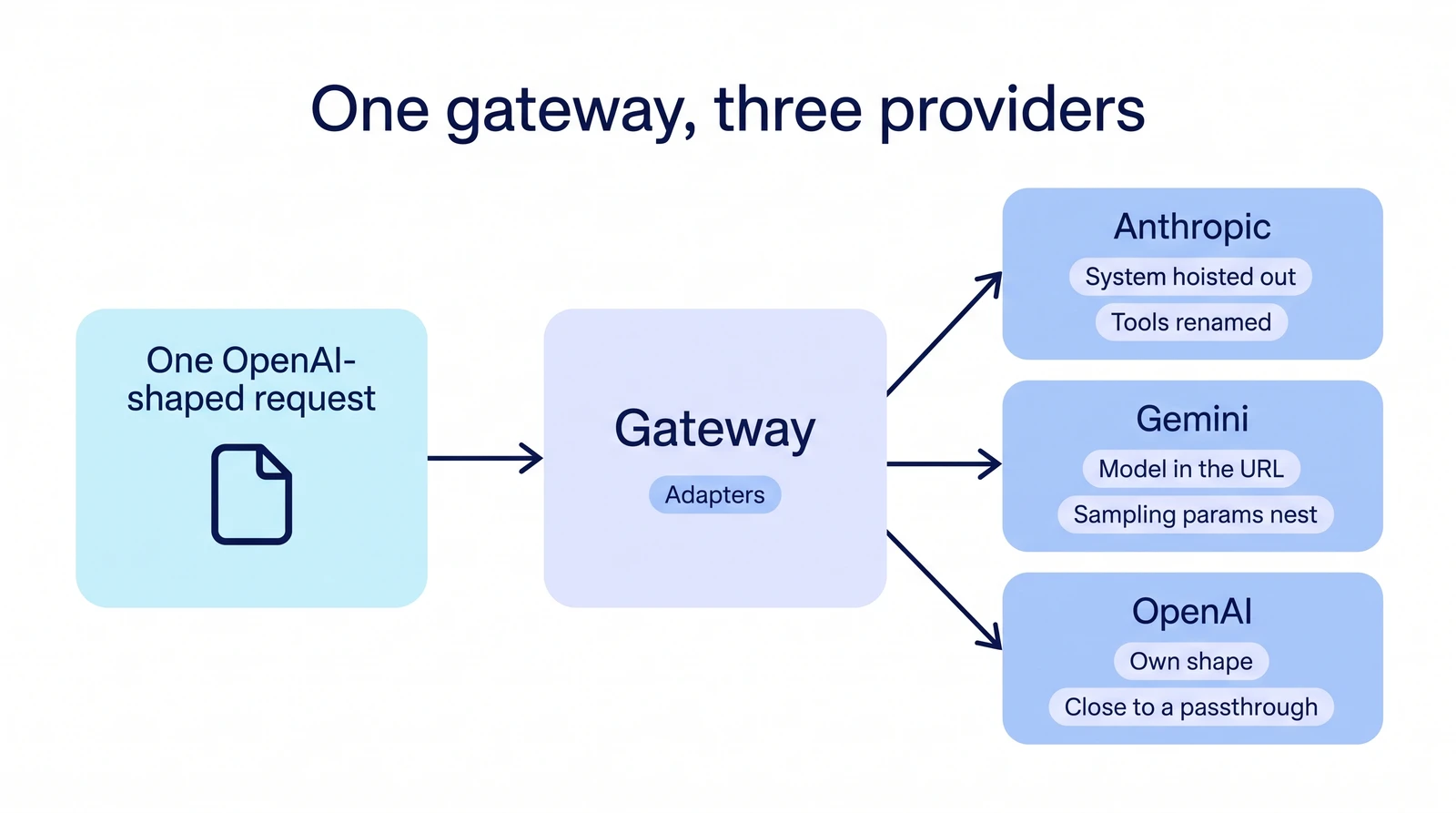
Anthropic, Gemini, and OpenAI each expect a different request: a different auth
header, a different place for sampling parameters, and a different key for the
same tool definition. The AcruxCore gateway takes one OpenAI-shaped request and
its adapters rewrite it into each provider's shape, so changing provider is a
one-field edit to model.
We took one fixed request — a system message, a user message, and one tool definition — and traced it through all three adapters that ship today to show exactly what each one rewrites and why the gateway needs to do it at all.
The one request every path starts from
{
  "model": "demo-model",
  "messages": [
    { "role": "system", "content": "You are a concise, friendly support agent." },
    { "role": "user", "content": "My order has not arrived yet — can you look it up?" }
  ],
  "temperature": 0.2,
  "max_tokens": 200,
  "tools": [
    {
      "type": "function",
      "function": {
        "name": "lookup_order",
        "description": "Look up an order by its id.",
        "parameters": { "type": "object", "properties": { "orderId": { "type": "string" } }, "required": ["orderId"] }
      }
    }
  ],
  "tool_choice": "auto"
}
That's the whole client-facing contract, regardless of which model answers it. Below is what each adapter actually builds from it, captured by running the gateway's own adapter code directly against this exact request.
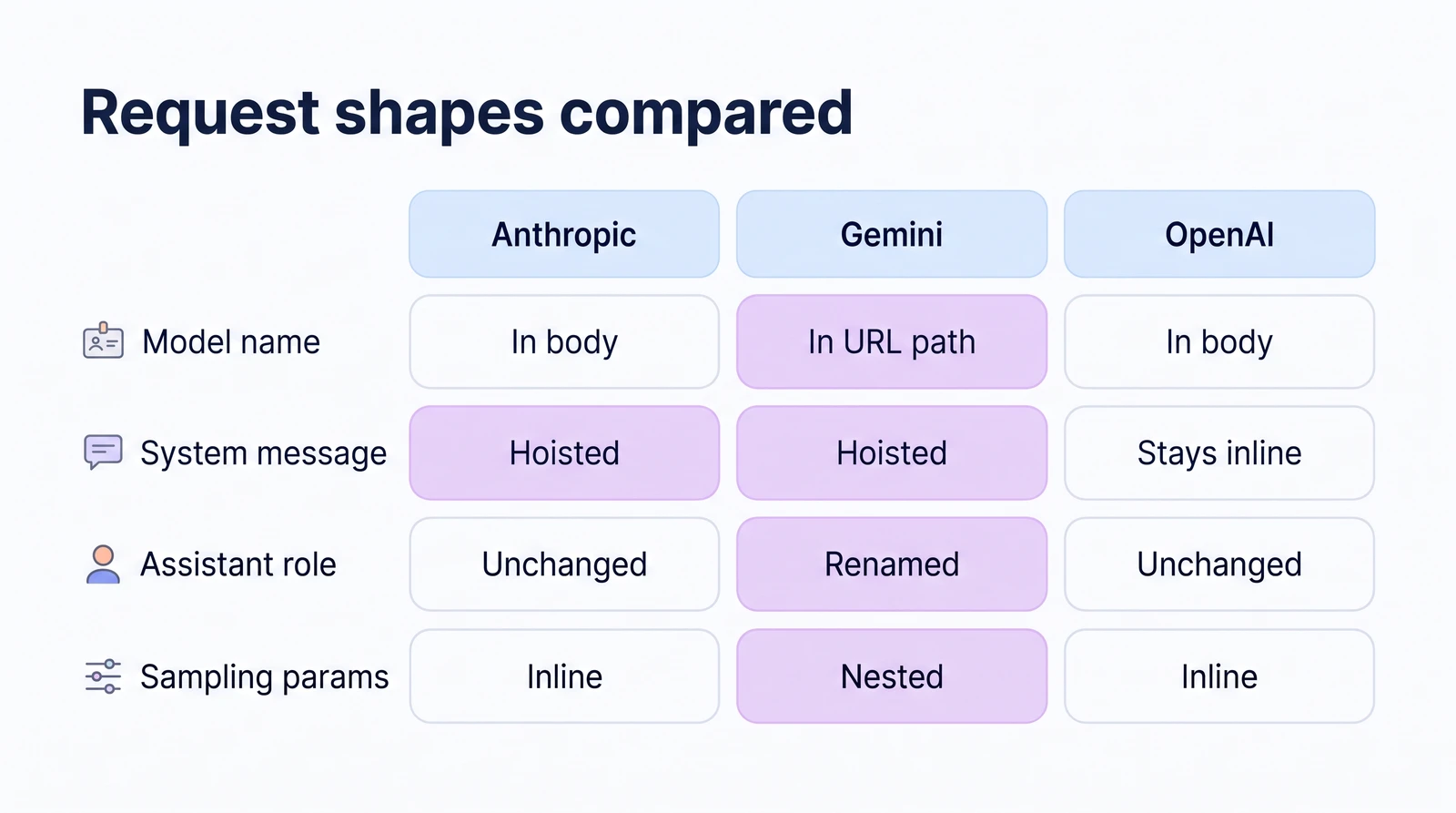
Before the details, here is where the three shapes differ.
Anthropic: system hoisted out, tools renamed, no Authorization header
POST https://api.anthropic.com/v1/messages
x-api-key: <key>
anthropic-version: 2023-06-01

{
  "model": "demo-model",
  "messages": [
    { "role": "user", "content": "My order has not arrived yet — can you look it up?" }
  ],
  "max_tokens": 200,
  "system": "You are a concise, friendly support agent.",
  "temperature": 0.2,
  "tools": [
    { "name": "lookup_order", "description": "Look up an order by its id.", "input_schema": { "type": "object", "properties": { "orderId": { "type": "string" } }, "required": ["orderId"] } }
  ],
  "tool_choice": { "type": "auto" }
}
- The
systemmessage never appears inmessagesat all — it's pulled out and joined into a top-levelsystemstring. max_tokensis required; the adapter defaults it to 1024 if a caller omits it, since Anthropic's API rejects a request without one.- Auth is
x-api-key, notAuthorization: Bearer— plus a mandatoryanthropic-versionheader pinning the API version. - A tool's
parametersbecomesinput_schema— same JSON Schema, different key.
A live call through the gateway to an Anthropic-backed model with this same system and user message came back through the same normalization path as the other two:
Show output: the response from the Anthropic-backed model
{"id":"msg_011CdbQLdD7d1TBhx2cp7izz","model":"claude-haiku-4-5-20251001","object":"chat.completion","created":1785558766,"choices":[{"index":0,"message":{"role":"assistant","content":"I'd be happy to help you look up your order! Could you please provide me with your order ID? You can usually find this in your confirmation email or account."},"finish_reason":"stop"}],"usage":{"prompt_tokens":584,"completion_tokens":37,"total_tokens":621}}
Gemini: model in the URL, messages become contents, sampling params nest
POST https://generativelanguage.googleapis.com/v1beta/models/demo-model:generateContent
x-goog-api-key: <key>

{
  "contents": [
    { "role": "user", "parts": [{ "text": "My order has not arrived yet — can you look it up?" }] }
  ],
  "systemInstruction": { "parts": [{ "text": "You are a concise, friendly support agent." }] },
  "generationConfig": { "temperature": 0.2, "maxOutputTokens": 200 },
  "tools": [
    { "functionDeclarations": [{ "name": "lookup_order", "description": "Look up an order by its id.", "parameters": { "type": "object", "properties": { "orderId": { "type": "string" } }, "required": ["orderId"] } }] }
  ],
  "toolConfig": { "functionCallingConfig": { "mode": "AUTO" } }
}
- The model name is in the URL path, not the request body at all.
messagesbecomescontents, andassistantbecomesmodel— Gemini has noassistantrole.temperatureandmax_tokensdon't pass through directly; they nest undergenerationConfig(andmax_tokensis renamedmaxOutputTokens).- Tools get wrapped in an extra array:
tools: [{ functionDeclarations: [...] }]— one object holding all your functions, not one array entry per function. - Auth is
x-goog-api-key— a third distinct header name, and no version header.
A live call through the gateway to a Gemini-backed model with this same
system and user message came back through the same normalization path as
the other two. gemini-3.6-flash is a thinking model, so completion_tokens
includes its reasoning, which reasoning_tokens also reports:
Show output: the response from gemini-3.6-flash
{"id":"chatcmpl-8794e3b4-4e8d-48eb-9b52-f0f8c3156d4c","model":"gemini-3.6-flash","object":"chat.completion","created":1792949745,"choices":[{"index":0,"message":{"role":"assistant","content":"I'd be happy to help check on your order! Could you please provide your order ID?"},"finish_reason":"stop"}],"usage":{"prompt_tokens":70,"completion_tokens":115,"total_tokens":185,"reasoning_tokens":95,"completion_tokens_details":{"reasoning_tokens":95}}}
OpenAI: the gateway's own shape, close to a passthrough
POST https://api.openai.com/v1/chat/completions
Authorization: Bearer <key>

{
  "model": "demo-model",
  "messages": [
    { "role": "system", "content": "You are a concise, friendly support agent." },
    { "role": "user", "content": "My order has not arrived yet — can you look it up?" }
  ],
  "temperature": 0.2,
  "max_completion_tokens": 200,
  "tools": [
    { "type": "function", "function": { "name": "lookup_order", "description": "Look up an order by its id.", "parameters": { "type": "object", "properties": { "orderId": { "type": "string" } }, "required": ["orderId"] } } }
  ],
  "tool_choice": "auto",
  "stream": false
}
Because the gateway's own client-facing API already mirrors OpenAI's Chat
Completions shape, this adapter does almost nothing: messages, tools,
and tool_choice pass straight through unchanged, and Authorization: Bearer
is the standard header. Two things change. max_tokens is sent as
max_completion_tokens, which OpenAI's reasoning models require, and an explicit
stream: false is added. A live call through the gateway to gpt-4o-mini with
this same system and user message came back exactly as you'd expect from that
passthrough:
Show output: the response from gpt-4o-mini
{"id":"chatcmpl-EcwMIJOD35Up0SNP0MUPnhgHli0oQ","model":"gpt-4o-mini-2024-07-18","object":"chat.completion","created":1792949502,"choices":[{"index":0,"message":{"role":"assistant","content":"Please provide me with your order ID so I can look it up for you."},"finish_reason":"stop"}],"usage":{"prompt_tokens":68,"completion_tokens":17,"total_tokens":85}}
Side by side
| Anthropic | Gemini | OpenAI | |
|---|---|---|---|
| Model name | In body (model) | In URL path | In body (model) |
| System message | Hoisted to top-level system string | Hoisted to systemInstruction.parts | Stays inline in messages |
assistant role | Unchanged | Renamed to model | Unchanged |
| Sampling params | Inline (temperature, max_tokens) | Nested under generationConfig, max_tokens→maxOutputTokens | Inline; max_tokens→max_completion_tokens |
| Tool schema field | input_schema | parameters, wrapped in functionDeclarations | parameters, unchanged |
| Auth header | x-api-key + anthropic-version | x-goog-api-key | Authorization: Bearer |
max_tokens | Required — defaults to 1024 if omitted | Optional | Optional |
Key point: Anthropic requires
max_tokens, and Gemini and OpenAI treat it as optional. The Anthropic adapter defaults it to 1024 when a caller omits it.
Whichever model you point at, your code keeps sending the one shape at the top of this post — the row you never have to write yourself is whichever one your chosen provider needs.
What this means for you
- Switching models is a
modelfield change, not a rewrite — the translation in every row above happens inside the gateway, not in your code. - Anthropic's required
max_tokensis the one place a request could behave differently across providers if you rely on omitting it — set it explicitly if you plan to swap models later. - Tool definitions travel as one JSON Schema, no matter which provider
answers — you write
parametersonce and never touchinput_schemaorfunctionDeclarationsyourself.
Want to reproduce this? Every response above is the real thing — one live
call per provider through the running gateway, to an Anthropic-backed, a
Gemini-backed, and an OpenAI-backed model, all given the exact same system
and user message (only the registered model name differed from the
"demo-model" placeholder shown in the request bodies above). The request
shapes themselves come from running the gateway's real, unmodified adapter
classes directly against the one request at the top of this post, with
gateway-provider-shapes.mts.
That script imports the adapters from the AcruxCore repo, so run it from a clone
with npx tsx.
gateway-provider-shapes.mts — prints each provider's request shape from the real adapters.
Want to try this yourself? The Quickstart gets you from sign-up to a traced, gateway-routed call in about ten minutes.