9 posts tagged with "LLM gateway"

One endpoint in front of every model provider — routing, caching, cost accounting, and virtual keys.

View All Tags

Langfuse AI Gateway vs LiteLLM vs AcruxCore: a self-hosted gateway benchmark
Published · 16 min read
LLM-ops platform

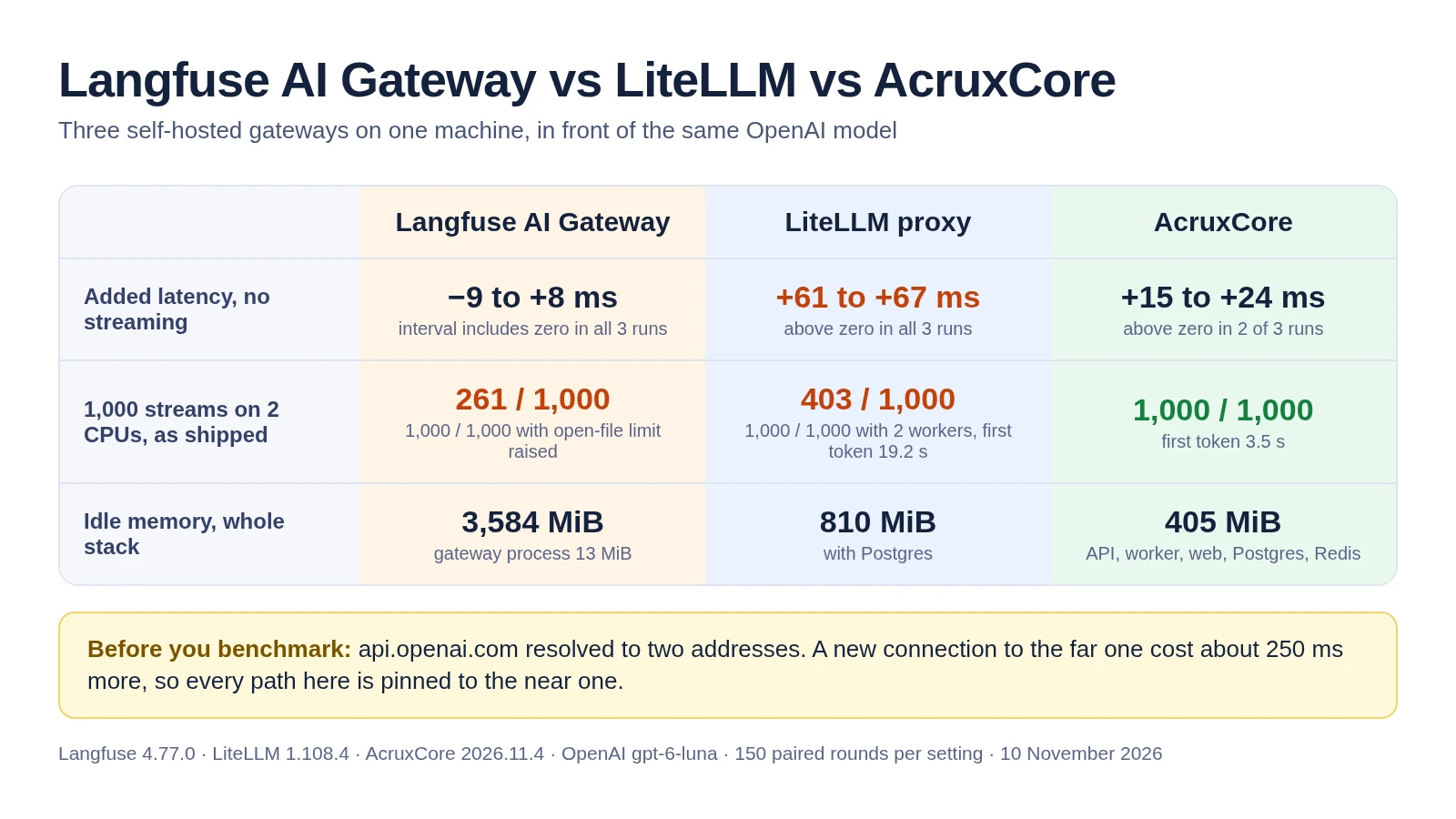
Results table: added latency without streaming is −9 to +8 ms for Langfuse, +61 to +67 ms for LiteLLM and +15 to +24 ms for AcruxCore; at 1,000 streams on 2 CPUs as shipped, 261, 403 and 1,000 succeed; idle stack memory is 3,584, 810 and 405 MiB; every path is pinned to one OpenAI address

Langfuse opened its AI Gateway in public beta on 4 November 2026. We tested it against the LiteLLM proxy and AcruxCore. All three ran on the same machine and called the same OpenAI model. For each gateway, we measured the time it adds to a call, how many streams it handles at once, how much memory it needs and what it can do.

  • Added latency, without streaming: LiteLLM added 61 to 67 ms to each call in all three runs. AcruxCore added 15 to 24 ms, and its 95% interval stayed above zero in two of the three runs. Langfuse added 8 ms or less, and its interval included zero in every run. For the first token of a stream, no gateway added a delay in all three runs.

  • At 1,000 simultaneous streams on 2 CPUs, AcruxCore and Langfuse with a raised open-file limit finished all 1,000. Langfuse as shipped failed 739 of them, because its gateway process keeps Docker's default limit of 1,024 open files. One line in its Compose file fixes it. LiteLLM used both CPUs from 100 streams on, and its median time to the first token reached 19 seconds at 1,000.

  • Idle memory: the Langfuse gateway process uses 13 MiB, but the Langfuse stack it needs uses 3.5 GiB. LiteLLM with its database uses 810 MiB, and AcruxCore's whole stack uses 405 MiB.

Before any of that, one finding about OpenAI itself changed our first results by more than any gateway did.
15 LiteLLM alternatives: self-hosted gateways, hosted gateways and libraries (2026)

Published · 33 min read
LLM-ops platform

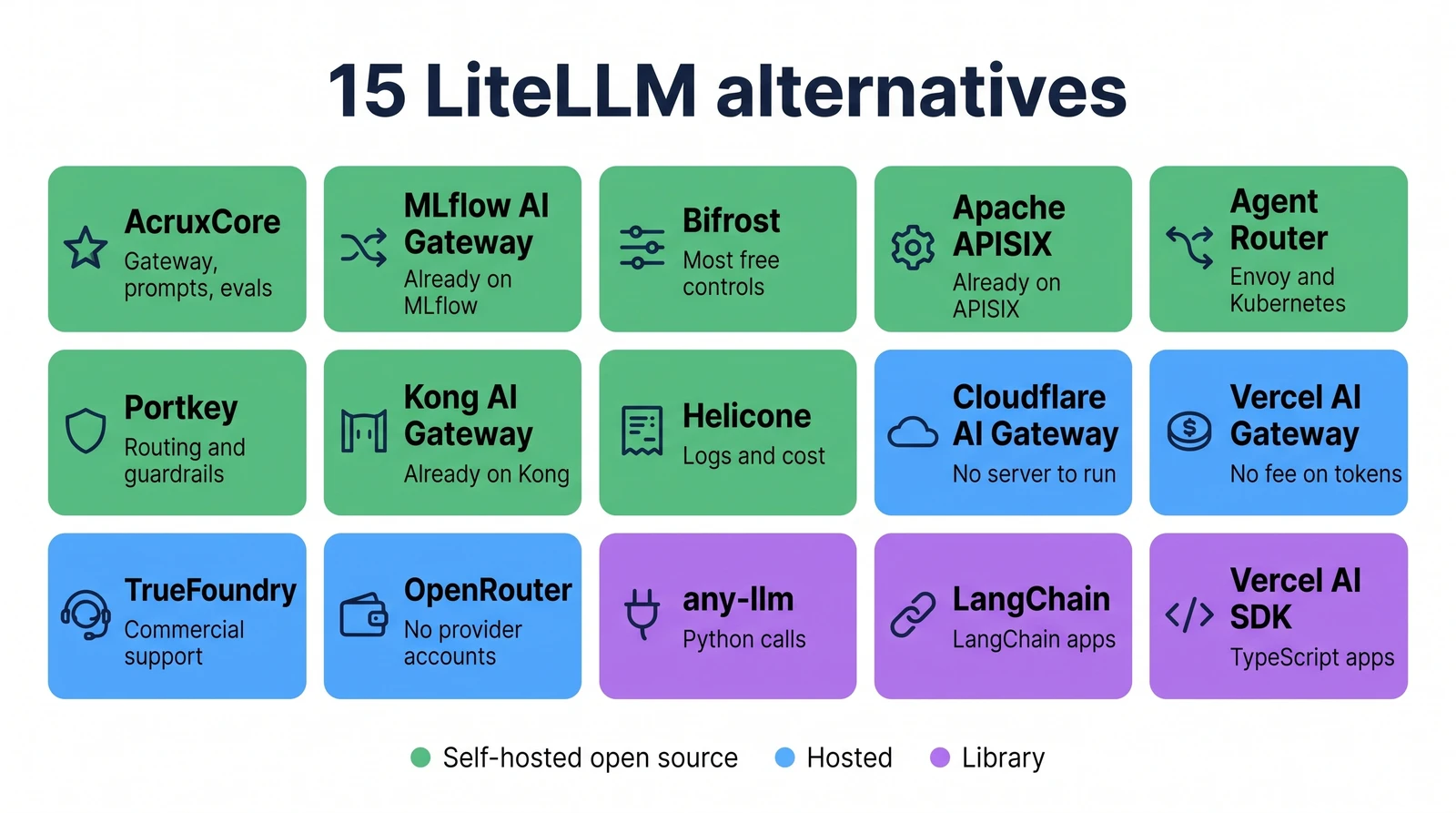
Fifteen LiteLLM alternatives in a colour-coded grid, each with what it is best for. Self-hosted open source: AcruxCore (ours), MLflow AI Gateway, Bifrost, Apache APISIX, Agent Router, Portkey, Kong AI Gateway, Helicone. Hosted: Cloudflare AI Gateway, Vercel AI Gateway, TrueFoundry, OpenRouter. Library: any-llm, LangChain, Vercel AI SDK

This post compares fifteen LiteLLM alternatives on license, self-hosting, gateway controls and price. It sorts them into gateways you run yourself, hosted gateways and libraries, so you can tell which kind of tool replaces the part of LiteLLM you use.

We build AcruxCore, one of the tools in this post. We do not rank it.

13 OpenRouter alternatives: gateways, resellers and local models (2026)

Published · Updated · 30 min read
LLM-ops platform

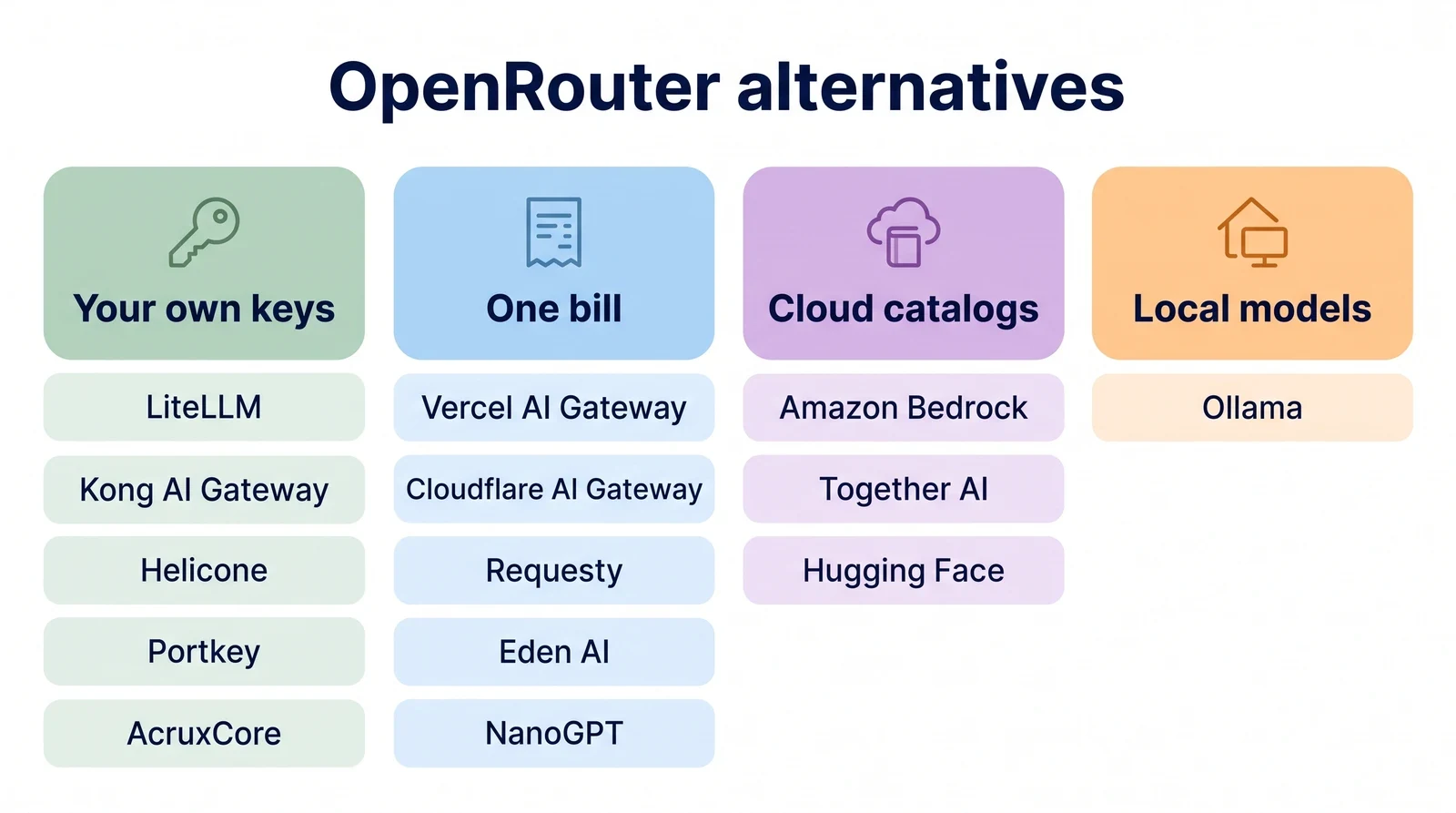
OpenRouter alternatives in four columns: Your own keys (LiteLLM, Kong AI Gateway, Helicone, Portkey, AcruxCore (ours)), One bill (Vercel AI Gateway, Cloudflare AI Gateway, Requesty, Eden AI, NanoGPT), Cloud catalogs (Amazon Bedrock, Together AI, Hugging Face) and Local models (Ollama)

This post compares thirteen OpenRouter alternatives on fees, bring-your-own-key support, self-hosting and routing. After it, you can tell whether you need a reseller, a gateway you run yourself, a cloud catalog or a local runtime.

We build AcruxCore, one of the tools in this post. We do not rank it.

AcruxCore vs MLflow: two gateways, one with guardrails

Published · Updated · 20 min read
LLM-ops platform

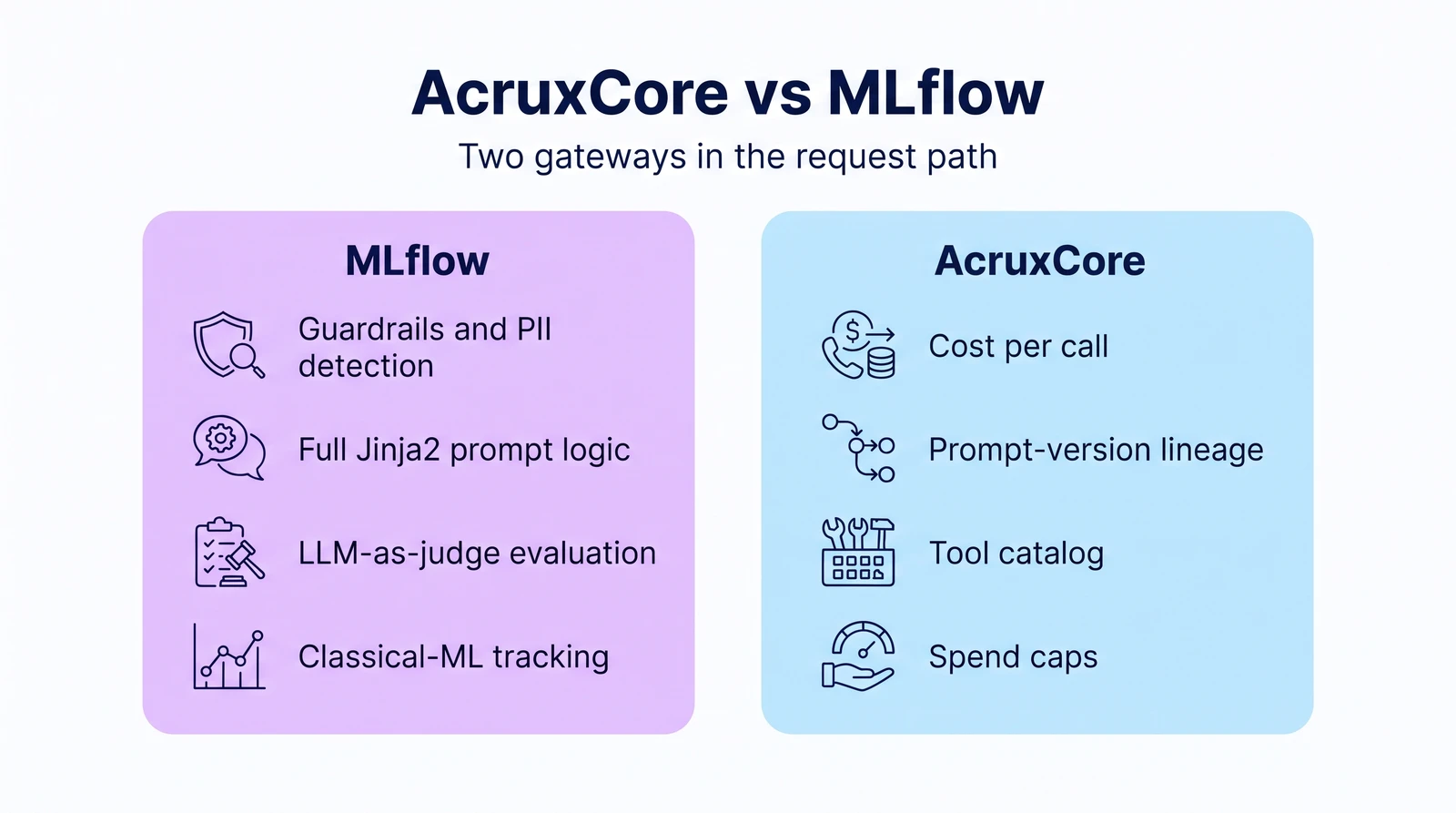
Two gateways in the request path: MLflow is strongest at guardrails and PII detection, full Jinja2 prompt logic, LLM-as-judge evaluation and classical-ML tracking; AcruxCore at cost per call, prompt-version lineage, a tool catalog and spend caps

MLflow is the open-source ML and GenAI platform first built at Databricks. It has shipped since 2018 and had about 28,500 GitHub stars and 447 contributors on 25 October 2026. Its GenAI side is newer: a Prompt Registry, a tracing store, LLM-as-judge evaluation, and an AI Gateway that sits in the request path. AcruxCore's gateway sits there too, so this comparison is between two request-path gateways. We sent the same support prompt, vip-support-triage, through both. The prompt changes tone for VIP customers and lists their open tickets. We registered and versioned it, called it through each gateway, linked the trace to its prompt version, and built an evaluation dataset.

The short answer: MLflow has Safety, PII and custom guardrails on every gateway endpoint, full Jinja2 prompts, and an experiment tracker for classical ML, and AcruxCore has no guardrails. AcruxCore returns cost on every gateway response and runs the tools in its catalog. Linking a trace to its prompt version takes a separate SDK call on MLflow and one argument on AcruxCore.

AcruxCore is our product. The MLflow and AcruxCore scripts are linked in each section.

Full-cycle latency of six LLM-ops platforms vs real OpenAI

Published · Updated · 18 min read
LLM-ops platform

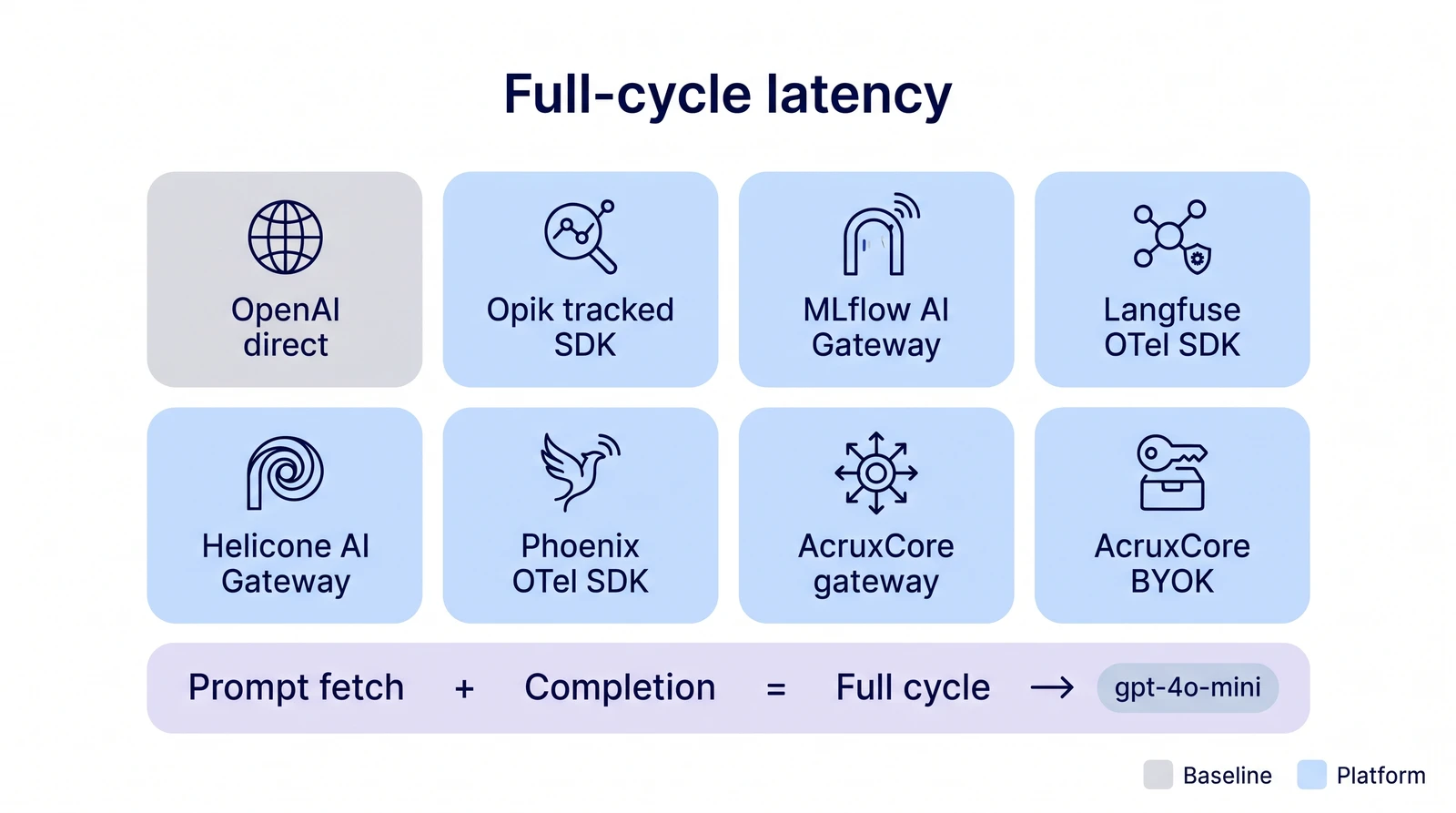
The eight paths in the full-cycle benchmark: the OpenAI direct baseline, Opik tracked SDK, MLflow AI Gateway, Langfuse OTel SDK, Helicone AI Gateway, Phoenix OTel SDK, AcruxCore gateway and AcruxCore BYOK, each timed as prompt fetch plus completion on gpt-4o-mini

Opik, MLflow, Langfuse, Helicone, Phoenix, and AcruxCore all landed within about 220 ms of each other on the median, between 810 ms and 1032 ms for a prompt fetch plus a gpt-4o-mini completion. In the latest of four runs, only Opik's gap against calling OpenAI directly was larger than the noise, and Opik was faster than the direct call, not slower.

The benchmark measures the full cycle on real OpenAI billing: a raw OpenAI baseline, the five other platforms, and AcruxCore's two calling modes, eight paths in one interleaved run. We ran it four independent times, because one 100-round run against a live third-party API is too noisy to trust a single number.

We build AcruxCore. We ran every tool ourselves, and the scripts are linked below.

AcruxCore vs Helicone: two request-path gateways compared

Published · Updated · 15 min read
LLM-ops platform

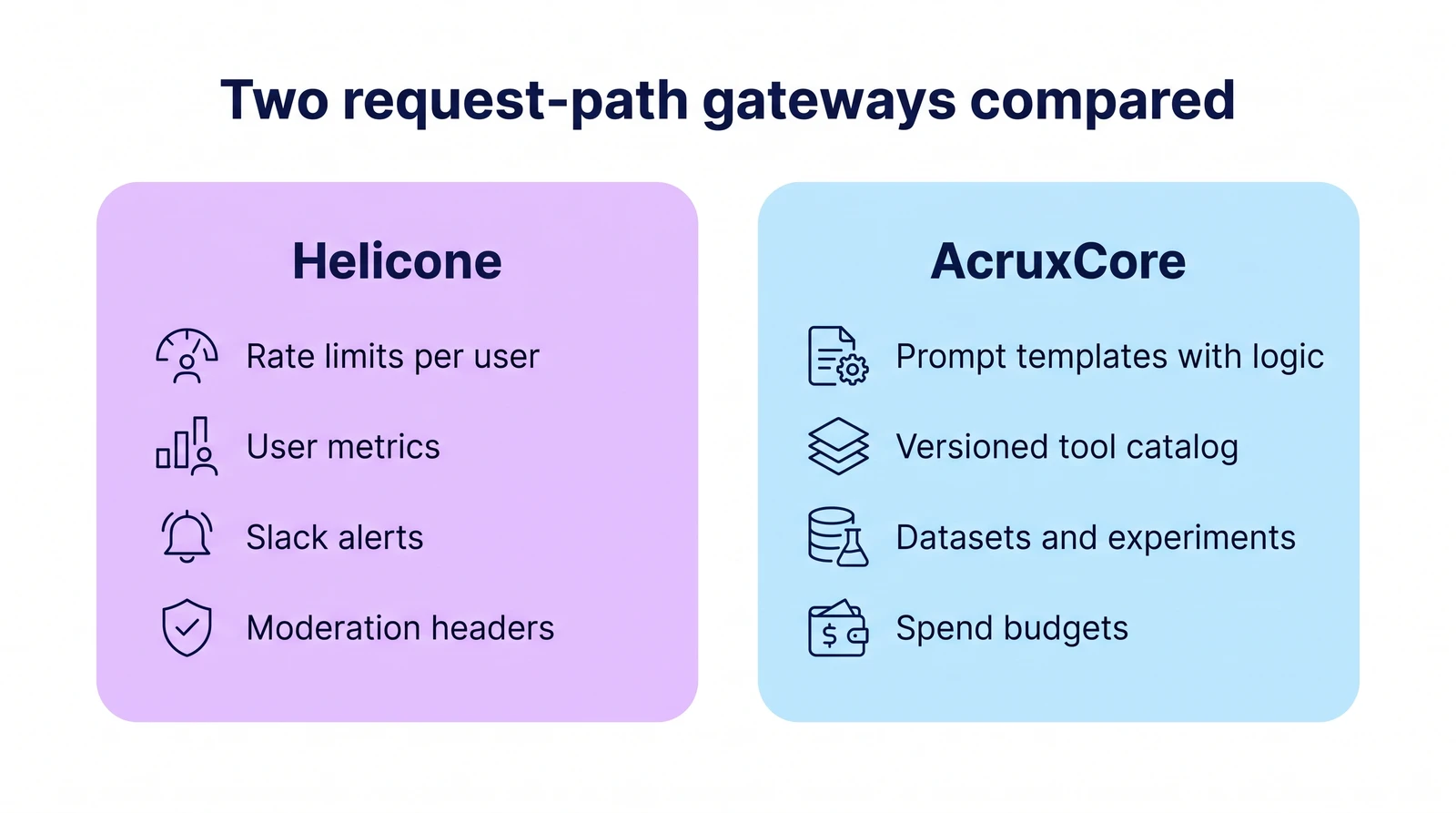
Helicone is strongest at rate limits per user, user metrics, Slack alerts and moderation headers; AcruxCore at prompt templates with logic, a versioned tool catalog, datasets and experiments, and spend budgets

Helicone is an LLM gateway and observability tool. You point your OpenAI client at its base URL, and it logs each call, caches responses and applies rate limits. AcruxCore also puts a gateway in the request path, and adds versioned prompts, a tool catalog and evaluations around it. We rebuilt the support prompt vip-support-triage on a self-hosted Helicone and on AcruxCore, and timed both gateways against a direct call to OpenAI.

The short answer: the two gateways added about the same small delay. Helicone is ahead on controls per end user: rate limits per user, user metrics, and alerts on error rate or latency sent to Slack. AcruxCore is ahead on what sits around the call: prompt templates with {% if %} and {% for %}, a versioned tool catalog, datasets and experiments, and spend budgets that refuse a call before it reaches the provider.

AcruxCore is our product. Each script we ran is linked next to its result.

Exact-match gateway caching: latency and cost saved

Published · Updated · 8 min read
LLM-ops platform

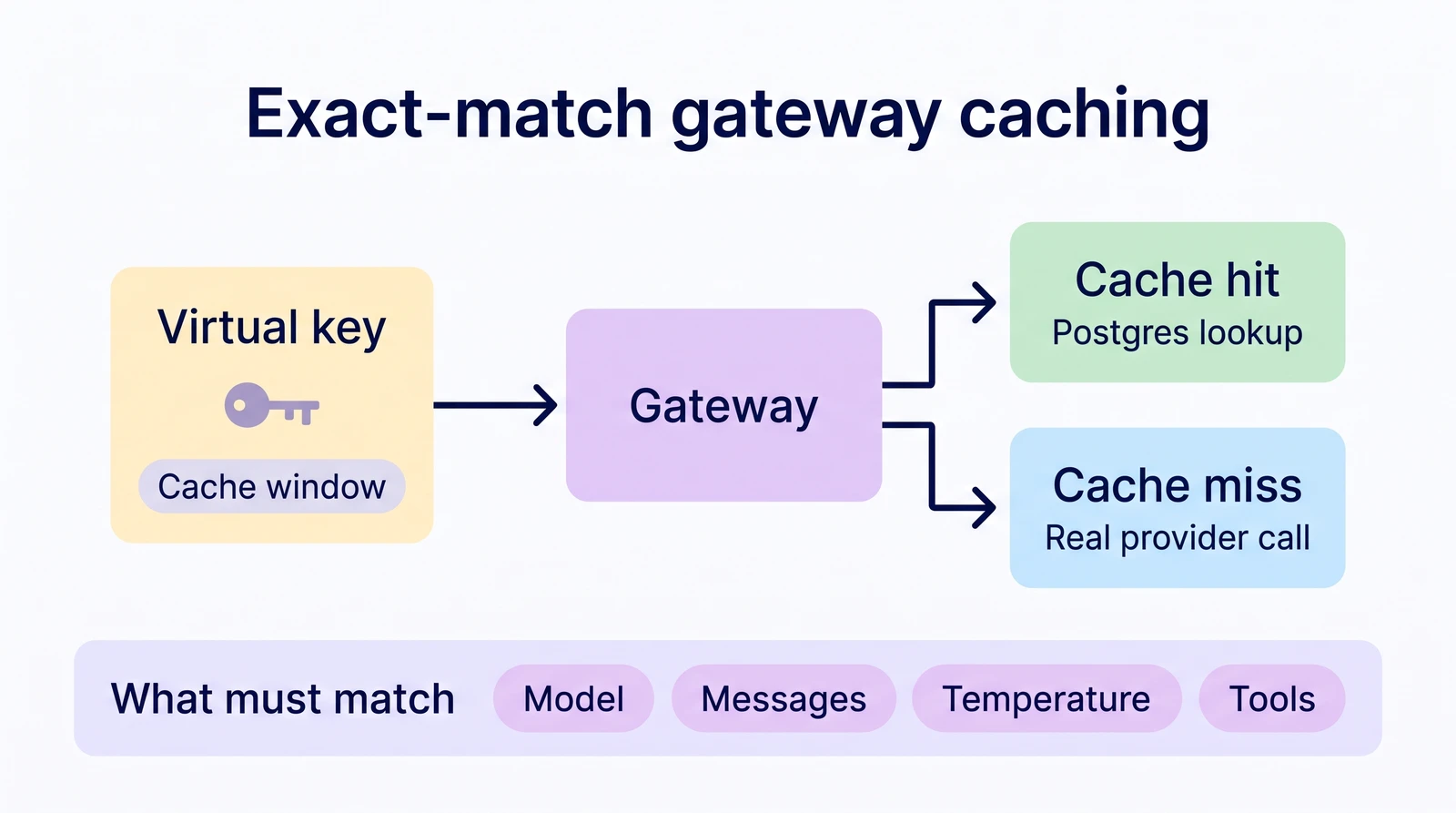
A call on a virtual key with a cache window goes through the gateway; an exact repeat is a cache hit served by a Postgres lookup, anything else is a cache miss and a real provider call; the model, messages, temperature and tools must all match

A cache hit in the AcruxCore gateway returned in a median of 9 ms, against 902 ms for the same call sent to the provider, and it cost $0. The test sent each of 15 prompts four times, so 3 of every 4 calls were repeats, and caching cut spend by 75%.

A gateway virtual key can be given a cache window: set cacheTtlSeconds and an exact-match repeat of a call — same model, same messages, same sampling parameters, tools and response format — is served from Postgres instead of the provider. We ran the same fixed set of prompts through it repeatedly to see what a hit is actually worth, in milliseconds and in dollars.

One gateway, three providers: request shapes compared

Published · Updated · 8 min read
LLM-ops platform

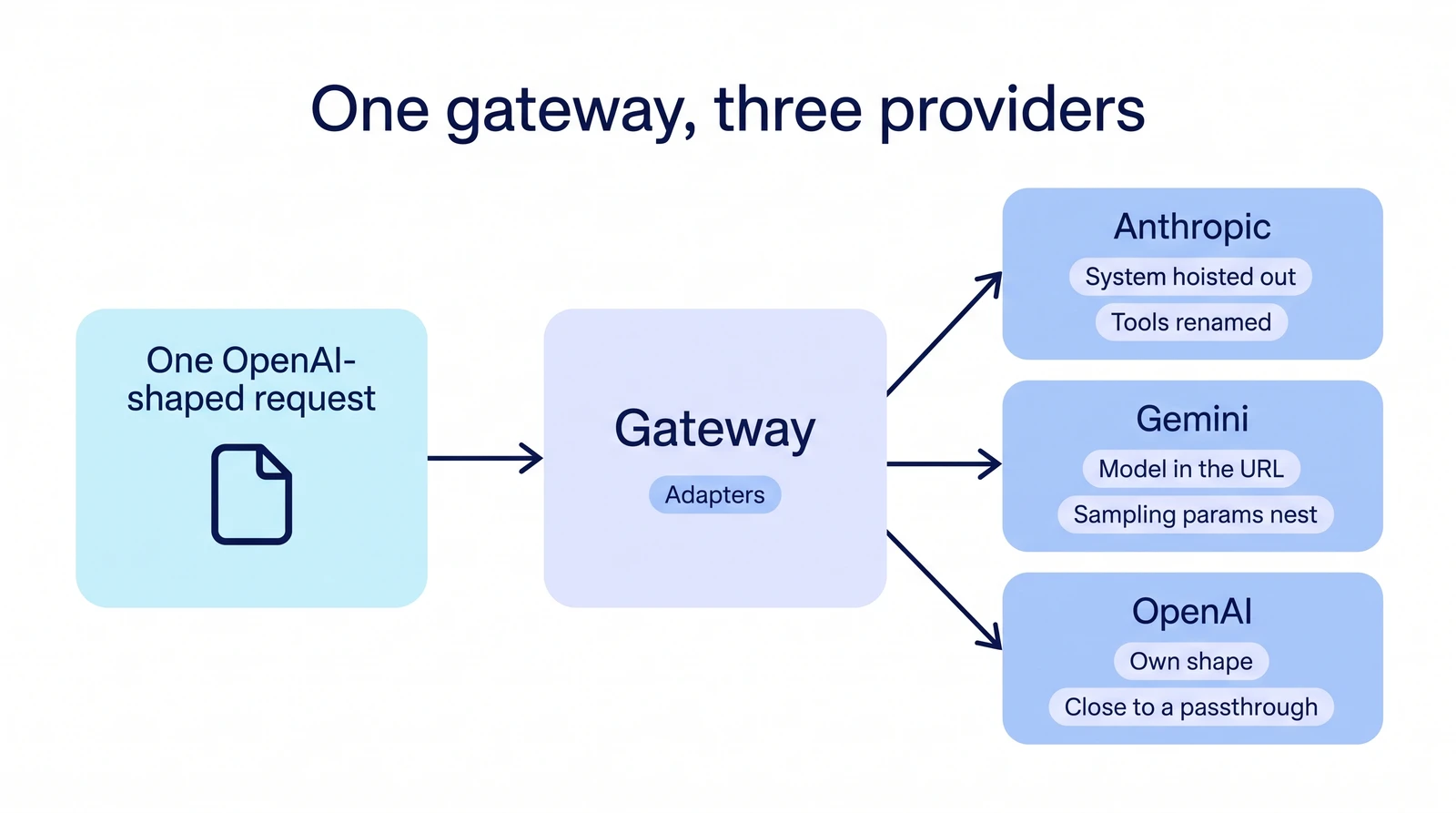
One OpenAI-shaped request enters the gateway, whose adapters rewrite it: for Anthropic the system message is hoisted out and tools are renamed, for Gemini the model goes in the URL and sampling params nest, and for OpenAI the shape is close to a passthrough

Anthropic, Gemini, and OpenAI each expect a different request: a different auth header, a different place for sampling parameters, and a different key for the same tool definition. The AcruxCore gateway takes one OpenAI-shaped request and its adapters rewrite it into each provider's shape, so changing provider is a one-field edit to model.

We took one fixed request — a system message, a user message, and one tool definition — and traced it through all three adapters that ship today to show exactly what each one rewrites and why the gateway needs to do it at all.

How much overhead does an LLM gateway add?

Published · Updated · 9 min read
LLM-ops platform

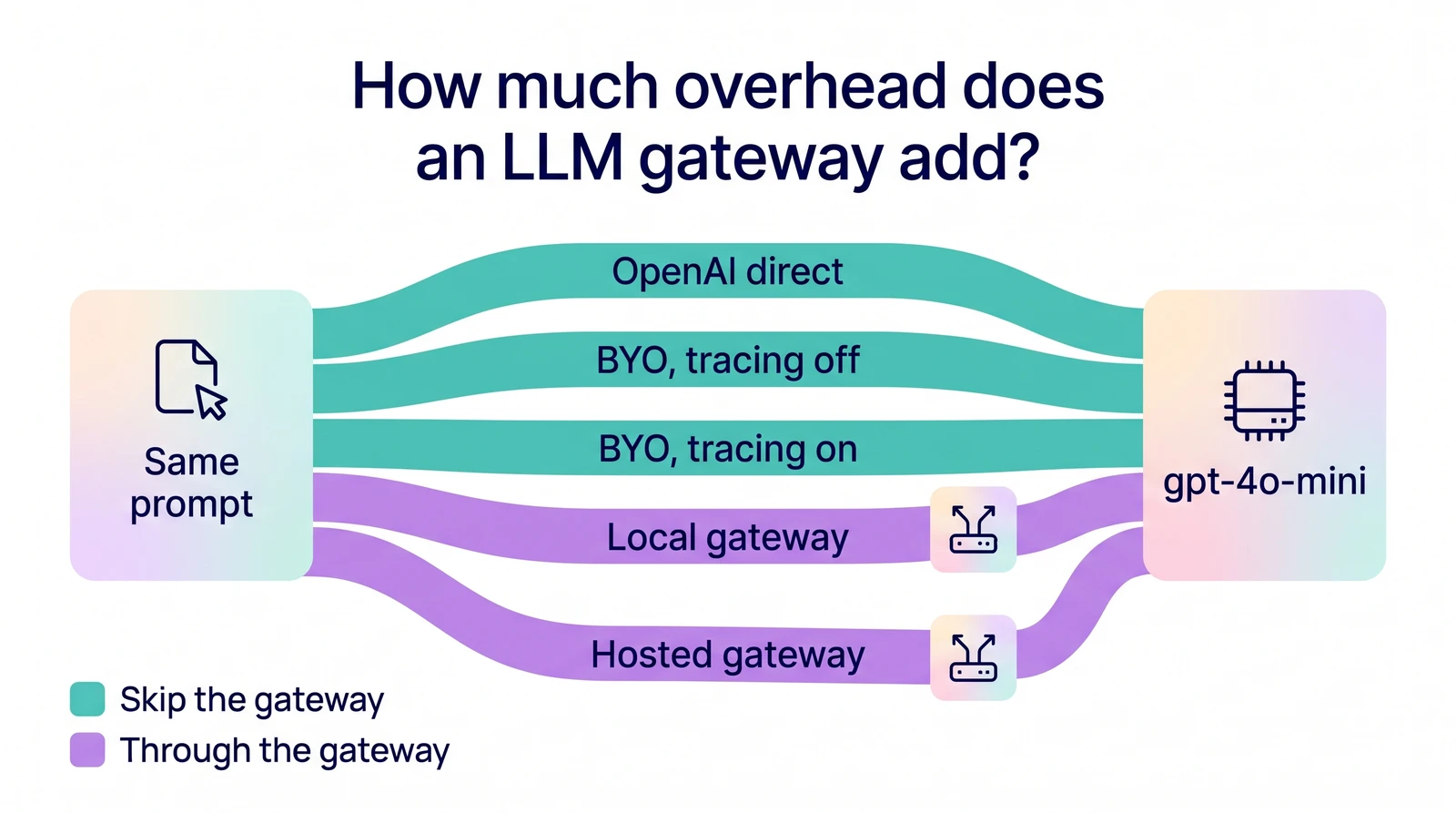
Five paths from the same prompt to gpt-4o-mini: OpenAI direct, BYO with tracing off and BYO with tracing on skip the gateway, while the local gateway and the hosted gateway go through it

An AcruxCore gateway running on the same machine as your app added a median of 9 ms to an OpenAI call that takes about 640 ms. The 95% confidence interval runs from −15 ms to +28 ms, so this test cannot tell the gateway apart from a direct call. Calling OpenAI with your own key through the SDK, with no gateway, also adds nothing measurable, with tracing on or off.

A gateway gives you one endpoint for every provider, cost accounting, caching, virtual keys, and budgets, and it also adds a network hop. We measured five ways to reach the same model — through our gateway, around it with your own key, and raw — to see where the milliseconds go.