15 posts tagged with "Prompt management"

Versioning prompts, promoting them between environments, and templating them without a redeploy.

View All Tags

AcruxCore vs Agenta: built-in evaluators vs a gateway

Published · Updated · 22 min read
LLM-ops platform

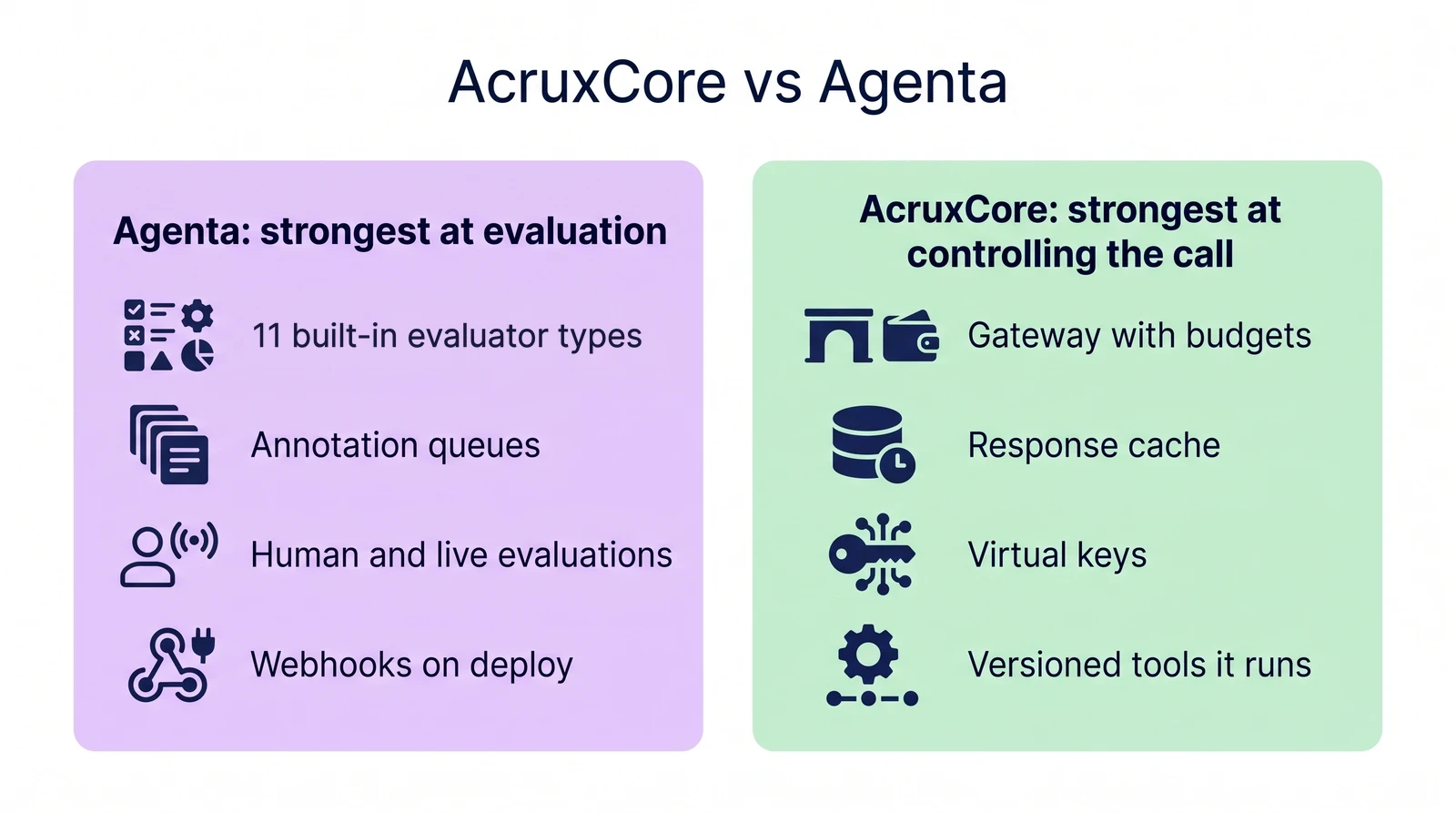
Header card for AcruxCore vs Agenta, listing each product's main strengths side by side

The short answer: Agenta is stronger at evaluation, and AcruxCore is stronger at controlling the model call. Agenta has 11 built-in evaluator types, plus five regex presets, and annotation queues. AcruxCore has a gateway with budgets, caching and virtual keys, and a catalog of versioned tools that it runs.

Agenta is an open-source platform from Agentatech UG. Its README describes a workspace where you build agents by chatting with them. You then talk to those agents in Slack, Telegram or WhatsApp. Behind the agent pages, Agenta also ships a prompt registry, a playground, evaluation, annotation queues and tracing. Agenta documents those parts in its v1.0 docs, which it marks as no longer actively maintained. Those parts still ship in version 0.122.7, the version we ran. This post compares those parts with AcruxCore, because those are the parts the two products share.

Each section below shows what we saw on Agenta, then what AcruxCore does with the same prompt.

AcruxCore is our product. The Agenta and AcruxCore scripts are linked where they are used.
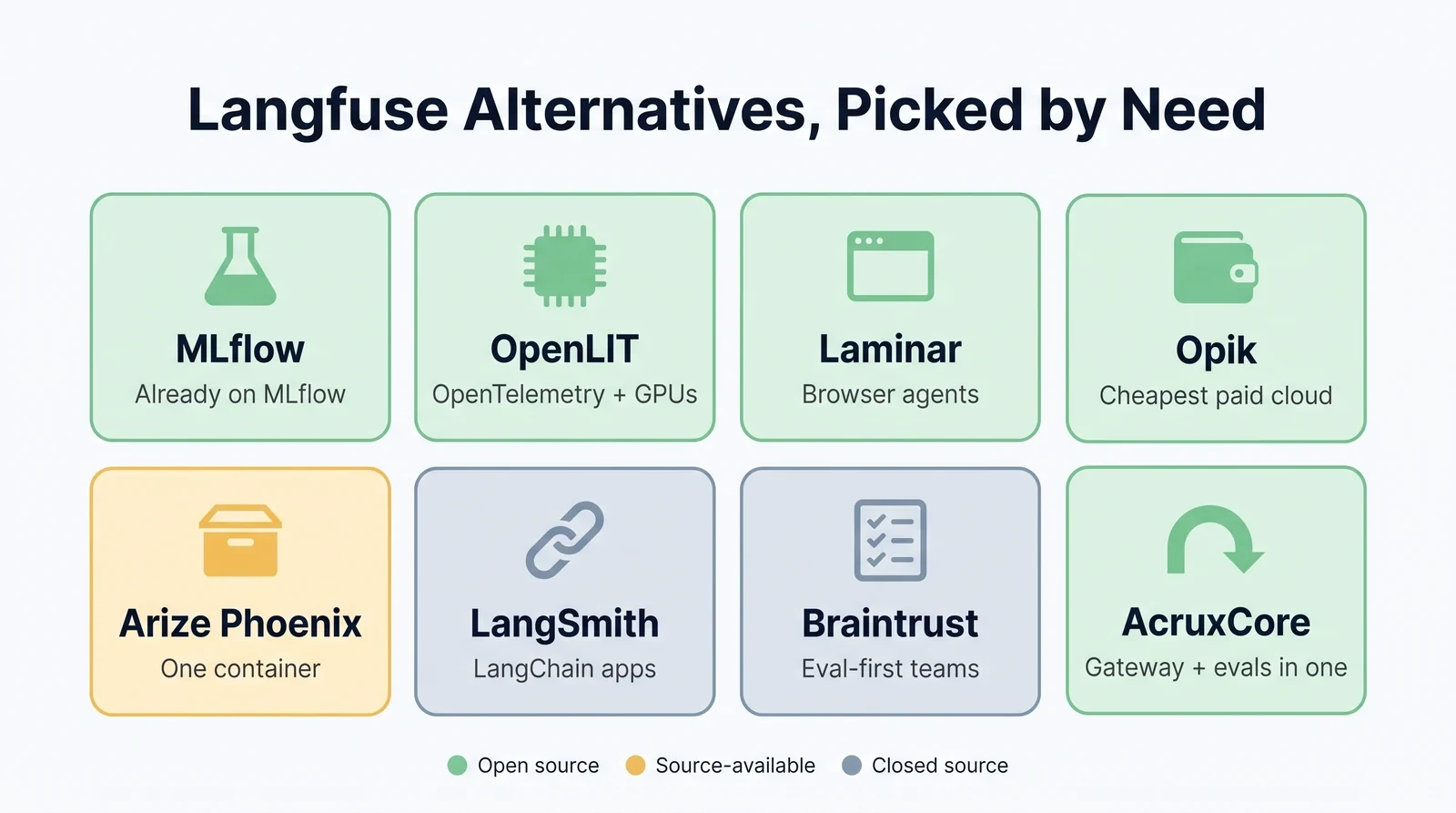
7 best Langfuse alternatives for startups: self-hosted, cheaper and open source (2026)

Published · Updated · 25 min read
LLM-ops platform

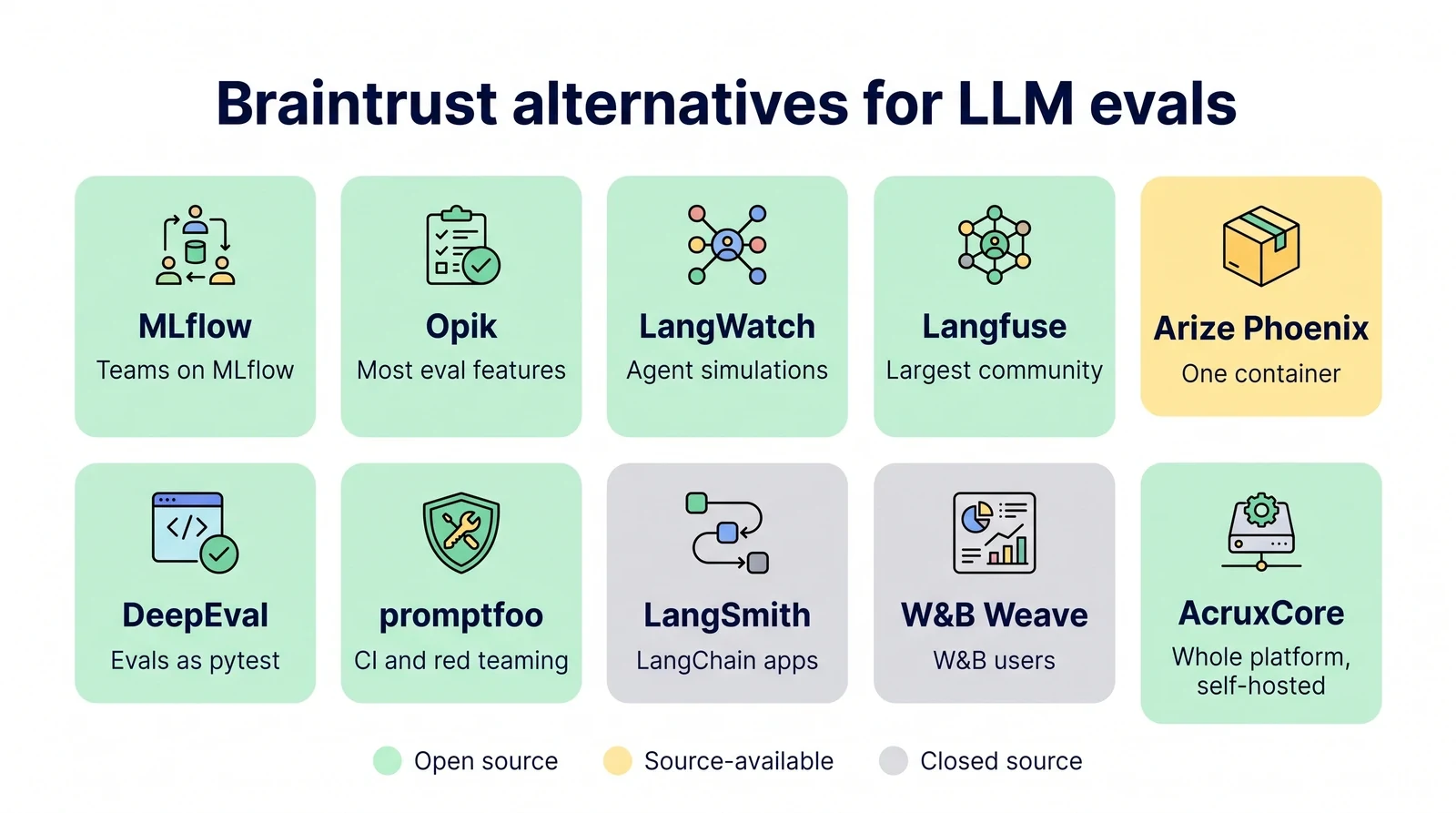
Langfuse alternatives in a grid, each with what it is best for, coloured by license: MLflow, OpenLIT, Laminar and Opik open source, Arize Phoenix source-available, LangSmith and Braintrust closed source, and AcruxCore (ours) open source

This post compares seven alternatives to Langfuse on self-hosting effort, license, price and the features that need an enterprise plan. For each Langfuse alternative, it lists what the tool adds, what it lacks, and what changes when you move from Langfuse to it.

We build AcruxCore, one of the tools in this post. We do not rank it.

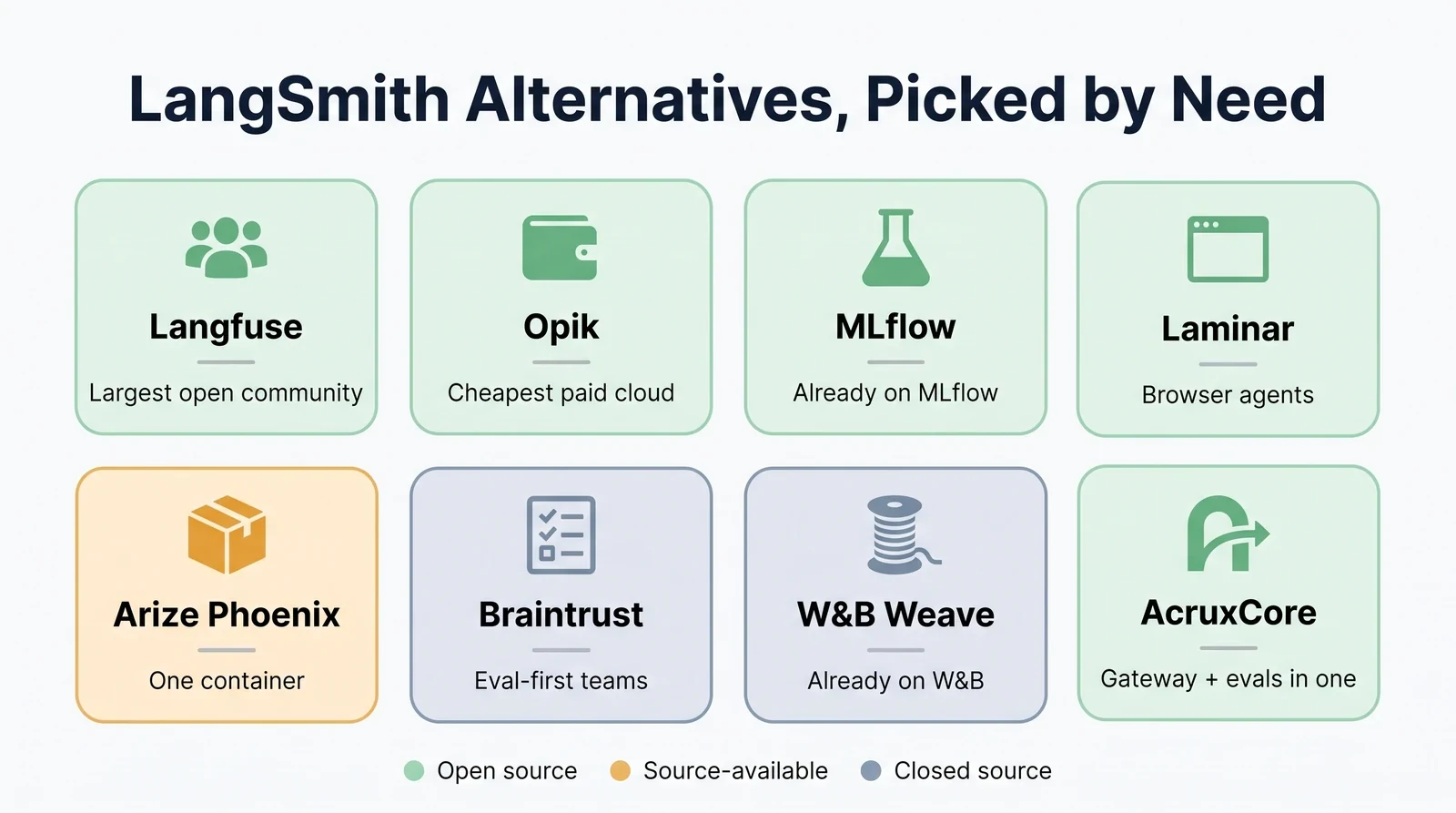
7 LangSmith alternatives for startups: open source, self-hosted and cheaper (2026)

Published · Updated · 24 min read
LLM-ops platform

LangSmith alternatives in a grid, each with what it is best for, coloured by license: Langfuse, Opik, MLflow and Laminar open source, Arize Phoenix source-available, Braintrust and W&B Weave closed source, and AcruxCore (ours) open source

This post compares seven LangSmith alternatives on license, self-hosting, price and features. For each alternative to LangSmith, it lists what the tool adds, what it lacks, and how it changes the per-seat price and the 14-day trace retention that push teams off LangSmith. A section at the end shows how to move your traces.

We build AcruxCore, one of the tools in this post. We do not rank it.

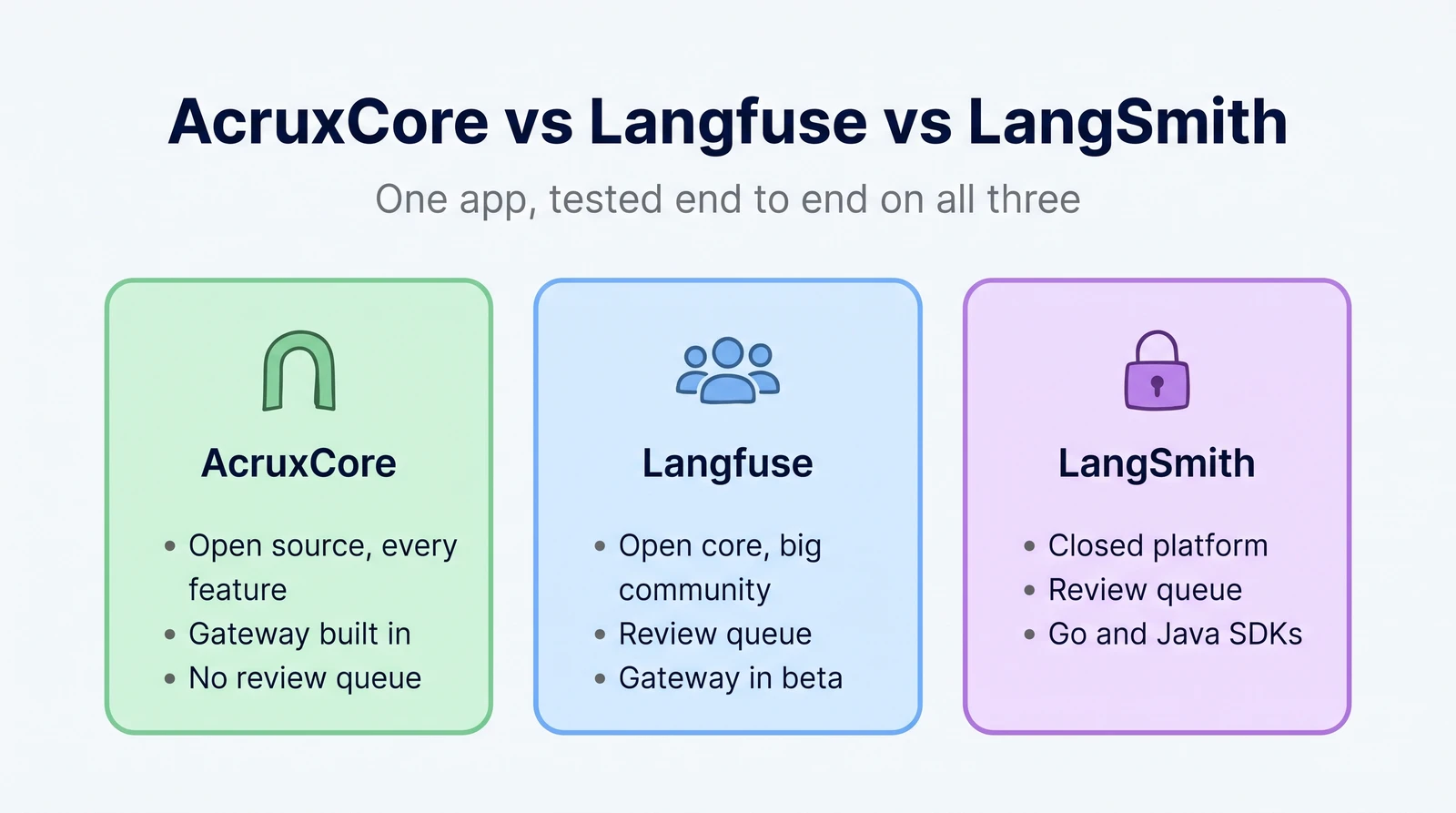
AcruxCore vs Langfuse vs LangSmith: one app tested end to end on all three

Published · Updated · 19 min read
LLM-ops platform

AcruxCore vs Langfuse vs LangSmith, one app tested on all three. AcruxCore: open source with every feature, gateway built in, no review queue. Langfuse: open core with a big community, review queue, gateway in beta. LangSmith: closed platform, review queue, Go and Java SDKs

This post compares AcruxCore, Langfuse and LangSmith on the things a developer checks before choosing one. We also ran one app on all three platforms, with the same code, data, prompts and model, and measured each step. The app is a small agent that reads a client's email, checks each request against a signed project scope, prices the extra work, and writes a reply.

We build AcruxCore, one of the three tools compared here. We ran all three ourselves, and the scripts for every leg are linked below.

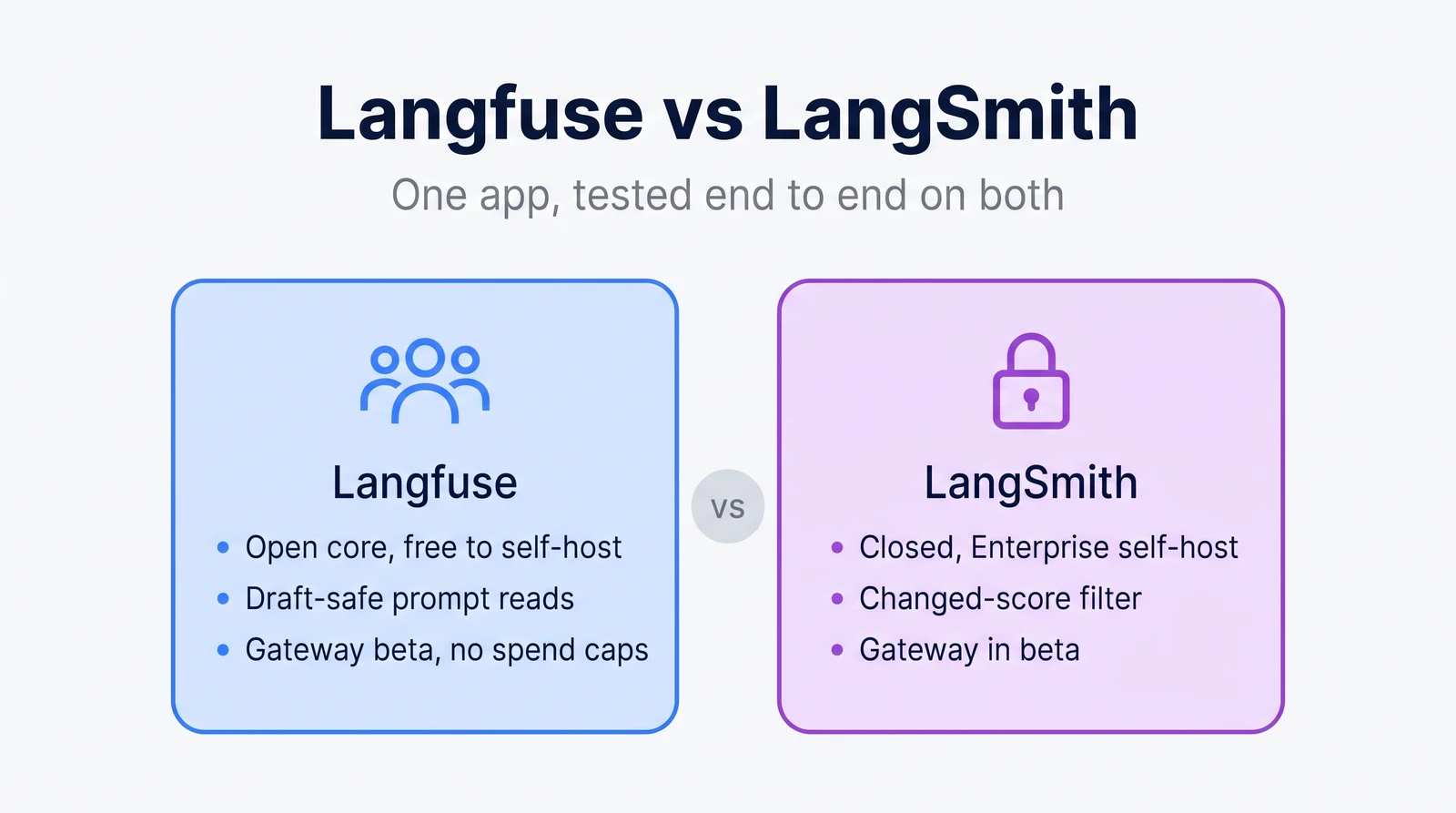
Langfuse vs LangSmith: one app tested end to end on both

Published · Updated · 20 min read
LLM-ops platform

Langfuse vs LangSmith, one app tested on both. Langfuse: open core and free to self-host, draft-safe prompt reads, a gateway in beta with no spend caps. LangSmith: closed with Enterprise-only self-hosting, a changed-score filter, a gateway in beta

This post compares Langfuse and LangSmith on the things a developer checks before choosing one. We also ran one app on both hosted platforms, with the same code, data, prompts and model, and measured each step. The app is a small agent that reads a client's email, checks each request against a signed project scope, prices the extra work, and writes a reply.

Pick Langfuse if you want an open-source platform that you can self-host for free, a large community, and 90 days of data at a low price. Pick LangSmith if you compare experiment runs often, need Go or Java, or want a gateway that enforces spend and rate limits. At our profile of 100,000 traces a month and 3 people, LangSmith Plus cost $567 a month and Langfuse Core cost $98.36.

We build AcruxCore, a third tool in this space that this post does not test. We ran Langfuse and LangSmith ourselves, and the scripts are linked below.

AcruxCore vs Braintrust: when the platform runs your tool code

Published · Updated · 25 min read
LLM-ops platform

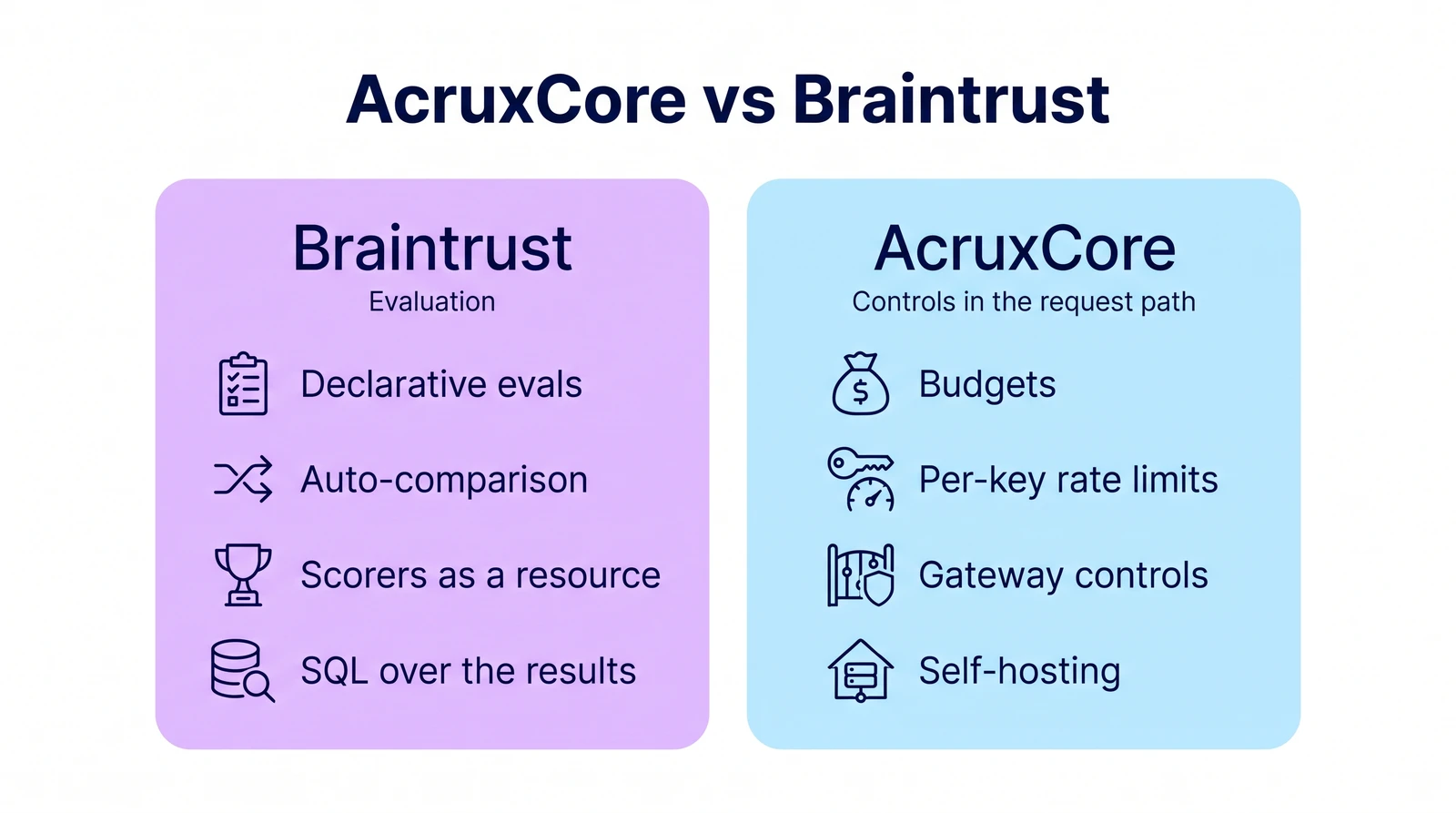
Braintrust is strongest at evaluation, with declarative evals, auto-comparison, scorers as a resource and SQL over the results; AcruxCore at controls in the request path, with budgets, per-key rate limits, gateway controls and self-hosting

Braintrust is a hosted LLM evaluation platform that runs your tool code instead of only storing the tool's schema. Braintrust takes your Python, bundles it, and runs it on its own infrastructure. That one decision sets the Python version you may use, whether your handler can open a file, and where your data has to live. This comparison is built around that decision. To compare Braintrust with all the other alternatives at once, see 9 Braintrust alternatives.

Braintrust is not open source, and self-hosting needs the Enterprise plan. There is no free self-hosted install to test against, so everything below ran on their hosted Starter tier.

The short answer: if your main job is to measure prompt quality against a dataset, Braintrust does it better. AcruxCore is stronger on controls in the request path: budgets that refuse the call, per-key rate limits, and tool code that stays in your own process.

AcruxCore is our product. All four scripts from this comparison are linked in the SDK section.

AcruxCore vs MLflow: two gateways, one with guardrails

Published · Updated · 20 min read
LLM-ops platform

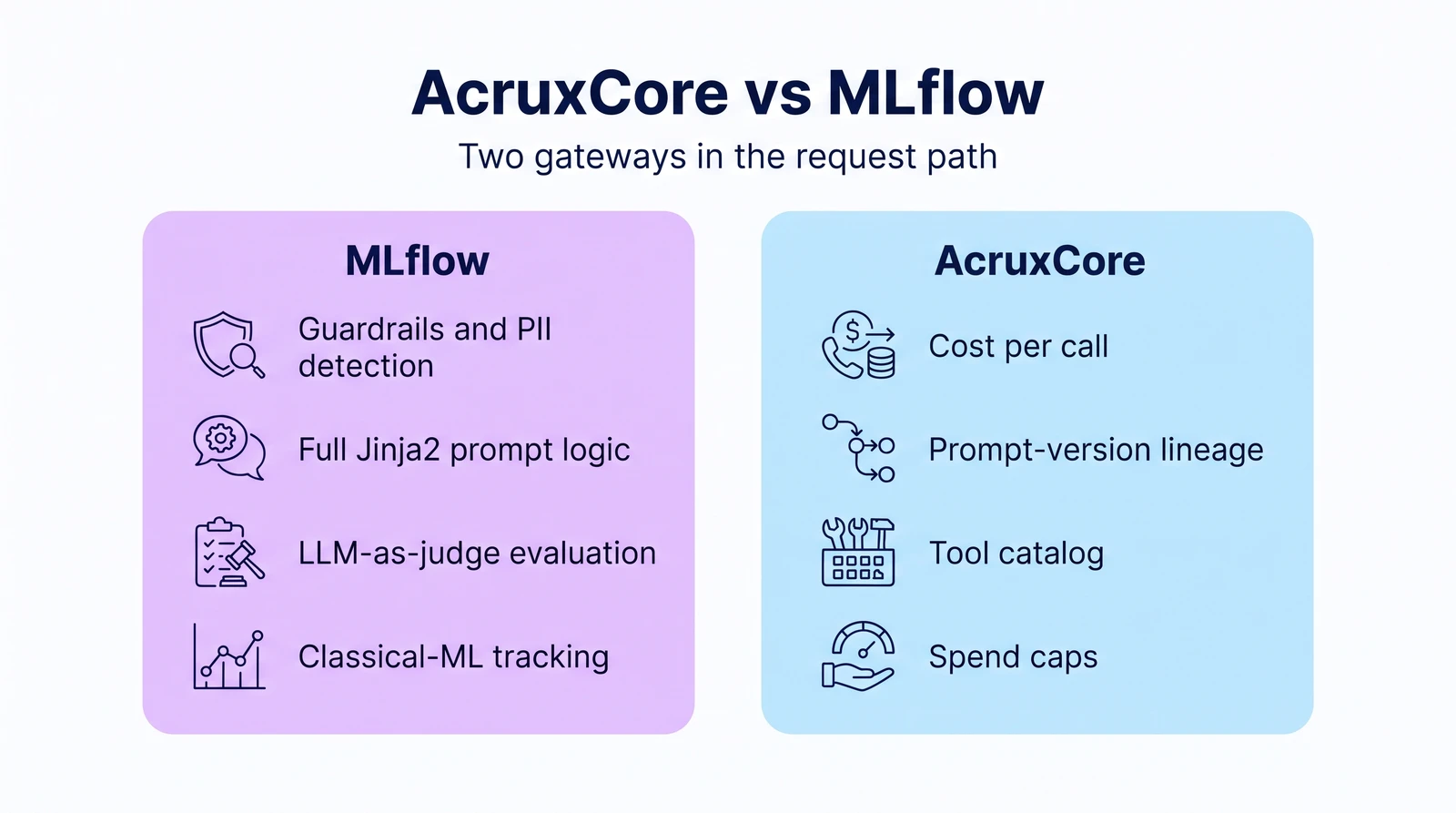
Two gateways in the request path: MLflow is strongest at guardrails and PII detection, full Jinja2 prompt logic, LLM-as-judge evaluation and classical-ML tracking; AcruxCore at cost per call, prompt-version lineage, a tool catalog and spend caps

MLflow is the open-source ML and GenAI platform first built at Databricks. It has shipped since 2018 and had about 28,500 GitHub stars and 447 contributors on 25 October 2026. Its GenAI side is newer: a Prompt Registry, a tracing store, LLM-as-judge evaluation, and an AI Gateway that sits in the request path. AcruxCore's gateway sits there too, so this comparison is between two request-path gateways. We sent the same support prompt, vip-support-triage, through both. The prompt changes tone for VIP customers and lists their open tickets. We registered and versioned it, called it through each gateway, linked the trace to its prompt version, and built an evaluation dataset.

The short answer: MLflow has Safety, PII and custom guardrails on every gateway endpoint, full Jinja2 prompts, and an experiment tracker for classical ML, and AcruxCore has no guardrails. AcruxCore returns cost on every gateway response and runs the tools in its catalog. Linking a trace to its prompt version takes a separate SDK call on MLflow and one argument on AcruxCore.

AcruxCore is our product. The MLflow and AcruxCore scripts are linked in each section.

AcruxCore vs Opik: prompts, tracing, tools and guardrails compared

Published · Updated · 17 min read
LLM-ops platform

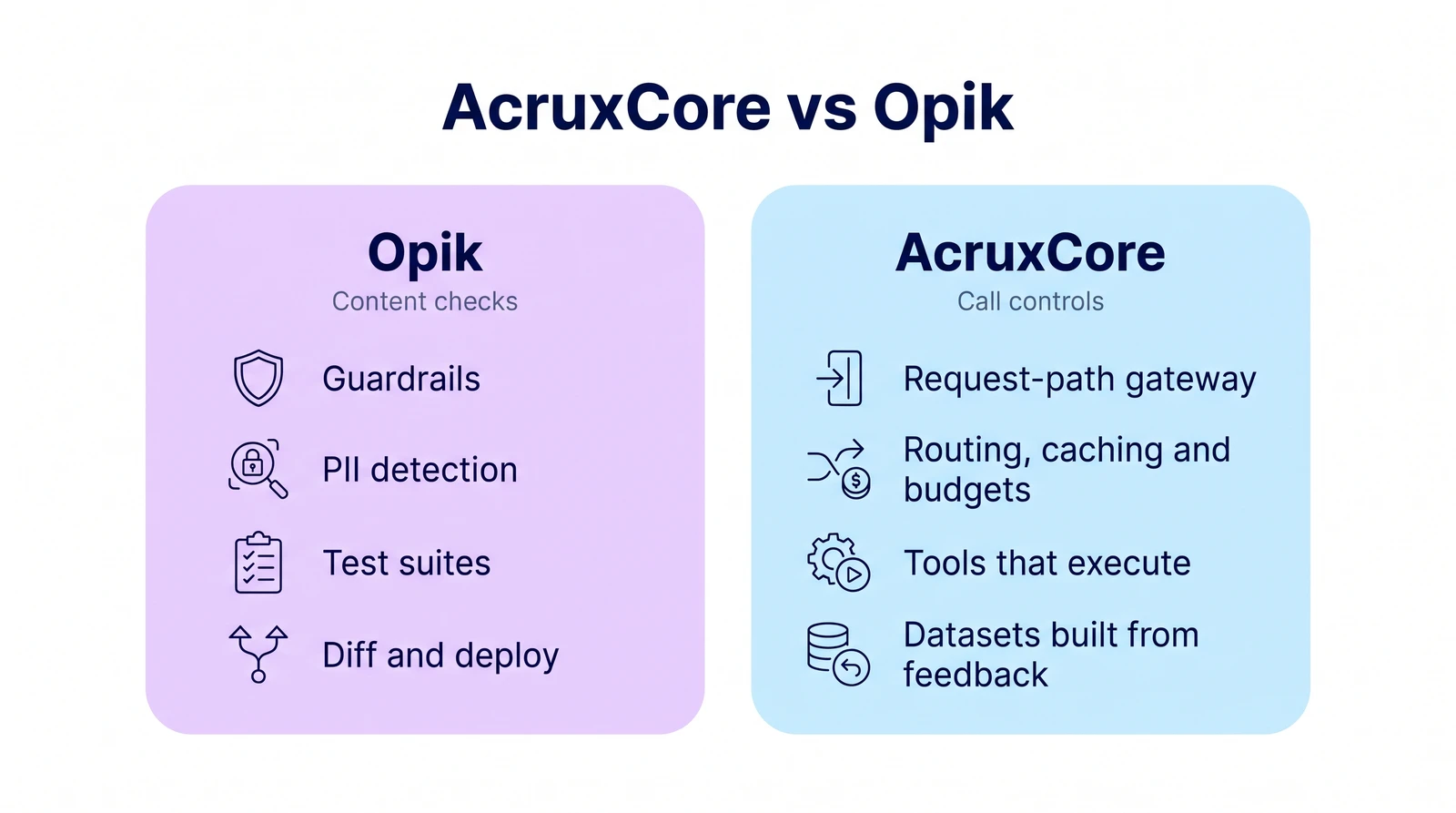
Opik focuses on content checks with guardrails, PII detection, test suites and diff and deploy; AcruxCore focuses on call controls with a request-path gateway, routing, caching and budgets, tools that execute and datasets built from feedback

Opik is Comet's open-source LLM-ops platform, released under Apache 2.0. It traces calls that a wrapped client makes, keeps a prompt library, and adds two things many tracing tools lack: content guardrails, and a separate object for regression test suites. AcruxCore is built around a gateway in the request path instead. We rebuilt the support prompt vip-support-triage on a self-hosted Opik and on AcruxCore. The prompt changes tone for VIP customers and lists their open tickets. On Opik we versioned it, ran it in the Playground, traced an SDK call, built a dataset from the trace and ran an experiment over it.

The short answer: Opik has guardrails and test suites, and AcruxCore has neither. AcruxCore runs every call through a gateway that applies budgets and caching, executes the tools in its catalog, and writes a trace with no client code. Opik's own LLM Gateway is a beta that its docs describe as built for development and testing.

AcruxCore is our product. Each script we ran is linked next to its result.

AcruxCore vs Langfuse: one app measured on both platforms

Published · Updated · 18 min read
LLM-ops platform

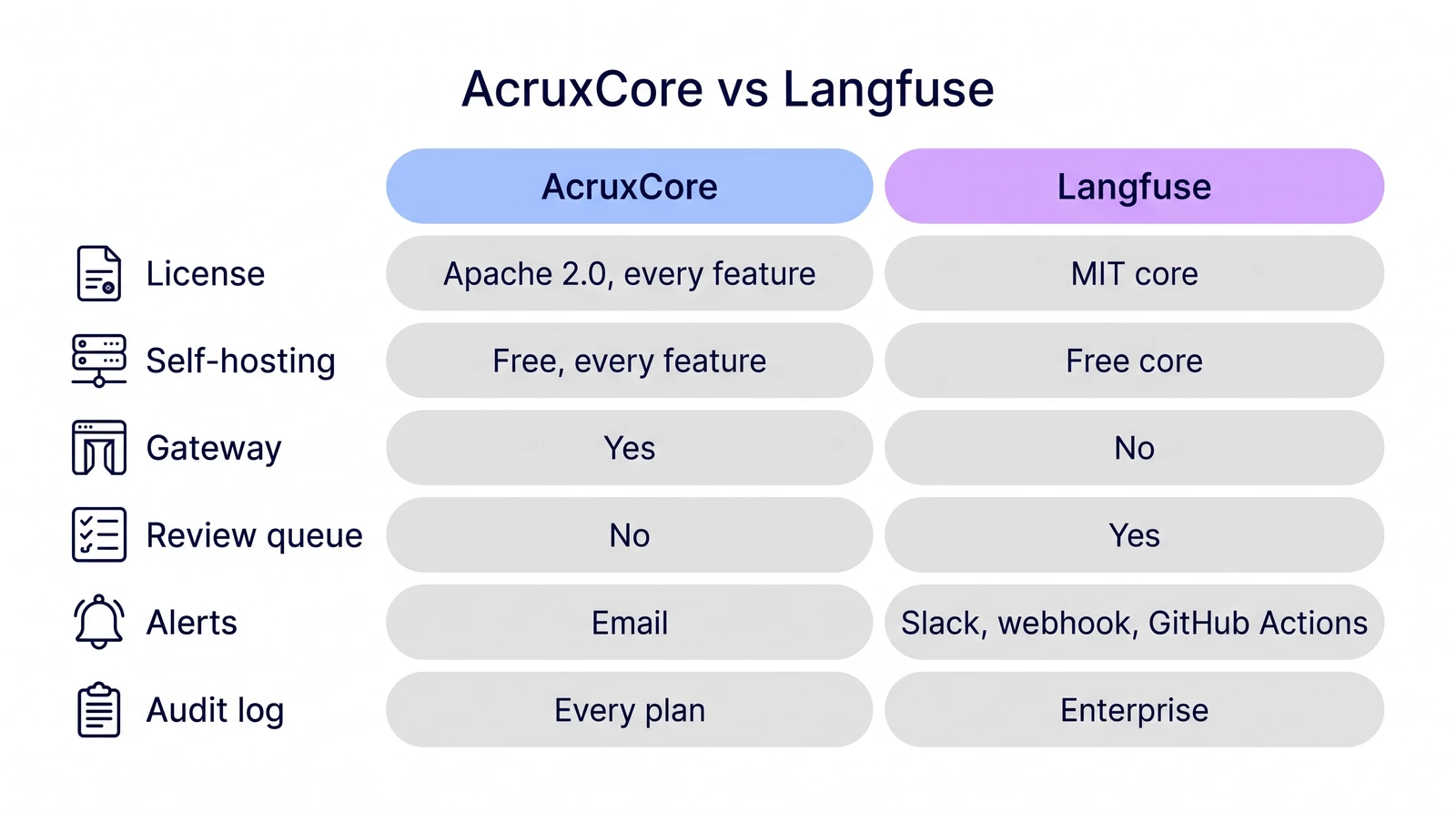
AcruxCore vs Langfuse at a glance: license, self-hosting, gateway, review queue, alert channels and audit log for each product in a matched grid

Choose Langfuse if your team reviews model output by hand in a queue, wants cost or latency alerts in Slack, builds on the Vercel AI SDK, or wants the largest open-source community in this space. Choose AcruxCore if you want a gateway with fallbacks, budgets and a cache, versioned tools that the platform runs, and an audit log, all free and open source, hosted or self-hosted, and your team can review replies on the trace page.

The test app, its data, its prompts and its model were identical on Langfuse and AcruxCore. The sections below give what we measured for tracing, prompts, experiments, review and live traffic, and then list what each platform has that the other lacks.

We build AcruxCore. The scripts and run logs for both legs are in the repo, linked at the end.